

Tissue Preservation Science
Tissue preservation science examines the biological principles and laboratory methods used to maintain tissue characteristics during storage, transportation, and subsequent evaluation. Scientific preservation techniques are designed to minimize structural changes while maintaining tissue integrity throughout handling and storage. Cryobiology, preservation chemistry, controlled freezing, storage conditions, and thawing protocols are all important areas of investigation within modern tissue science.
This educational resource explains the scientific concepts underlying tissue preservation, including cryopreservation principles, ice crystal formation, controlled thawing, storage considerations, and scientific evaluation following preservation. The discussion focuses on established biological concepts presented throughout the scientific literature and does not address product-specific processing methods or clinical applications.
Although preservation science plays an important role in biological research and laboratory practice, scientific understanding of preservation methods should remain distinct from regulatory evaluation. Biological investigations explain how preservation influences tissue characteristics, whereas regulatory classification depends upon applicable statutes, regulations, intended use, manufacturing methods, and documented product characteristics. Maintaining this distinction is essential when interpreting scientific literature and reviewing technical documentation.
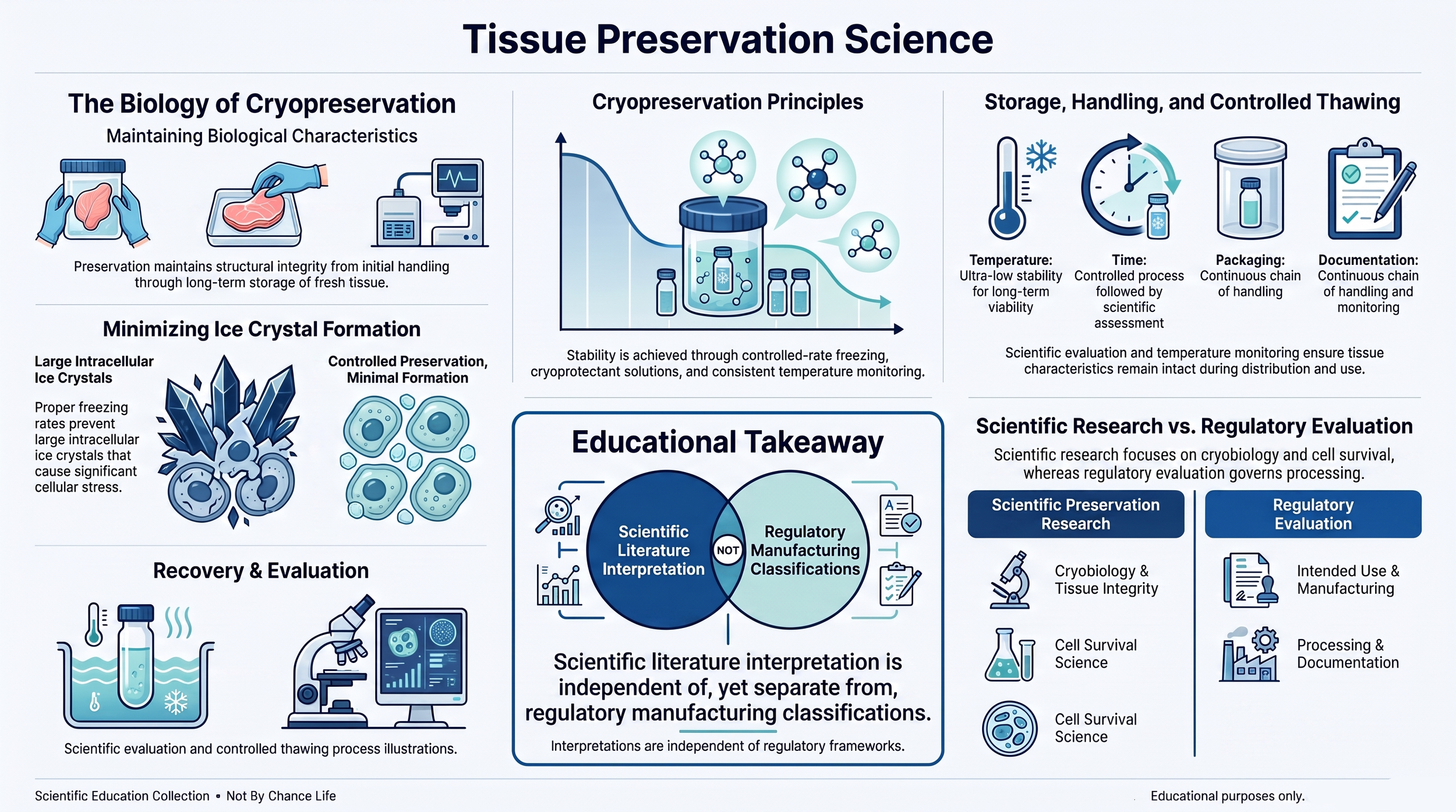
What Is Tissue Preservation Science?
Tissue preservation science is the study of biological methods used to maintain tissue characteristics during storage, transportation, and laboratory evaluation. The field combines principles from cryobiology, cell biology, chemistry, materials science, and physiology to better understand how tissues respond to preservation, storage conditions, and controlled thawing while minimizing structural and molecular changes over time.
Preservation methods are designed to reduce biological deterioration that naturally occurs after tissue recovery. Scientific research focuses on maintaining tissue architecture, extracellular matrix organization, cellular structures, and other biological characteristics so that preserved tissues can be evaluated under controlled conditions. The specific preservation strategy selected depends upon the tissue type, intended scientific purpose, storage requirements, and preservation methodology being investigated.
One of the most widely studied preservation approaches is cryopreservation, which involves storing tissues at extremely low temperatures to substantially slow biological activity. Scientific investigations continue to examine how cooling rates, cryoprotective solutions, storage temperatures, thawing procedures, and handling practices influence tissue characteristics throughout the preservation process.
Because preservation science encompasses numerous biological variables, no single preservation method is universally applicable to every tissue or research objective. Different tissues possess unique structural compositions, water content, extracellular matrix organization, and cellular characteristics that may influence how they respond to preservation. Consequently, preservation protocols continue to evolve as scientific understanding advances.
Understanding tissue preservation science helps readers interpret scientific literature more effectively while recognizing that preservation research should not be interpreted as determining regulatory classification, product characteristics, or clinical application. Preservation science explains biological processes, whereas regulatory evaluation considers separate statutory and regulatory criteria.
Cryopreservation Principles
Cryopreservation is a scientific preservation technique that uses extremely low temperatures to slow cellular metabolism and biochemical activity. By reducing biological activity, tissues may be stored for extended periods while limiting many of the natural degradative processes that occur at higher temperatures. Cryobiology investigates the physical and biological changes that occur throughout cooling, frozen storage, and controlled thawing.
A central objective of cryopreservation is minimizing damage associated with freezing. As temperatures decrease, water naturally begins to form ice crystals. Because ice crystal formation may influence tissue structure and cellular integrity, preservation scientists study methods that encourage controlled freezing while limiting unwanted crystal formation. Cooling rate, solution composition, water movement, and storage conditions all contribute to preservation outcomes.
Cryoprotective solutions are frequently used during preservation research because they help reduce cellular stress associated with freezing. Numerous cryoprotective agents have been described throughout the scientific literature, each possessing different physical and chemical characteristics that influence preservation performance. Their selection depends upon the biological system being studied and the goals of the preservation protocol.
Equally important is maintaining stable storage conditions after preservation. Scientific investigations consistently emphasize careful temperature control, validated storage environments, appropriate packaging, continuous documentation, and standardized handling procedures as important components of preservation science. These practices help reduce unnecessary environmental variation during storage and transportation.
Ice Crystal Formation and Tissue Integrity
One of the primary scientific challenges in tissue preservation is controlling the formation of ice crystals during freezing. Because water is a major component of most biological tissues, lowering the temperature below the freezing point causes water molecules to transition into crystalline structures. The size, location, and rate of crystal formation may influence cellular architecture, extracellular matrix organization, and overall tissue characteristics.
Large intracellular ice crystals are generally associated with increased mechanical stress because expanding crystals may disrupt cellular structures during freezing. Preservation research therefore focuses on methods that encourage controlled cooling, appropriate water movement, and optimized cryoprotective conditions that reduce excessive intracellular crystal formation while maintaining stable preservation environments.
Extracellular ice formation also influences preservation outcomes. As water freezes outside cells, osmotic gradients may develop that affect cellular hydration and membrane stability. Scientific investigations continue to examine how cooling rates, solution composition, and tissue characteristics influence these complex physical processes during preservation and subsequent thawing.
Different tissues respond differently to freezing because biological structures vary considerably throughout the body. Factors such as extracellular matrix composition, cellular density, connective tissue organization, hydration, and tissue architecture all contribute to preservation behavior. Consequently, preservation protocols are typically developed and evaluated according to the biological characteristics of the tissue being studied rather than applying a single universal approach.
Current cryobiology research continues to investigate improved preservation strategies that minimize structural disruption while maintaining tissue characteristics throughout storage and recovery. These investigations contribute to a growing scientific understanding of preservation biology while illustrating the complexity of maintaining biological systems outside their normal physiological environment.
Storage, Handling, and Controlled Thawing
Preservation science extends beyond freezing alone. Appropriate storage conditions, transportation practices, temperature stability, handling procedures, and controlled thawing all contribute to maintaining tissue characteristics throughout the preservation process. Scientific investigations frequently evaluate each of these variables because changes occurring after preservation may influence subsequent laboratory observations.
Maintaining consistent storage temperatures is an important principle of cryobiology. Temperature fluctuations may introduce additional physical stress that can affect preserved tissues over time. For this reason, preservation protocols commonly emphasize validated storage environments, continuous monitoring, appropriate packaging systems, and documented handling procedures designed to reduce unnecessary environmental variation.
Controlled thawing represents another important stage of preservation science. During thawing, tissues gradually transition from frozen storage conditions back toward physiological temperatures. Scientific investigations examine how thawing rate, temperature control, handling practices, and laboratory procedures influence tissue characteristics following preservation. Researchers continue to evaluate optimal thawing methodologies for different tissue types and preservation systems.
Following thawing, tissues may undergo scientific evaluation using laboratory techniques appropriate to the objectives of the investigation. These assessments may include structural analysis, microscopic examination, biochemical characterization, molecular evaluation, extracellular matrix assessment, or other research methodologies depending upon the scientific questions being addressed. Such evaluations contribute to understanding preservation biology but should not be interpreted as regulatory determinations or product-specific conclusions.
Scientific Research and Regulatory Evaluation
Scientific investigation of tissue preservation and the regulatory evaluation of human tissue products represent separate disciplines with different objectives. Preservation research seeks to understand how biological tissues respond to freezing, storage, transportation, thawing, and laboratory assessment. Regulatory evaluation, by contrast, determines whether a Human Cell, Tissue, or Cellular and Tissue-Based Product (HCT/P) satisfies applicable statutory and regulatory requirements based upon documented characteristics, intended use, manufacturing processes, and supporting documentation.
Scientific publications describing cryobiology, preservation chemistry, ice crystal formation, cellular recovery, or tissue integrity contribute valuable biological knowledge but should not be interpreted as establishing regulatory classification, FDA authorization, or product-specific performance. These investigations are designed to improve scientific understanding rather than determine whether an individual product satisfies applicable regulatory standards.
For HCT/Ps regulated under 21 CFR Part 1271, regulatory classification depends upon factors such as intended use, processing methods, manufacturing practices, and documented product characteristics rather than preservation science alone. Preservation methods may represent one aspect of a broader technical evaluation, but they do not independently determine regulatory status.
Maintaining this distinction allows readers to interpret preservation literature within the proper scientific context while recognizing that regulatory conclusions require separate evaluation. Scientific understanding strengthens technical literacy, whereas regulatory compliance depends upon documentation, federal requirements, and the characteristics of the individual product under review.
Readers interested in the regulatory framework governing HCT/Ps should continue with the Regulatory Foundations collection, while those reviewing supplier information should explore the Supplier Evaluation Process. Together with the Scientific Education collection, these resources provide complementary perspectives that support informed interpretation of both biological science and technical documentation.
Related Scientific Education Resources
Tissue preservation science is closely connected with several other scientific disciplines explored throughout the Scientific Education collection. Understanding preservation biology alongside extracellular matrix organization, tissue biology, cell viability, and scientific research methodology provides a broader foundation for interpreting peer-reviewed literature and technical documentation.
- Scientific Education
- Extracellular Matrix (ECM) Biology
- Placental & Perinatal Tissue Biology
- Extracellular Vesicle & Exosome Biology
- Secretome Biology
- Cell Viability & Post-Thaw Assessment
- Reading Scientific Literature
- Scientific Glossary
Readers seeking additional regulatory context may also benefit from the Regulatory Foundations collection and the Supplier Evaluation Process, which explain how biological science, federal regulations, and documentation review complement one another while serving distinct educational purposes.
This educational resource is provided for scientific education only. Discussions of tissue preservation science, cryobiology, cryopreservation, storage biology, controlled thawing, ice crystal formation, tissue integrity, and related biological concepts are intended solely to improve scientific literacy. They should not be interpreted as evidence of regulatory classification, FDA authorization, clinical effectiveness, or product-specific performance. Regulatory determinations should always be based upon applicable statutes, regulations, FDA guidance documents, intended use, processing methods, and the documented characteristics of the individual Human Cell, Tissue, or Cellular and Tissue-Based Product (HCT/P).