
HCT/P Documentation FAQ
Reviewing supplier documentation for Human Cells, Tissues, and Cellular and Tissue-Based Products (HCT/Ps) often raises important questions regarding regulatory terminology, supporting documentation, donor eligibility, traceability, quality documentation, and the federal framework established under 21 CFR Part 1271. This FAQ provides concise educational answers to many of the questions healthcare professionals encounter while reviewing supplier documentation.
Rather than replacing detailed educational resources, this page serves as the central reference guide for the Supplier Documentation Knowledge Center. Each answer introduces a topic, explains its relevance within a documentation-first review methodology, and directs readers to dedicated educational pages that explore the subject in greater depth.
The objective is to improve documentation transparency, strengthen regulatory literacy, and encourage consistent documentation review by helping readers understand how individual records fit together within a complete documentation package.
Estimated Reading Time: 15–18 minutes
Who This Guide Is For
This educational reference is intended for licensed healthcare professionals, healthcare organizations, procurement personnel, compliance teams, researchers, and qualified professionals reviewing supplier documentation associated with Human Cells, Tissues, and Cellular and Tissue-Based Products (HCT/Ps).
The FAQ is designed to answer common documentation questions while supporting a structured, documentation-first approach to supplier evaluation and regulatory education.
Before Using This FAQ
This FAQ is intended to complement—not replace—the detailed educational guides available throughout the Supplier Documentation Knowledge Center. Individual questions often involve multiple regulatory concepts and documentation categories that are explored more comprehensively within dedicated educational resources.
For the most effective educational experience, readers are encouraged to use this FAQ as a quick-reference guide while consulting the relevant in-depth pages for detailed explanations, regulatory context, and documentation review methodologies.
Recommended Learning Sequence
Documentation Review at a Glance
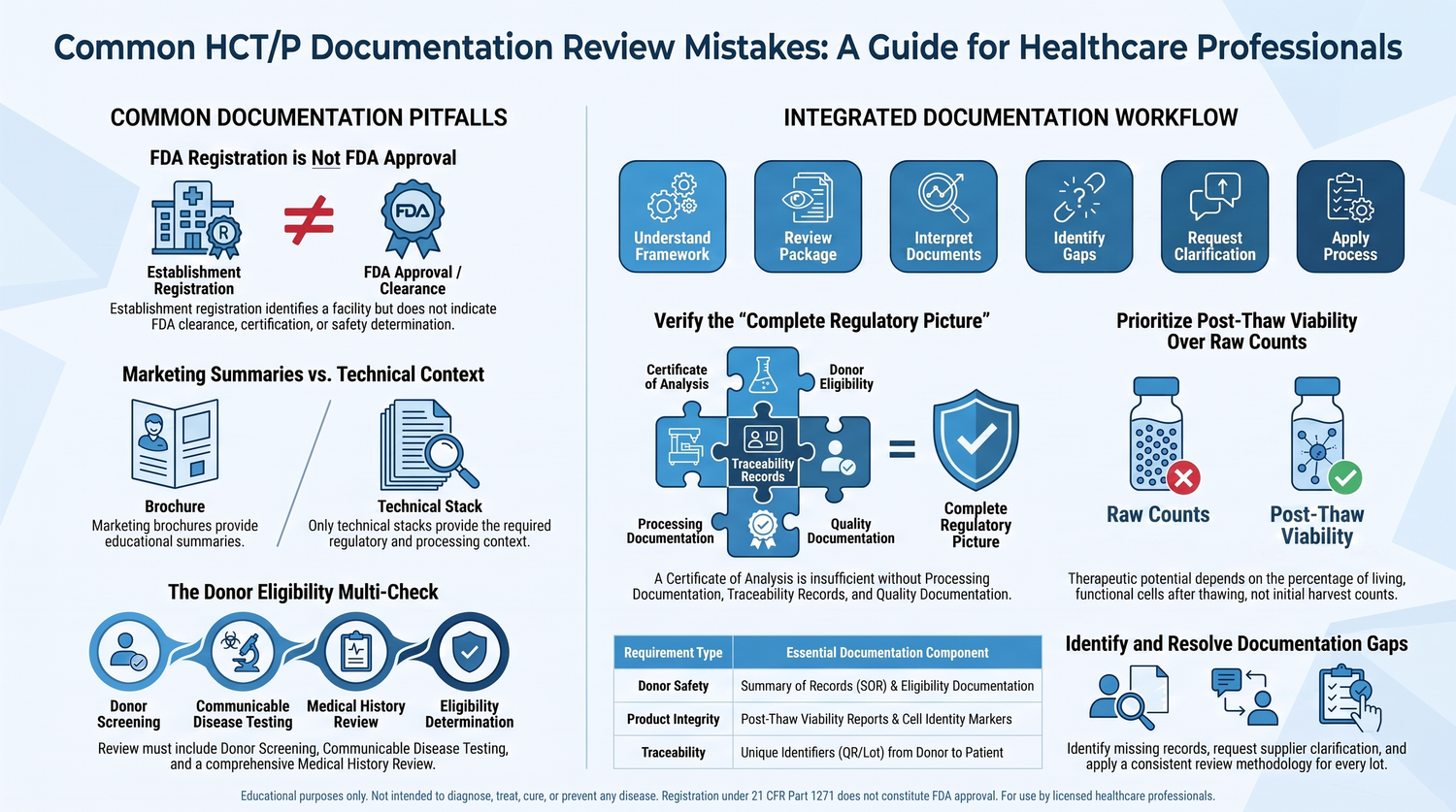
The infographic below summarizes the major documentation concepts discussed throughout this FAQ. It illustrates how supplier documentation, regulatory concepts, supporting records, and structured documentation review work together within the educational framework established throughout the Not By Chance Life Knowledge Center.
Documentation Fundamentals
The following questions address the foundational concepts healthcare professionals commonly encounter when reviewing supplier documentation for Human Cells, Tissues, and Cellular and Tissue-Based Products (HCT/Ps). These answers are intended to improve regulatory literacy while supporting a structured, documentation-first review methodology.
What is an HCT/P documentation package?
An HCT/P documentation package is the collection of regulatory, technical, quality, donor-related, and supporting records associated with a Human Cells, Tissues, and Cellular and Tissue-Based Product. Depending on the supplier and product category, documentation packages may include donor eligibility documentation, processing information, Certificates of Analysis, quality documentation, traceability records, storage guidance, and other supporting materials.
Rather than reviewing each document independently, healthcare professionals should evaluate how the documentation package functions as a complete educational record. Reviewing documentation as a unified package improves context, organization, and documentation transparency.
Continue reading: Supplier Evaluation Process | HCT/P Documentation Checklist
Why is supplier documentation important?
Supplier documentation provides educational context regarding regulatory concepts, donor qualification, processing information, quality systems, storage, traceability, and supporting technical documentation. Reviewing these materials helps healthcare professionals better understand the information provided by a tissue establishment while improving documentation transparency and regulatory literacy.
Documentation should not be interpreted independently as establishing regulatory status or clinical appropriateness. Instead, it contributes to a structured educational review when considered together with the remaining documentation package.
Continue reading: Documentation Transparency | Comparing HCT/P Supplier Documentation
Why do documentation packages differ between suppliers?
Documentation packages often differ because suppliers organize supporting records differently and may provide varying levels of technical detail, educational resources, and documentation supporting their products. Similar regulatory concepts may therefore appear in different formats across documentation packages.
A structured review methodology helps professionals compare documentation consistently while recognizing that differences in organization do not necessarily indicate differences in regulatory status or documentation quality.
Continue reading: Comparing HCT/P Supplier Documentation
Should every supplier provide identical documentation?
No. Documentation packages vary depending on product characteristics, manufacturing practices, quality systems, and organizational procedures. Educational review focuses on understanding the documentation that has been provided, identifying opportunities for clarification, and applying the same review methodology to every supplier.
Comparisons should emphasize documentation categories, organization, supporting records, and educational context rather than document quantity alone.
Continue reading: Comparing HCT/P Supplier Documentation
Supplier Documentation Questions
The questions below focus on practical aspects of supplier documentation review and documentation-focused communication throughout the evaluation process.
Can additional documentation be requested?
Depending on the supplier and the information sought, healthcare professionals may request additional educational documentation or clarification regarding the documentation package. Requests should remain documentation-focused and seek greater understanding of supporting records rather than regulatory conclusions or clinical claims.
When requesting additional documentation, it is often helpful to specify which documentation category requires clarification, such as donor eligibility, processing information, quality documentation, traceability, or technical specifications.
Continue reading: Questions to Ask an HCT/P Supplier
What if documentation appears incomplete?
Documentation that appears incomplete should not automatically be interpreted as evidence of regulatory non-compliance. Additional supporting records, technical explanations, or educational materials may provide the necessary context to better understand the documentation package.
A structured review process encourages reviewers to document questions, request clarification where appropriate, and avoid drawing conclusions before the available documentation has been fully evaluated.
Continue reading: Common Documentation Review Mistakes
Should documents be reviewed individually or together?
Documentation should first be understood individually and then reviewed collectively as a complete documentation package. Individual documents provide specific information, but meaningful educational review depends on understanding how donor documentation, regulatory references, quality documentation, processing information, traceability records, and technical documents relate to one another.
Reviewing documentation as a complete package promotes consistency, improves documentation transparency, and supports a more organized educational evaluation.
Continue reading: Documentation Transparency | Supplier Evaluation Process
FDA Regulatory Questions
Many supplier documentation packages reference federal regulations, FDA terminology, and statutory concepts that can be unfamiliar to healthcare professionals. The following questions provide educational context for several of the regulatory concepts most frequently encountered during documentation review.
Does FDA establishment registration mean FDA approval?
No. FDA establishment registration should not be interpreted as FDA approval, product clearance, certification, endorsement, or a determination regarding product safety or effectiveness. For certain HCT/Ps regulated under 21 CFR Part 1271, tissue establishments register with the FDA and list applicable HCT/P activities as part of the regulatory framework.
Registration represents one element of the overall documentation package and should be reviewed alongside donor eligibility documentation, processing records, quality documentation, traceability information, and other supporting materials.
Continue reading: 21 CFR Part 1271 Regulatory Framework | Section 361 HCT/Ps
Why is 21 CFR Part 1271 frequently referenced?
21 CFR Part 1271 establishes the federal regulatory framework governing Human Cells, Tissues, and Cellular and Tissue-Based Products (HCT/Ps). Supplier documentation frequently references these regulations because they provide context regarding donor eligibility, establishment registration, Current Good Tissue Practice (cGTP), and other regulatory concepts commonly associated with HCT/P documentation.
Understanding how these regulations relate to documentation improves regulatory literacy and helps place individual documents within their broader educational context.
Continue reading: 21 CFR Part 1271 Regulatory Framework
What is Section 361?
Section 361 of the Public Health Service Act provides statutory authority related to preventing the introduction, transmission, and spread of communicable disease. Within supplier documentation, references to Section 361 are commonly discussed alongside the regulatory criteria contained in 21 CFR 1271.10(a).
Educational review should consider Section 361 as one component of the broader regulatory framework rather than interpreting individual references independently.
Continue reading: Section 361 Overview | Section 361 vs. Section 351
What is 21 CFR 1271.10(a)?
21 CFR 1271.10(a) identifies the regulatory criteria used when evaluating whether certain HCT/Ps may be regulated solely under Section 361 of the Public Health Service Act and the applicable provisions of 21 CFR Part 1271. During documentation review, references to these criteria are often presented alongside discussions of minimal manipulation, homologous use, and other regulatory concepts.
Understanding how these criteria relate to supplier documentation strengthens regulatory literacy while supporting a structured educational review.
Continue reading: 21 CFR 1271.10(a) Classification Criteria
Documentation Categories
Supplier documentation packages commonly include multiple categories of supporting records. Each category provides different educational information and contributes to understanding the complete documentation package.
What is donor eligibility documentation?
Donor eligibility documentation consists of records associated with the donor qualification process under applicable portions of 21 CFR Part 1271. Depending on the product and regulatory requirements, documentation may include donor screening, communicable disease testing, relevant medical history review, and associated eligibility determinations.
These records should be reviewed together with processing documentation, traceability information, and quality documentation rather than independently.
Continue reading: Donor Eligibility
What is a Certificate of Analysis (COA)?
A Certificate of Analysis (COA) is a technical document that may summarize product-specific information such as lot identification, testing results, technical specifications, storage information, or other documented characteristics. The exact contents of a COA vary depending on the product and manufacturer.
A COA represents one component of the complete documentation package and should be interpreted alongside the remaining supporting documentation.
Continue reading: Comparing HCT/P Supplier Documentation
What is Current Good Tissue Practice (cGTP)?
Current Good Tissue Practice (cGTP) refers to the requirements established under Subpart D of 21 CFR Part 1271 intended to help prevent the introduction, transmission, or spread of communicable disease during the manufacture of HCT/Ps. Documentation associated with cGTP may include quality procedures, environmental controls, recordkeeping, storage documentation, labeling controls, and distribution records.
Educational review is strengthened when cGTP documentation is considered together with donor eligibility, processing documentation, traceability records, and supporting technical documentation.
Continue reading: Current Good Tissue Practice (cGTP)
What is chain of custody documentation?
Chain of custody documentation records the documented movement and handling of tissue from donor recovery through processing, storage, and distribution. These records support documentation continuity by connecting product identification with associated documentation throughout the documented lifecycle of the HCT/P.
Educational review of chain of custody documentation helps healthcare professionals understand documentation relationships while supporting traceability and documentation transparency.
Continue reading: Chain of Custody & Tissue Traceability
Documentation Review Best Practices
Effective documentation review follows a structured, documentation-first methodology. The following best practices help promote consistency, improve documentation transparency, and strengthen regulatory literacy throughout the supplier evaluation process.
Documentation Review Principles
- Review the complete documentation package. Individual documents should be interpreted within the context of the supporting records provided.
- Apply a consistent methodology. Review every supplier using the same documentation categories and evaluation process.
- Request clarification when appropriate. Missing information may require additional documentation or explanation rather than immediate conclusions.
- Separate documentation from marketing. Focus on supporting records, regulatory references, and technical documentation rather than promotional claims.
- Maintain an educational perspective. Documentation review supports regulatory literacy and informed evaluation but does not establish regulatory status or clinical appropriateness.
Continue Your Documentation Journey
This FAQ is one component of the Supplier Documentation Knowledge Center. The resources below provide more detailed educational discussions of supplier documentation, regulatory concepts, and structured documentation review.
Professional Notice
Not By Chance Life LLC provides educational resources intended to improve understanding of supplier documentation, documentation transparency, regulatory concepts, and structured documentation review related to Human Cells, Tissues, and Cellular and Tissue-Based Products (HCT/Ps).
This FAQ is provided as an educational reference and should not be interpreted as a regulatory determination, supplier endorsement, product recommendation, legal opinion, or clinical guidance. Healthcare professionals should evaluate documentation using independent professional judgment together with publicly available regulations and official FDA guidance.
This information is provided for educational purposes only.
Registration under 21 CFR Part 1271 does not constitute FDA approval, clearance, endorsement, or evaluation of safety or effectiveness.
Not By Chance Life LLC does not manufacture, recover, process, store, package, label, distribute, or administer Human Cells, Tissues, and Cellular and Tissue-Based Products (HCT/Ps).
This information is not intended to diagnose, treat, cure, or prevent any disease.