
HCT/P Supplier Documentation Evaluation Framework
Selecting a supplier of Human Cells, Tissues, and Cellular and Tissue-Based Products (HCT/Ps) involves more than comparing product literature or reviewing promotional materials. Licensed healthcare professionals may need to understand the documentation associated with the products and organizations they evaluate, including regulatory information, donor eligibility records, processing documentation, quality systems, and product traceability.
This educational guide presents a structured documentation-first framework designed to help healthcare professionals organize and understand supplier documentation within the regulatory environment established under 21 CFR Part 1271. Rather than focusing on marketing claims or product comparisons, this resource emphasizes documentation transparency, regulatory education, and systematic review of available information.
Throughout this guide, you will learn why documentation matters, how different documentation categories relate to one another, and how a structured review process can improve regulatory understanding before an independent professional assessment.
On This Page
- Why Documentation Matters
- Documentation Roadmap
- Step 1 — Regulatory Framework & Classification Context
- Step 2 — Donor Eligibility
- Step 3 — Processing Documentation
- Step 4 — Current Good Tissue Practice (cGTP)
- Step 5 — Chain of Custody & Traceability
- Step 6 — Complete Documentation Review
- From Education to Professional Evaluation
- Frequently Asked Questions
Why Documentation Matters
Documentation can provide important information for understanding the regulatory context, sourcing, donor eligibility, processing, quality systems, traceability, storage, and distribution practices represented by a supplier or responsible organization.
A documentation-first approach encourages healthcare professionals to examine relevant records and supporting information before relying on promotional materials. This structured methodology promotes consistency, improves transparency, and supports informed educational review.
Importantly, documentation review does not by itself determine regulatory classification, establish compliance, determine clinical effectiveness, or establish product superiority. Documentation should be interpreted within the applicable statutes, regulations, FDA guidance, product characteristics, intended use, processing information, and other relevant facts.
The Documentation Roadmap
Supplier documentation is easier to evaluate when reviewed in a logical sequence. Each documentation category contributes a different type of information to the overall professional review.
The six-step framework presented throughout this guide follows a structured educational progression:
- Understand the regulatory framework and represented classification context.
- Review donor eligibility documentation.
- Evaluate processing documentation.
- Review Current Good Tissue Practice (cGTP) documentation.
- Review chain of custody and traceability.
- Complete an overall documentation assessment.
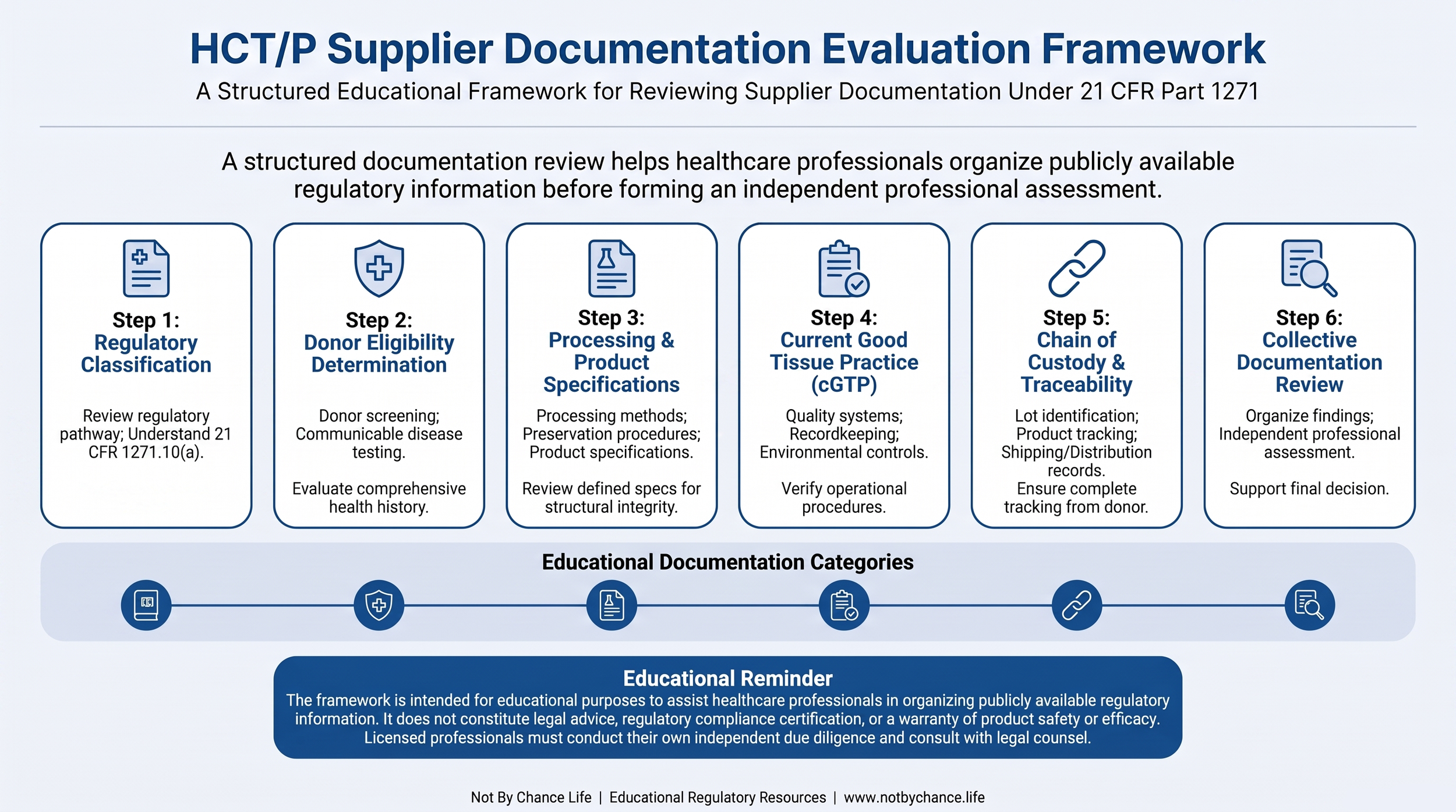
Each step is explained individually throughout the remainder of this guide and connects to more detailed educational resources within the Not By Chance Life Knowledge Center.
Step 1 — Understand the Regulatory Framework & Classification Context
Every documentation review should begin with the applicable regulatory framework and an understanding of how the product is represented within that framework. Regulatory requirements provide the context for interpreting the other documentation reviewed throughout the evaluation process.
For many HCT/P evaluations, an important educational starting point is the criteria described in 21 CFR 1271.10(a). These criteria describe when an HCT/P may be regulated solely under Section 361 of the Public Health Service Act and 21 CFR Part 1271 if all applicable criteria are met.
The review should distinguish between the applicable regulatory requirements and statements contained within supplier documentation. A supplier's classification statement may provide useful context, but the statement itself does not determine regulatory classification.
Documentation Commonly Reviewed
- Regulatory classification statements
- Product labeling
- Supplier or responsible-organization documentation
- Instructions for use, when applicable
- Applicable regulatory references
- Intended-use documentation
Questions Healthcare Professionals May Consider
- How is the product represented within the applicable regulatory framework?
- What regulatory pathway does the documentation describe?
- Which supporting regulatory references are identified?
- Is the intended use described consistently throughout the documentation?
- Are supplier representations being distinguished from regulatory requirements?
For additional regulatory education, continue with:
Step 2 — Review Donor Eligibility Documentation
After establishing the regulatory context, healthcare professionals may review available documentation relating to donor eligibility. Donor eligibility requirements for applicable HCT/Ps are addressed within 21 CFR Part 1271, including requirements concerning donor screening and testing for relevant communicable disease agents and diseases.
Educational review focuses on understanding what donor eligibility information is documented, how supporting records are organized, and how those records relate to the applicable regulatory requirements.
Documentation Commonly Reviewed
- Donor eligibility determination documentation
- Communicable disease testing information
- Donor screening information
- Medical and behavioral risk information, where applicable
- Laboratory information associated with donor testing
- Related supporting documentation
Questions Healthcare Professionals May Consider
- Does the documentation explain the donor eligibility determination?
- Are applicable donor screening and testing records identified?
- Is relevant communicable disease testing documented?
- Can the supporting information be followed consistently through the documentation package?
- Are areas requiring clarification identifiable?
For additional educational information, continue to:
Documentation Is Strongest When Reviewed Together
One common documentation-review mistake is evaluating individual records in isolation. Regulatory context, donor eligibility, processing documentation, quality systems, and traceability each address different aspects of the overall documentation picture.
A documentation-first approach encourages healthcare professionals to consider supporting records collectively before forming an independent professional assessment. Understanding how documentation categories relate to one another can reveal questions, inconsistencies, missing context, or areas requiring additional clarification.
Step 3 — Evaluate Processing Documentation
Processing documentation may describe how an HCT/P has been recovered, processed, preserved, packaged, stored, labeled, or prepared for distribution. Reviewing this information helps healthcare professionals understand the processing represented by the supplier and identify information relevant to further regulatory or documentation review.
Educational review should focus on what the documentation actually describes rather than relying on promotional terminology or assumptions regarding product performance.
Processing documentation can provide important context for regulatory concepts such as minimal manipulation. However, documentation describing a process should not, by itself, be treated as establishing that a particular regulatory criterion has been satisfied.
Documentation Commonly Reviewed
- Processing methodology
- Preservation procedures
- Storage requirements
- Expiration dating or dating information, when applicable
- Packaging documentation
- Product specifications
- Quality-control information
- Supplier processing information
Questions Healthcare Professionals May Consider
- Does the documentation describe the processing methods used?
- Are preservation procedures explained?
- Are storage requirements documented?
- Is relevant quality-control information identified?
- Is terminology used consistently throughout the documentation package?
- Are there processing details that require additional clarification?
Educational resources describing Minimal Manipulation and Homologous Use provide additional regulatory context for evaluating processing and intended-use information.
Step 4 — Review Current Good Tissue Practice (cGTP) Documentation
Current Good Tissue Practice requirements are addressed in Subpart D of 21 CFR Part 1271. These requirements are intended to prevent the introduction, transmission, or spread of communicable diseases by HCT/Ps and include requirements applicable to relevant manufacturing steps and controls.
Educational review of cGTP-related documentation can help healthcare professionals understand the quality systems, procedures, controls, records, and operational practices represented in the available documentation.
Documentation Commonly Reviewed
- Quality procedures
- Environmental controls or monitoring information, where applicable
- Storage controls
- Distribution procedures
- Complaint-file procedures, where applicable
- Tracking systems
- Recordkeeping procedures
- Corrective-action documentation, when applicable
Questions Healthcare Professionals May Consider
- What quality systems are described in the available documentation?
- Are relevant recordkeeping procedures documented?
- How is tracking addressed?
- Are storage and distribution controls described?
- Can the relationship among procedures, controls, and supporting records be understood?
Continue your educational review with Current Good Tissue Practice (cGTP) for a more detailed discussion of these regulatory concepts.
Supplier Documentation Review Matrix
The following matrix summarizes the educational purpose of each documentation category discussed throughout this guide. It is an organizational tool for professional education and documentation review, not a regulatory compliance checklist or certification system.
| Documentation Category | Educational Purpose | Related Learning Resource |
|---|---|---|
| Regulatory Framework & Classification Context | Understand the regulatory pathway represented in the documentation and identify applicable regulatory concepts for further evaluation. | 21 CFR 1271.10(a) |
| Donor Eligibility | Review available information concerning donor eligibility, screening, testing, and supporting records. | Donor Eligibility |
| Processing Documentation | Understand the processing, preservation, storage, and product-preparation information represented in available documentation. | Minimal Manipulation |
| Current Good Tissue Practice (cGTP) | Review available information concerning relevant quality systems, procedures, controls, and records. | Current Good Tissue Practice |
| Chain of Custody & Traceability | Understand how identification, tracking, storage, distribution, and related documentation are maintained across relevant stages. | Chain of Custody |
| Overall Documentation Review | Evaluate available documentation collectively and identify questions, limitations, inconsistencies, or areas requiring clarification. | Regulatory Evaluation Pathway |
No single document should automatically be interpreted as establishing the complete regulatory picture. Regulatory context, donor eligibility information, processing documentation, quality systems, traceability records, and other relevant information should be considered according to their respective roles in the evaluation.
Step 5 — Review Chain of Custody & Documentation Traceability
Traceability documentation can describe how an HCT/P is identified and tracked through relevant stages such as recovery, processing, storage, shipment, distribution, and receipt.
Although traceability information alone does not determine regulatory classification, it can provide important context regarding documentation continuity, identification, recordkeeping, and quality-system practices.
Documentation Commonly Reviewed
- Lot or unique identification information
- Chain-of-custody documentation
- Shipping documentation
- Storage information
- Distribution records
- Product identification procedures
- Receiving documentation, where available
- Other traceability records
Questions Healthcare Professionals May Consider
- Can product identification be followed through the available documentation?
- Are lot or identification numbers used consistently?
- Are relevant storage requirements documented?
- Are shipping and distribution records identifiable where appropriate?
- Are there gaps in the documented chain that require clarification?
Healthcare professionals seeking additional educational information may continue to Chain of Custody & Traceability.
Step 6 — Complete an Overall Documentation Assessment
The final step is reviewing the available documentation package as an integrated body of information. Each documentation category contributes different information to the professional evaluation.
Rather than searching for a single document that answers every question, healthcare professionals can consider how the regulatory framework, supplier representations, donor eligibility information, processing documentation, quality systems, traceability records, labeling, and other relevant materials relate to one another.
The purpose of this final assessment is not to assign an NBCL score, approve a supplier, certify documentation, or make a regulatory determination. It is to organize the available evidence, identify unresolved questions, understand documentation limitations, and support an independent professional evaluation.
Final Documentation Review Checklist
- ✓ Applicable regulatory framework reviewed
- ✓ Supplier classification representations identified and evaluated in context
- ✓ Donor eligibility documentation reviewed
- ✓ Processing documentation reviewed
- ✓ Current Good Tissue Practice (cGTP) information reviewed
- ✓ Chain-of-custody and traceability documentation reviewed
- ✓ Product labeling, storage, and handling information reviewed where relevant
- ✓ Documentation package considered collectively
- ✓ Questions, limitations, inconsistencies, and missing context identified for follow-up where appropriate
Questions to Consider Before Requesting Additional Documentation
When additional information is needed, using consistent documentation-focused questions can help healthcare professionals request clarification without relying on promotional claims or assumptions.
- How is the product represented within the applicable regulatory framework?
- What documentation is available for professional review?
- What donor eligibility information is available?
- What processing information is provided?
- What quality-system or cGTP-related information is available?
- How is chain of custody or traceability documented?
- What storage, handling, labeling, or distribution information is available?
- Are supporting records internally consistent?
- Which statements represent supplier assertions rather than regulatory requirements?
- What areas require additional clarification?
For a more detailed question framework, continue to Questions to Ask an HCT/P Supplier.
For guidance on organizing documentation requests, see Requesting HCT/P Supplier Documentation.
From Documentation Education to Professional Evaluation
The Not By Chance Life Knowledge Center provides the educational framework for understanding HCT/P regulations, documentation categories, documentation transparency, and structured supplier-documentation review.
When a qualified healthcare professional is ready to move from education into an active professional evaluation, NBCL Connect provides a separate professional workflow environment for interacting with participating organizations.
NBCL Connect — Evaluate & Connect
NBCL Connect is a Professional Evaluation Management Platform designed to support structured professional interaction between qualified healthcare professionals and participating organizations.
Within the platform, qualified professionals may be able to:
- discover participating organizations;
- start a professional evaluation or connection request;
- request documentation made available by participating organizations;
- communicate with participating organizations;
- coordinate meetings and follow-up activities; and
- manage an ongoing professional relationship.
NBCL Connect provides workflow infrastructure. It does not rank or recommend organizations, approve supplier documentation, determine regulatory classification, determine product suitability or clinical appropriateness, or make purchasing or clinical decisions for professionals.
NBCL Connect → Evaluate & Connect Use NBCL Connect, when appropriate, to apply those educational principles within a structured professional evaluation and communication workflow.
Continue Learning
The Supplier Documentation Knowledge Center is designed as an interconnected educational system. Continue through the resources below to deepen each part of the documentation-review methodology.
- HCT/P Supplier Evaluation Process — Follow the broader documentation-review journey from regulatory foundations through professional evaluation.
- HCT/P Documentation Checklist — Organize documentation review using consistent categories.
- Documentation Transparency for HCT/Ps — Understand how documentation organization, clarity, availability, and context affect professional review.
- Requesting HCT/P Supplier Documentation — Learn a documentation-first approach to identifying and requesting relevant information.
- Questions to Ask an HCT/P Supplier — Use structured questions during documentation review.
- Comparing HCT/P Supplier Documentation — Compare documentation using consistent categories without ranking suppliers.
- Common HCT/P Documentation Review Mistakes — Identify frequent errors that can weaken documentation evaluation.
- HCT/P Documentation FAQ — Review common documentation and regulatory-literacy questions.
- HCT/P Documentation Glossary — Review terminology used throughout the Supplier Documentation Knowledge Center.
Frequently Asked Questions
Why should healthcare professionals review documentation before comparing suppliers?
Beginning with documentation creates a consistent framework for reviewing regulatory context, donor eligibility information, processing documentation, quality systems, traceability, and other relevant records before promotional or comparative considerations influence the evaluation.
Does FDA establishment registration mean a product is FDA approved?
No. FDA establishment registration does not constitute FDA approval, clearance, endorsement, or a determination regarding a product's safety or effectiveness.
Why is the regulatory framework reviewed first?
The applicable regulatory framework provides the context for interpreting supplier documentation. Supplier statements regarding regulatory classification may be reviewed as part of the documentation package, but those statements should not be treated as independently determining regulatory status.
What is the purpose of donor eligibility documentation?
Donor eligibility documentation can provide information concerning the donor eligibility determination, screening, testing, and related records required or maintained under the applicable regulatory framework.
Why is processing documentation important?
Processing documentation can describe how an HCT/P was processed, preserved, stored, packaged, labeled, or prepared for distribution. This information may be relevant to understanding the product and evaluating applicable regulatory concepts, but processing documentation alone does not establish regulatory classification.
What does cGTP documentation describe?
cGTP-related documentation may describe procedures, controls, recordkeeping, tracking, storage, distribution, and other practices relevant to applicable requirements under 21 CFR Part 1271.
Why review chain-of-custody and traceability documentation?
Traceability documentation can help professionals understand how product identification and supporting records are maintained across relevant stages such as recovery, processing, storage, shipment, distribution, and receipt.
Should one document be reviewed independently?
Individual documents may answer particular questions, but professional review is generally strengthened by considering related records together and understanding the role and limitations of each type of information.
Does a complete documentation package establish regulatory compliance?
No. Documentation may provide information relevant to regulatory and professional evaluation, but the existence or completeness of a documentation package does not by itself establish regulatory classification or compliance.
Does Not By Chance Life approve supplier documentation?
No. Not By Chance Life provides regulatory education, documentation guidance, scientific education, provider education, documentation-transparency resources, and professional evaluation infrastructure. It does not approve supplier documentation or certify participating organizations.
Does NBCL Connect recommend or rank participating organizations?
No. NBCL Connect provides a structured professional evaluation and communication environment. Participation does not constitute endorsement, certification, accreditation, regulatory recognition, product approval, product recommendation, or a determination of superiority.
Professional Access
Qualified healthcare professionals who are ready to move from educational review into active professional evaluation can learn about professional access or proceed to NBCL Connect.
Regulatory & Educational Notice
Not By Chance Life LLC provides regulatory education, documentation guidance, scientific education, provider education, educational resources, documentation transparency, and professional evaluation infrastructure.
This page is intended for educational purposes and does not constitute legal, regulatory, medical, or clinical advice. It does not determine regulatory status, establish product classification, certify compliance, approve documentation, recommend suppliers or organizations, determine product suitability, or replace independent professional judgment.
Supplier documentation may contribute to professional evaluation but does not independently determine whether a particular HCT/P satisfies applicable regulatory requirements.
Scientific publications and scientific information may provide educational context regarding biology, tissue science, processing, preservation, or related concepts. Scientific literature does not independently determine regulatory classification.
Registration under 21 CFR Part 1271 does not constitute FDA approval, clearance, endorsement, or an FDA determination regarding product safety or effectiveness.
Not By Chance Life LLC is an educational and professional evaluation platform and is not presented as a medical practice, treatment provider, HCT/P manufacturer, laboratory, or clinical decision-maker.