
Scientific Education
Scientific understanding provides important context for interpreting biological research, understanding tissue science, and evaluating the terminology commonly encountered throughout peer-reviewed scientific literature. The Scientific Education collection explains the biological principles that underlie Human Cells, Tissues, and Cellular and Tissue-Based Products (HCT/Ps) while remaining separate from regulatory classification, product evaluation, and clinical decision-making.
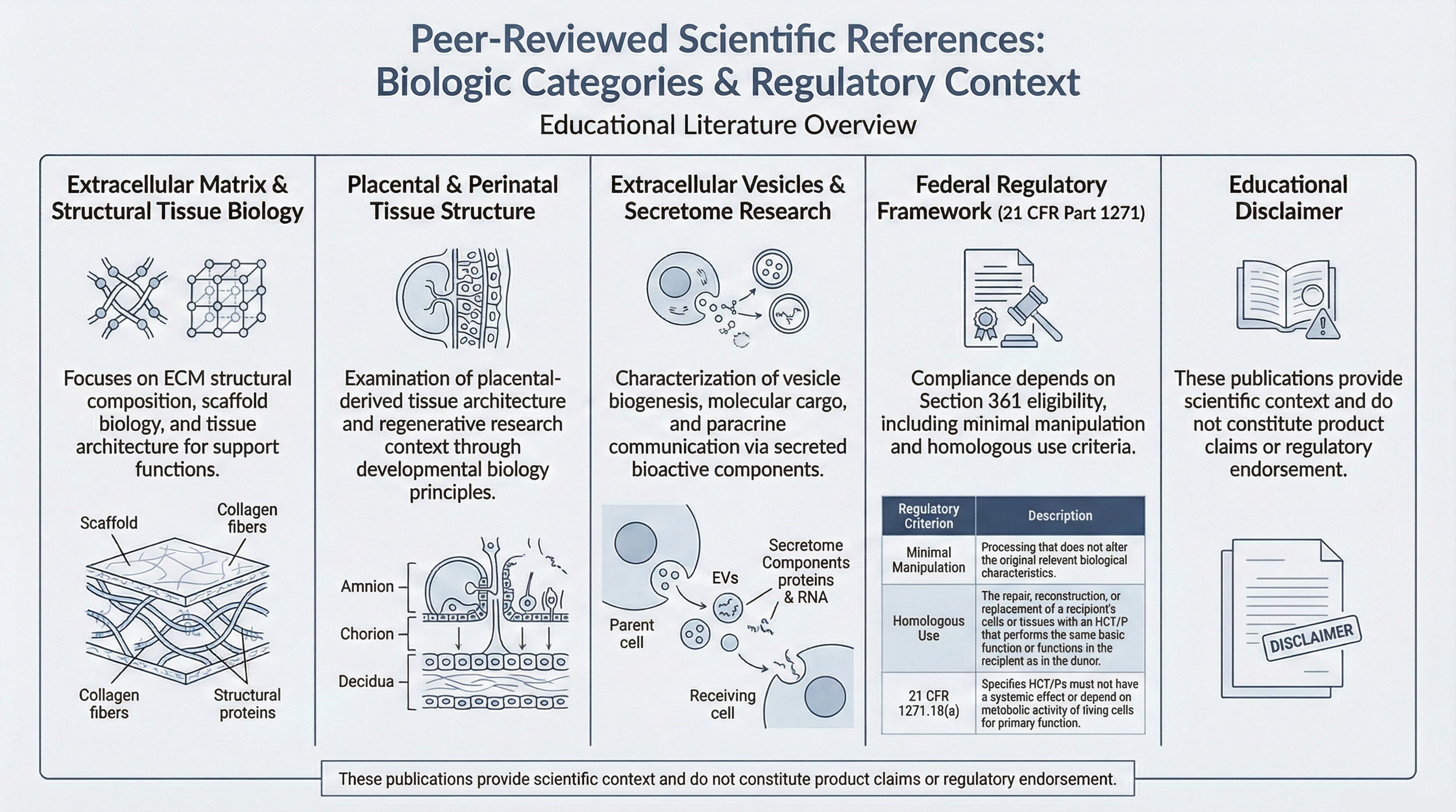
Unlike the Regulatory Foundations collection, which explains the federal framework governing HCT/Ps under 21 CFR Part 1271, this collection focuses on biology. Readers will explore extracellular matrix biology, placental and perinatal tissue biology, extracellular vesicles, secretome biology, tissue preservation science, cell viability, and the principles of critically interpreting scientific literature.
Throughout the Knowledge Center, scientific publications are presented as educational resources that improve scientific literacy. Biological research contributes valuable understanding of tissue structure, cellular communication, preservation science, and laboratory investigation, but scientific literature alone does not establish regulatory classification, product characteristics, or clinical application. Those determinations depend upon applicable statutes, regulations, FDA guidance, intended use, and documented product-specific information.
Why Scientific Education Matters
Scientific publications play an important role in advancing our understanding of biology, tissue structure, cellular communication, preservation science, and laboratory research. They help explain how human tissues are organized, how biological systems function under normal conditions, and how researchers investigate complex biological processes. Developing a foundational understanding of these scientific concepts allows readers to interpret technical terminology and evaluate scientific publications with greater confidence.
However, scientific knowledge and regulatory evaluation serve different purposes. Scientific research seeks to expand biological understanding through observation, experimentation, and peer-reviewed investigation. Regulatory evaluation determines whether a specific Human Cell, Tissue, or Cellular and Tissue-Based Product (HCT/P) satisfies applicable federal requirements based upon its documented characteristics, intended use, manufacturing process, and the governing regulatory framework.
For this reason, the Scientific Education collection is designed to complement—not replace—the educational resources found throughout the Regulatory Foundations and Supplier Evaluation Process collections. Together, these resources help readers distinguish biological science from regulatory requirements while developing a more complete understanding of both disciplines.
Each page within this collection focuses on a specific area of biological science commonly encountered throughout peer-reviewed literature, including extracellular matrix biology, placental and perinatal tissue biology, extracellular vesicles, secretome biology, preservation science, cell viability, and scientific research methodology. These topics are presented to strengthen scientific literacy and provide educational context for readers reviewing scientific publications or supplier documentation.
Scientific Education Collections
The Scientific Education collection is organized into interconnected educational resources that explain the biological concepts most frequently encountered when reviewing peer-reviewed scientific literature related to Human Cells, Tissues, and Cellular and Tissue-Based Products (HCT/Ps). Each page examines a specific scientific topic while maintaining a clear distinction between biological science, regulatory classification, and product-specific documentation.
Although each topic may be studied independently, the collection is designed to build progressively, providing readers with a comprehensive scientific foundation before moving into regulatory interpretation and documentation review.
-
Extracellular Matrix Biology
Understand the composition, organization, structural functions, and biological significance of the extracellular matrix and its role throughout normal human tissues. -
Placental & Perinatal Tissue Biology
Explore the anatomy, organization, and normal biological functions of the placenta, amnion, chorion, umbilical tissue, and Wharton's Jelly. -
Extracellular Vesicle & Exosome Biology
Examine extracellular vesicles, exosomes, microvesicles, cellular communication, and the biological mechanisms described throughout scientific literature. -
Secretome Biology
Learn about the cellular secretome, cytokines, chemokines, growth factors, and other signaling molecules commonly discussed in biological research. -
Tissue Preservation Science
Review cryopreservation, storage science, tissue handling, preservation principles, and factors that influence tissue integrity following preservation. -
Cell Viability & Post-Thaw Assessment
Understand scientific approaches used to measure, interpret, and evaluate cell viability together with the limitations associated with laboratory testing. -
Reading Scientific Literature
Develop the skills needed to critically evaluate peer-reviewed publications, understand levels of evidence, recognize study limitations, and interpret scientific findings responsibly. -
Scientific Glossary
Reference commonly used biological, tissue science, preservation, and regulatory terminology encountered throughout the Scientific Education collection.
Science Provides Context—Documentation Supports Evaluation
Scientific understanding and regulatory evaluation are complementary but distinct disciplines. Throughout the Scientific Education collection, biological concepts are presented to improve scientific literacy and provide context for interpreting peer-reviewed research. Regulatory evaluation, however, depends upon documented evidence describing the characteristics of a specific Human Cell, Tissue, or Cellular and Tissue-Based Product (HCT/P), together with the applicable federal regulatory framework.
For example, understanding extracellular matrix organization, placental tissue biology, extracellular vesicles, preservation science, or cell viability may help readers better understand terminology commonly encountered throughout scientific publications and supplier documentation. These biological concepts provide valuable educational context but should not be interpreted as determining regulatory status, product classification, or clinical application.
Similarly, peer-reviewed publications frequently investigate laboratory observations, experimental models, biological mechanisms, and emerging scientific hypotheses. These studies contribute to scientific knowledge but should be interpreted alongside regulatory requirements, manufacturer documentation, donor eligibility records, processing information, quality systems, intended use, and other supporting documentation when evaluating a specific HCT/P.
By maintaining a clear distinction between biological science and regulatory evaluation, readers can develop a more complete understanding of both disciplines while avoiding the common mistake of using scientific literature alone to draw regulatory or product-specific conclusions.
Relationship to the Knowledge Center
The Scientific Education collection represents one of three primary educational pillars within the Not By Chance Life Knowledge Center. Each collection focuses on a different aspect of Human Cells, Tissues, and Cellular and Tissue-Based Products (HCT/Ps), allowing readers to build knowledge progressively while understanding how biology, regulation, and documentation complement one another.
-
Regulatory Foundations
Explains the federal regulatory framework governing HCT/Ps under 21 CFR Part 1271, including Section 361, minimal manipulation, homologous use, donor eligibility, current good tissue practice (cGTP), and related FDA guidance. -
Supplier Evaluation Process
Provides a structured educational framework for reviewing supplier documentation, understanding processing information, evaluating supporting records, and interpreting documentation. Begin with the Supplier Evaluation Process. -
Scientific Education
Provides the biological foundation needed to understand extracellular matrix biology, tissue biology, extracellular vesicles, preservation science, cell viability, and the interpretation of scientific literature.
Together, these three collections provide a structured educational pathway that progresses from biological understanding, to regulatory interpretation, to documentation evaluation while maintaining appropriate scientific and regulatory context throughout the Knowledge Center.
Continue Your Scientific Education
The Scientific Education collection is intended to serve as a long-term educational resource for readers seeking a deeper understanding of tissue biology, scientific research, and the biological concepts frequently encountered throughout Human Cells, Tissues, and Cellular and Tissue-Based Products (HCT/Ps). While each page focuses on a distinct scientific discipline, the collection has been designed as an integrated learning framework that encourages readers to develop progressively broader scientific knowledge.
Readers are encouraged to explore the supporting pages within this collection before returning to the Regulatory Foundations and Supplier Evaluation collections. Understanding the underlying biology provides valuable context for interpreting scientific publications, technical terminology, and documentation while maintaining a clear distinction between scientific evidence, regulatory requirements, and documented product characteristics.
- Extracellular Matrix Biology
- Placental & Perinatal Tissue Biology
- Extracellular Vesicle & Exosome Biology
- Secretome Biology
- Tissue Preservation Science
- Cell Viability & Post-Thaw Assessment
- Reading Scientific Literature
- Scientific Glossary
Additional educational resources throughout the Knowledge Center include the Regulatory Foundations collection, the Supplier Evaluation Process, and the complete Educational Resources library.
This Scientific Education collection is provided exclusively for educational purposes. Scientific concepts, biological principles, and peer-reviewed publications presented throughout these resources are intended to improve scientific literacy and support informed interpretation of scientific literature. They should not be interpreted as evidence of FDA approval, regulatory classification, clinical effectiveness, or product-specific performance. Regulatory determinations should always be based upon applicable statutes, regulations, FDA guidance documents, intended use, manufacturing processes, and documented characteristics of the individual Human Cell, Tissue, or Cellular and Tissue-Based Product (HCT/P).