

Reading Scientific Literature
Scientific publications are essential tools for advancing biological knowledge, improving scientific understanding, and communicating new research findings. However, interpreting scientific literature requires more than simply reading study conclusions. Responsible scientific interpretation depends upon understanding study design, levels of evidence, statistical analysis, peer review, methodological limitations, and the broader body of published research. Individual publications contribute valuable information, but they should always be interpreted within their appropriate scientific context.
This educational resource explains the principles of scientific literacy and responsible interpretation of peer-reviewed research. Topics include evidence hierarchy, peer review, study design, common sources of bias, statistical limitations, conflicts of interest, and the distinction between biological research and regulatory evaluation. The objective is to strengthen scientific literacy by helping readers critically evaluate published research rather than relying upon isolated findings or individual conclusions.
Throughout regenerative medicine, tissue science, molecular biology, and related disciplines, scientific publications frequently investigate biological mechanisms, laboratory observations, and experimental models. These investigations improve scientific understanding but do not independently determine regulatory classification, product characteristics, clinical effectiveness, or FDA authorization. Understanding the distinction between scientific evidence and regulatory evaluation is therefore essential when reviewing published research or technical documentation.
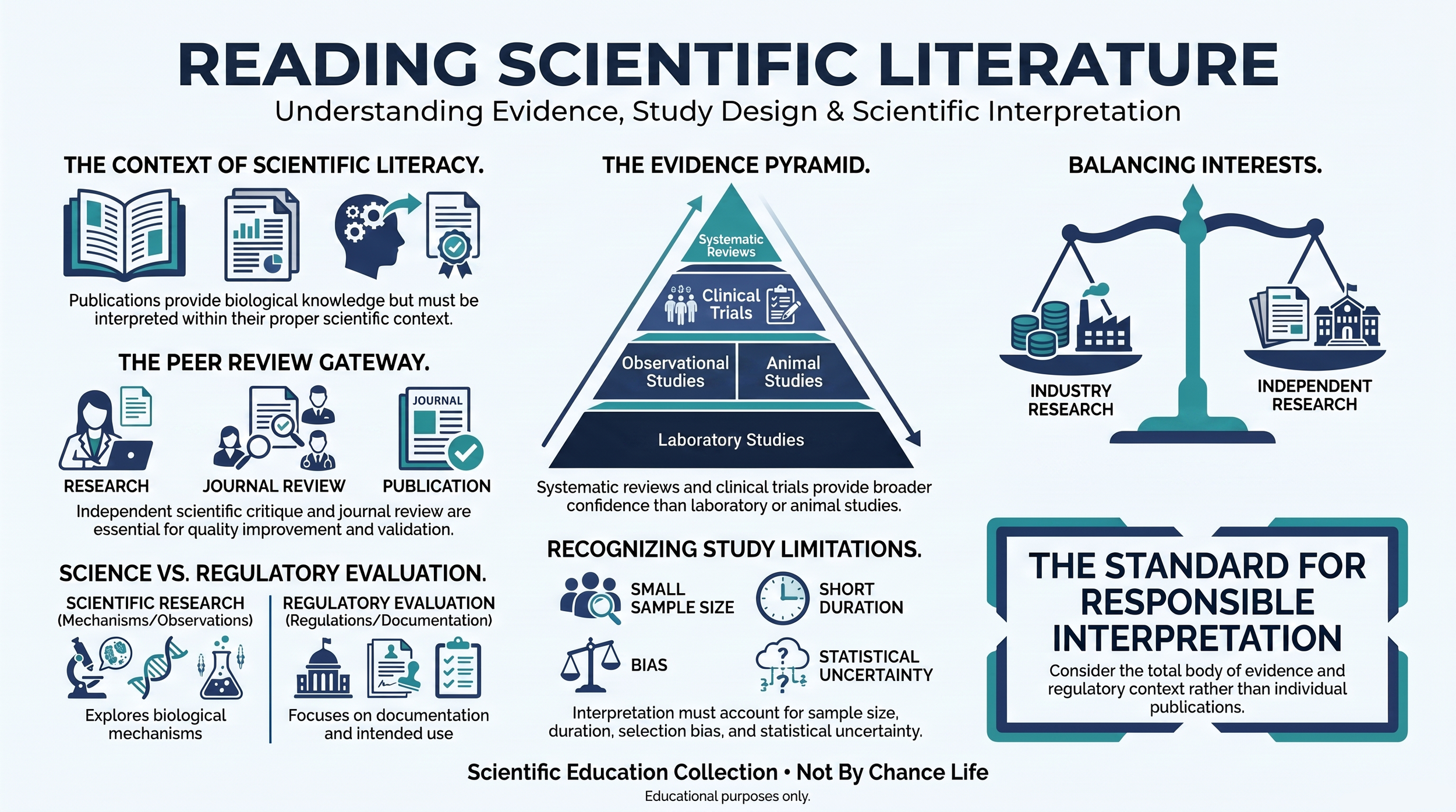
Scientific literacy is the ability to evaluate research critically by understanding how scientific knowledge is generated, tested, and refined over time. Rather than accepting individual publications at face value, scientifically literate readers examine the quality of the evidence, the study design, the methodology used, and how the findings compare with the broader body of published research. This approach encourages thoughtful interpretation while reducing the risk of drawing conclusions from isolated or incomplete evidence.
Scientific understanding develops gradually through the accumulation of evidence produced by many independent investigations. Individual studies often address specific research questions under carefully controlled conditions, and each publication contributes one piece of a much larger scientific picture. Because no single study can answer every question, responsible interpretation requires considering how multiple publications collectively support—or challenge—a scientific concept over time.
Readers should also recognize that different scientific disciplines employ different research methods depending upon the questions being investigated. Laboratory experiments, animal studies, observational research, clinical investigations, systematic reviews, and meta-analyses each contribute unique forms of evidence while possessing their own strengths and limitations. Understanding these differences helps readers place scientific findings into appropriate context.
Scientific literacy is particularly important when reviewing topics related to tissue science, extracellular matrix biology, preservation science, extracellular vesicles, and other rapidly evolving areas of biological research. New discoveries frequently expand scientific understanding, yet emerging findings should be interpreted cautiously until they are supported by additional independent evidence. Maintaining an evidence-based perspective allows readers to distinguish established scientific knowledge from preliminary observations or evolving hypotheses.
Developing scientific literacy also improves interpretation of supplier documentation and educational resources. Readers who understand how scientific evidence is generated are better prepared to evaluate technical claims, recognize the limitations of individual studies, identify appropriate supporting documentation, and appreciate the distinction between scientific investigation and regulatory evaluation.
Understanding the Hierarchy of Scientific Evidence
Not all scientific evidence carries the same weight. Different study designs answer different types of scientific questions, and each occupies a distinct position within the broader hierarchy of evidence. Understanding this hierarchy helps readers evaluate the relative strengths and limitations of published research while recognizing that higher levels of evidence generally provide greater confidence when multiple studies reach consistent conclusions.
At the foundation of the evidence hierarchy are laboratory studies, which investigate biological mechanisms under controlled experimental conditions. These investigations provide valuable insight into cellular behavior, molecular pathways, tissue biology, and extracellular interactions but are typically conducted outside normal physiological conditions.
Animal studies build upon laboratory findings by allowing researchers to investigate biological systems within living organisms. Although these investigations contribute important biological knowledge, differences between animal models and human biology mean that findings cannot automatically be generalized to human physiology.
Observational studies evaluate biological or clinical outcomes without assigning experimental interventions. These investigations can identify important associations but generally cannot establish direct cause-and-effect relationships because numerous variables may influence the observed results.
Clinical trials are designed to investigate specific research questions under carefully controlled protocols involving human participants. Depending upon study design, clinical investigations may provide stronger evidence than laboratory or observational studies, although interpretation still requires careful consideration of methodology, participant selection, duration, statistical analysis, and potential limitations.
Systematic reviews and meta-analyses generally occupy the highest levels of the evidence hierarchy because they evaluate and synthesize findings from multiple independent studies using predefined scientific methods. Rather than relying upon individual publications, these analyses examine the consistency of evidence across the broader scientific literature.
The Peer Review Process
Why Scientific Literacy Matters
Peer review is a quality-control process used by many scientific journals before research is published. During peer review, independent experts with relevant subject-matter expertise evaluate a manuscript to assess the scientific methodology, data analysis, interpretation of results, and overall contribution to the existing body of knowledge. Their feedback may lead to revisions, requests for additional analysis, or rejection if the work does not meet accepted scientific standards.
Although peer review improves the overall quality of published research, it should not be viewed as a guarantee that every conclusion is correct or that every study is free from limitations. Scientific publications may later be refined, challenged, or expanded as additional evidence becomes available. Scientific knowledge advances through continuous evaluation rather than through any single publication.
Readers should therefore view peer-reviewed publications as important components of scientific evidence while recognizing that individual studies represent contributions to an ongoing scientific conversation. The greatest confidence generally comes from findings that have been independently reproduced and supported by multiple investigators using different research methods.
When reviewing scientific literature related to Human Cells, Tissues, and Cellular and Tissue-Based Products (HCT/Ps), readers should distinguish between biological observations reported within research publications and regulatory determinations established through applicable statutes, regulations, FDA guidance documents, and product-specific characteristics. Scientific publications provide valuable biological context but do not independently determine regulatory classification. :contentReference[oaicite:0]{index=0}
How to Read Scientific Research Critically
Developing the ability to critically evaluate scientific literature helps readers distinguish well-supported evidence from preliminary findings or overstated conclusions. Rather than focusing only on the study's abstract or final conclusions, readers should examine multiple aspects of the publication to understand both its strengths and its limitations.
A useful starting point is identifying the research question. Understanding exactly what investigators intended to evaluate provides context for interpreting the results appropriately. Well-designed studies typically define their objectives clearly and describe the specific hypothesis being tested.
Next, readers should review the methodology. Important considerations include the experimental design, sample size, selection criteria, laboratory methods, statistical analyses, and any controls used during the investigation. These factors strongly influence the reliability and reproducibility of the findings.
The results section should be interpreted independently from the discussion. Data presented within tables, figures, and statistical analyses often provide a more objective understanding of the findings than narrative summaries alone. Readers should consider whether the reported results directly support the authors' conclusions or whether alternative explanations remain possible.
The discussion section provides valuable interpretation but should also be read critically. Authors commonly acknowledge study limitations, identify unanswered questions, and recommend future research. Recognizing these limitations helps place findings within their proper scientific context rather than viewing them as definitive answers.
Finally, readers should consider whether similar findings have been reported elsewhere. Scientific confidence increases when multiple independent investigators reproduce comparable results across different institutions, populations, and research methods. Consistency across numerous studies generally provides stronger evidence than isolated publications.
Scientific Evidence and Regulatory Decision-Making
Scientific research and regulatory evaluation serve complementary but distinct purposes. Scientific studies investigate biological mechanisms, generate hypotheses, evaluate experimental observations, and expand understanding of tissue biology and related scientific concepts. Regulatory agencies, by contrast, evaluate products using applicable statutes, regulations, guidance documents, intended use, manufacturing processes, product characteristics, and other regulatory criteria.
Because these objectives differ, scientific publications should not be interpreted as independently establishing regulatory status. Biological findings reported within the scientific literature may contribute valuable educational context, but regulatory classification requires evaluation under the applicable legal and regulatory framework. For Human Cells, Tissues, and Cellular and Tissue-Based Products (HCT/Ps), this framework includes the criteria established under 21 CFR Part 1271, together with relevant FDA guidance documents and product-specific characteristics. :contentReference[oaicite:1]{index=1}
Maintaining this distinction helps readers appropriately interpret scientific evidence while avoiding the common misconception that published biological research alone determines how products are regulated. Scientific literacy includes understanding both the value of scientific investigation and the separate role of regulatory evaluation.
Why Scientific Literacy Matters
Scientific literacy enables healthcare professionals, researchers, students, and other readers to engage with scientific literature more confidently and responsibly. By understanding how scientific evidence is generated, evaluated, and integrated over time, readers become better equipped to distinguish established knowledge from emerging research, interpret scientific publications within their appropriate context, and recognize the strengths and limitations of different forms of evidence.
Throughout the Scientific Education collection, this same evidence-based approach serves as the foundation for every topic. Rather than promoting individual studies or isolated findings, these educational resources emphasize critical evaluation, balanced interpretation, and integration of evidence across the broader scientific literature while maintaining appropriate distinction between scientific investigation and regulatory evaluation.
Continue Your Scientific Education
Scientific literacy provides the foundation for understanding every topic within the Scientific Education collection. As you continue through this educational pathway, you will explore extracellular matrix biology, tissue structure and function, preservation science, extracellular vesicles, cell signaling, and other biological concepts commonly discussed within the peer-reviewed literature. Each resource is designed to strengthen scientific understanding while reinforcing the importance of interpreting biological evidence within its appropriate scientific and regulatory context.
Frequently Asked Questions
What is scientific literacy?
Scientific literacy is the ability to locate, understand, evaluate, and appropriately interpret scientific information. It includes understanding how research is conducted, recognizing the strengths and limitations of different types of evidence, and distinguishing between scientific findings, clinical application, and regulatory decision-making.
Why are peer-reviewed publications important?
Peer-reviewed publications have undergone independent evaluation by subject-matter experts before publication. While peer review improves scientific quality, it does not guarantee that every conclusion is correct or that future research will not refine current understanding. Scientific knowledge develops through continuous investigation and independent verification.
Can one scientific study establish scientific consensus?
No. Individual studies contribute valuable evidence, but scientific consensus typically develops only after multiple independent investigations produce consistent findings across different populations, research groups, and methodologies. The overall body of evidence generally provides stronger support than any single publication.
Does published research determine how an HCT/P is regulated?
Scientific publications provide important biological and scientific context, but they do not independently determine regulatory classification. Regulatory evaluation is based on applicable statutes, regulations, FDA guidance documents, intended use, manufacturing processes, and product-specific characteristics, including the criteria established under 21 CFR Part 1271. :contentReference[oaicite:0]{index=0}
What should readers evaluate when reviewing scientific literature?
Readers should consider the research question, study design, methodology, sample size, statistical analysis, reported limitations, reproducibility of findings, and whether similar results have been independently confirmed by additional research. Evaluating the complete study rather than only the abstract or conclusions provides a more comprehensive understanding of the evidence.
How should scientific publications be interpreted within this Knowledge Center?
Throughout the Scientific Education collection, scientific publications are presented as educational resources that explain biological concepts and research methodology. They are intended to strengthen scientific literacy rather than establish regulatory conclusions, recommend clinical decision-making, or evaluate individual products.
Related Scientific Education Resources
- Extracellular Matrix (ECM): Structure, Function, and Biological Significance
- Understanding Perinatal Tissue Biology
- Cell Signaling in Tissue Biology
- Extracellular Vesicles: Scientific Overview
- Growth Factors, Cytokines, and Chemokines Explained
- Cryopreservation and Post-Thaw Biology
- Understanding Scientific Evidence and Research Quality
Related Regulatory Foundations Resources
Related Supplier Documentation Resources
Educational Disclaimer
This Scientific Education resource is provided for educational purposes only to improve scientific literacy regarding biological concepts discussed within peer-reviewed scientific literature. References to published research are intended to explain scientific principles and research methodology and should not be interpreted as establishing regulatory status, demonstrating clinical effectiveness, or supporting specific medical decision-making.
Regulatory classification of Human Cells, Tissues, and Cellular and Tissue-Based Products (HCT/Ps) is determined through applicable statutes, regulations, FDA guidance documents, intended use, manufacturing characteristics, and product-specific evaluation rather than scientific publications alone. Readers should consult qualified regulatory, scientific, and healthcare professionals when evaluating specific products or regulatory questions.
This information has not been evaluated by the U.S. Food and Drug Administration for diagnosing, treating, curing, or preventing any disease. This educational resource is intended for scientific and educational purposes only.