

Current Good Tissue Practice (cGTP): Understanding FDA Requirements for HCT/Ps
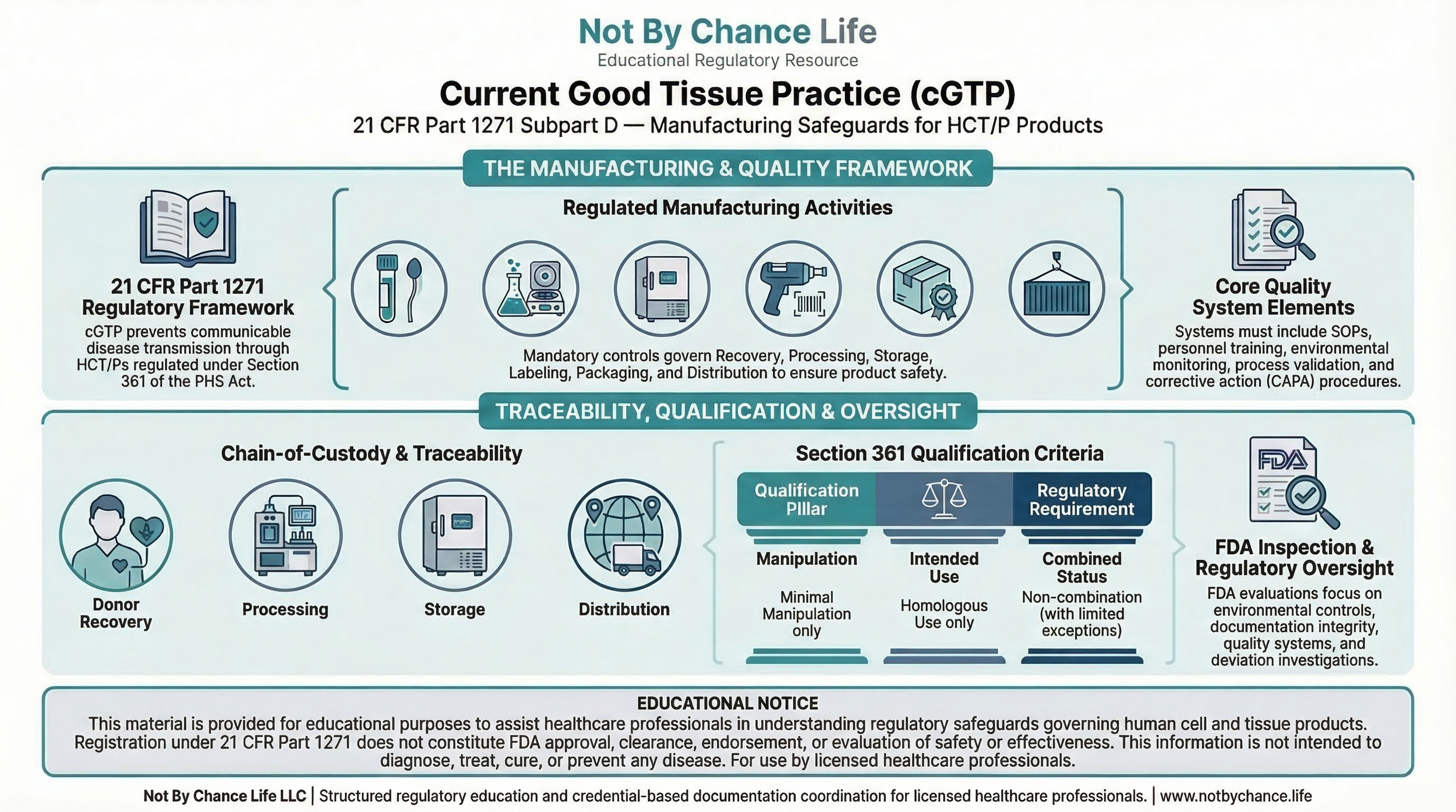
Current Good Tissue Practice (cGTP) refers to requirements established under 21 CFR Part 1271 Subpart D for the methods used in, and the facilities and controls used for, the manufacture of Human Cells, Tissues, and Cellular and Tissue-Based Products (HCT/Ps).
The regulatory purpose of cGTP is centered on preventing the introduction, transmission, or spread of communicable diseases through the use of HCT/Ps.
Healthcare professionals frequently encounter references to cGTP while reviewing supplier or establishment documentation. Understanding what cGTP establishes — and what it does not establish — is important for interpreting that documentation accurately.
cGTP requirements should be understood within the broader 21 CFR Part 1271 regulatory framework. They should not be interpreted as FDA approval, clearance, certification, endorsement, or a determination regarding the safety or effectiveness of a particular product.
For a structured overview of how cGTP relates to other concepts within the HCT/P framework, see the HCT/P Regulatory Evaluation Pathway.
Understanding Current Good Tissue Practice (cGTP)
Current Good Tissue Practice establishes manufacturing requirements intended to prevent circumstances that increase the risk of the introduction, transmission, or spread of communicable diseases through HCT/Ps.
The requirements address multiple aspects of manufacturing operations, including organization and management, quality programs, personnel, procedures, facilities, environmental controls, equipment, supplies and reagents, recovery, processing, process controls, labeling controls, storage, receipt, predistribution shipment, distribution, tracking, complaint files, and records.
On This Page
What Is Current Good Tissue Practice (cGTP)?
Current Good Tissue Practice requirements are established primarily in 21 CFR Part 1271 Subpart D. They govern methods used in, and facilities and controls used for, the manufacture of HCT/Ps in order to prevent the introduction, transmission, or spread of communicable diseases.
Within Part 1271, manufacturing is a broad concept. Depending on the activity and applicable requirements, it can encompass recovery, processing, storage, labeling, packaging, and distribution of HCT/Ps, as well as screening or testing a cell or tissue donor.
cGTP therefore concerns much more than laboratory testing. It establishes regulatory controls across activities involved in the manufacture and handling of HCT/Ps.
Why Current Good Tissue Practice Exists
The central regulatory purpose of cGTP is the prevention of the introduction, transmission, or spread of communicable diseases through the use of HCT/Ps.
The requirements establish controls intended to address risks associated with manufacturing activities and to support consistent implementation of procedures relevant to communicable-disease prevention.
Important Areas Addressed by cGTP
- Organizational responsibility and management.
- A quality program appropriate to the establishment's manufacturing activities.
- Qualified personnel and appropriate training.
- Procedures for applicable manufacturing activities.
- Facilities and environmental controls.
- Equipment, supplies, and reagents.
- Recovery and processing controls.
- Process and labeling controls.
- Storage, receipt, predistribution shipment, and distribution controls.
- Tracking, complaint files, and records.
These requirements should be interpreted according to the actual regulation and the manufacturing activities performed by the establishment rather than as a generalized certification of product quality.
Major Components of Current Good Tissue Practice
Current Good Tissue Practice is a system of interconnected requirements rather than a single test or certificate. Several major components are especially useful for understanding supplier and establishment documentation.
Organization and Management
Establishments subject to applicable cGTP requirements must maintain appropriate organizational responsibility for manufacturing activities and for compliance with applicable requirements.
Quality Program
An establishment that performs manufacturing steps must establish and maintain a quality program that is appropriate for the specific HCT/Ps manufactured and the manufacturing steps performed.
The quality program is an important regulatory component of cGTP. It should not be reduced to a general claim that an organization has a “quality system.”
Personnel
Personnel performing manufacturing activities must have the education, experience, and training necessary to perform assigned functions. Training and responsibilities should be documented as required.
Procedures
Establishments must establish and maintain procedures for applicable manufacturing activities. Procedures should be designed to prevent circumstances that increase the risk of introduction, transmission, or spread of communicable diseases.
Facilities and Environmental Control
Facilities must be of suitable size, construction, and location to prevent contamination of HCT/Ps with communicable-disease agents and to allow appropriate operations, cleaning, and maintenance.
Where environmental conditions could reasonably be expected to cause contamination or cross-contamination, appropriate environmental controls must be established and maintained.
Equipment
Equipment used in the manufacture of HCT/Ps must be appropriately designed for its intended use and suitably located and installed to facilitate operations, including cleaning and maintenance. Applicable equipment controls include schedules and procedures for cleaning, sanitizing, maintenance, and calibration.
Supplies and Reagents
Supplies and reagents used in manufacturing must not adversely affect the quality and safety of HCT/Ps and must be verified to meet specifications designed to prevent circumstances that increase communicable-disease risk.
Recovery and Processing
Recovery and processing must be conducted in accordance with applicable requirements designed to prevent contamination and cross-contamination and to prevent the introduction, transmission, or spread of communicable diseases.
Storage and Distribution
Applicable controls address storage, receipt, predistribution shipment, and distribution. These controls help ensure that HCT/Ps are handled according to established requirements and that products that do not meet applicable release requirements are not distributed.
Tracking and Records
Applicable tracking and recordkeeping requirements support traceability and provide documentation concerning manufacturing activities and HCT/P disposition.
cGTP and the Quality Program
The term quality system is commonly used in professional and supplier documentation, but the regulation specifically requires an establishment that performs manufacturing steps to establish and maintain a quality program appropriate for the specific HCT/Ps manufactured and the manufacturing steps performed.
The quality program is intended to address activities necessary to prevent the introduction, transmission, or spread of communicable diseases through the manufacture and use of HCT/Ps.
When reviewing supplier documentation, it is therefore useful to distinguish between a supplier's broader description of its quality-management system and the specific quality-program requirements established by 21 CFR Part 1271.
For additional educational context, see the HCT/P Quality Systems Guide.
Documentation and Traceability Under cGTP
Documentation is an important component of Current Good Tissue Practice because records provide evidence concerning manufacturing activities, procedures, investigations, tracking, and other regulated activities.
Depending on the establishment's activities and the applicable requirements, documentation may include records concerning personnel, procedures, equipment, processing, storage, distribution, complaints, investigations, tracking, and other manufacturing controls.
Examples of Documentation That May Be Relevant
- Written procedures and standard operating procedures.
- Personnel education, experience, and training documentation.
- Equipment cleaning, maintenance, and calibration records.
- Environmental control or monitoring records where applicable.
- Recovery and processing records.
- Storage and temperature-control records where applicable.
- Receipt, predistribution shipment, and distribution records.
- Tracking records.
- Complaint files and investigations.
- Records associated with deviations, corrective actions, or quality-program activities where applicable.
The exact records relevant to a particular evaluation depend on the establishment, the HCT/P, the manufacturing activities performed, and the applicable regulatory requirements.
Relationship to Other Regulatory Concepts
Current Good Tissue Practice is one part of the broader federal framework governing HCT/Ps. It should remain distinct from regulatory classification criteria, donor-eligibility requirements, establishment registration, and other requirements addressed elsewhere in 21 CFR Part 1271.
| Regulatory Topic | Relationship to cGTP |
|---|---|
| 21 CFR Part 1271 | Contains the broader federal regulatory framework governing HCT/Ps, including registration and listing, donor eligibility, cGTP, and other requirements. |
| Section 361 | Provides statutory authority associated with prevention of communicable-disease transmission; regulation solely under Section 361 and Part 1271 depends on satisfaction of the applicable regulatory criteria. |
| FDA Establishment Registration | Registration and listing are separate regulatory requirements and do not constitute FDA approval, certification, or proof of cGTP compliance. |
| Donor Eligibility | Addresses requirements concerning donor screening, testing, and eligibility determinations and operates alongside other communicable-disease safeguards. |
| Minimal Manipulation | Is a separate regulatory criterion relevant to the analysis under 21 CFR 1271.10(a). |
| Homologous Use | Is another separate criterion relevant to the analysis under 21 CFR 1271.10(a) and should not be inferred from cGTP documentation. |
| Quality Systems | Provides broader educational context for organizational quality management; cGTP contains specific federal requirements, including requirements for an appropriate quality program. |
Keeping these concepts separate is important. Evidence concerning one requirement should not automatically be treated as evidence that a different regulatory criterion or requirement has been satisfied.
Common Misconceptions About Current Good Tissue Practice
Misconception #1 — cGTP Means FDA Approval
No. cGTP establishes regulatory manufacturing requirements. Compliance with applicable cGTP requirements does not mean that FDA has approved, cleared, certified, or endorsed an HCT/P.
Misconception #2 — FDA Registration Proves cGTP Compliance
No. FDA establishment registration and HCT/P listing are regulatory requirements that are distinct from cGTP compliance. Registration should not be represented as FDA approval or certification of an establishment's products or manufacturing practices.
Misconception #3 — cGTP Guarantees Clinical Performance
No. cGTP requirements are directed toward manufacturing controls and communicable-disease safeguards. They do not establish clinical effectiveness, guarantee outcomes, or determine clinical appropriateness.
Misconception #4 — cGTP Applies Only to Laboratories
No. The regulatory concept of manufacture under Part 1271 encompasses multiple activities and is not limited to laboratory testing.
Misconception #5 — cGTP Documentation Determines Section 361 Status
No. cGTP documentation may provide information relevant to manufacturing requirements, but regulatory status under Section 361 and Part 1271 requires a separate analysis of the applicable criteria, including those in 21 CFR 1271.10(a).
Misconception #6 — cGTP Replaces Supplier Evaluation
No. Understanding applicable cGTP requirements is one component of documentation literacy. A structured supplier evaluation may also consider donor-eligibility information, establishment information, processing documentation, traceability, testing records, labeling, and other information relevant to the particular evaluation.
Applying cGTP Concepts During Supplier Documentation Evaluation
For healthcare professionals reviewing supplier documentation, cGTP provides an important regulatory framework for understanding manufacturing controls and records.
The objective of documentation review should not be to infer compliance from a single certificate, statement, or registration record. Instead, documentation can be evaluated according to what each record actually demonstrates and the limitations of that evidence.
Questions Documentation May Help Explore
- What manufacturing activities does the establishment state that it performs?
- What procedures and quality-program information are documented?
- What records are available concerning personnel, equipment, processing, storage, distribution, or other applicable activities?
- What traceability information is available?
- What donor-eligibility information is available where applicable?
- What documentation is available concerning complaints, investigations, deviations, or corrective actions where relevant?
- Are statements in supplier materials consistent with the documentation provided?
Questions cGTP Documentation Does Not Independently Answer
- Has FDA approved the HCT/P?
- Does the HCT/P satisfy every criterion in 21 CFR 1271.10(a)?
- Is the product regulated solely under Section 361?
- Is a particular intended use homologous?
- Is a particular processing method minimally manipulative?
- Is the product clinically effective?
- Is the product appropriate for a particular patient or clinical circumstance?
Continue with the Supplier Evaluation Process, Supplier Documentation Evaluation Framework, and HCT/P Documentation Checklist.
Regulatory Requirements vs. Supplier Documentation vs. Scientific Evidence
Current Good Tissue Practice also illustrates an important principle used throughout the Not By Chance Life Knowledge Center: different sources of information have different evidentiary roles.
- Federal regulations establish applicable regulatory requirements.
- FDA guidance and official FDA publications may provide interpretation and educational context concerning those requirements.
- Supplier documentation may provide evidence concerning an establishment's documented activities, procedures, testing, traceability, and other product- or organization-specific information.
- Scientific literature may provide biological, analytical, or methodological context.
Supplier documentation and scientific literature can support professional understanding, but neither replaces the applicable regulation or independently determines regulatory classification.
Frequently Asked Questions
What is Current Good Tissue Practice (cGTP)?
Current Good Tissue Practice refers to requirements under 21 CFR Part 1271 Subpart D governing methods used in, and facilities and controls used for, the manufacture of HCT/Ps to prevent the introduction, transmission, or spread of communicable diseases.
Does cGTP mean an HCT/P is FDA approved?
No. cGTP requirements should not be interpreted as FDA approval, clearance, certification, endorsement, or a determination regarding the safety or effectiveness of a particular HCT/P.
Does FDA establishment registration prove cGTP compliance?
No. Registration and listing are separate regulatory requirements. Establishment registration does not constitute FDA approval or certification and should not, by itself, be treated as proof that all applicable cGTP requirements have been satisfied.
Why is documentation important under cGTP?
Records document manufacturing activities and provide information relevant to procedures, quality-program activities, traceability, investigations, complaints, and other applicable regulatory controls.
How does cGTP relate to donor eligibility?
Donor eligibility and cGTP address different requirements within the HCT/P regulatory framework. Donor eligibility includes requirements concerning donor screening, testing, and eligibility determinations, while cGTP establishes manufacturing requirements directed toward preventing communicable-disease risks.
Does cGTP apply only to laboratories?
No. Manufacturing under Part 1271 encompasses a broader range of activities and is not limited to laboratory testing.
Can one document establish cGTP compliance?
A single supplier document generally cannot represent the full range of manufacturing activities, procedures, records, and controls potentially relevant to cGTP. Documentation should be interpreted according to its actual scope and what it demonstrates.
Does cGTP determine whether an HCT/P qualifies for regulation solely under Section 361?
No. cGTP requirements are distinct from the regulatory criteria used to determine whether an HCT/P may be regulated solely under Section 361 and 21 CFR Part 1271. The applicable classification criteria require their own analysis.
Professional Evaluation Through NBCL Connect
The Not By Chance Life Knowledge Center provides public regulatory, documentation, and scientific education. Qualified healthcare professionals who are ready to move from education into structured professional evaluation and communication with participating organizations may use NBCL Connect.
Knowledge Center → Learn & Understand
Use the Knowledge Center to understand regulatory foundations, evaluate documentation concepts, and explore scientific context.
NBCL Connect → Evaluate & Connect
Use NBCL Connect for structured professional evaluation, documentation requests to participating organizations, professional communication, meeting coordination, and ongoing relationship management.
NBCL Connect does not determine cGTP compliance, regulatory classification, documentation adequacy, product suitability, or clinical appropriateness. It does not rank, recommend, or endorse participating organizations.
Regulatory Notice
This guide is provided for educational purposes and is intended to support regulatory and documentation literacy concerning Current Good Tissue Practice and the HCT/P regulatory framework.
The applicable federal statutes and regulations, together with relevant FDA guidance and official interpretations, should be consulted when evaluating regulatory requirements. This page is not an official FDA interpretation and does not provide legal or regulatory advice.
FDA establishment registration does not constitute FDA approval, clearance, certification, endorsement, or a determination regarding the safety or effectiveness of a product.
Supplier documentation may provide evidence concerning documented activities, procedures, testing, traceability, and other information, but documentation alone does not determine regulatory classification or establish compliance with every applicable requirement.
Scientific literature may provide biological, analytical, or methodological context but does not independently establish regulatory classification, product-specific performance, or clinical appropriateness.
Not By Chance Life LLC provides regulatory education, documentation guidance, scientific education, and professional evaluation infrastructure. It does not provide medical care, legal advice, regulatory determinations, diagnosis, treatment recommendations, dosing guidance, or clinical protocols.