
Homologous Use Under 21 CFR Part 1271 — Regulatory Standard
What is homologous use?
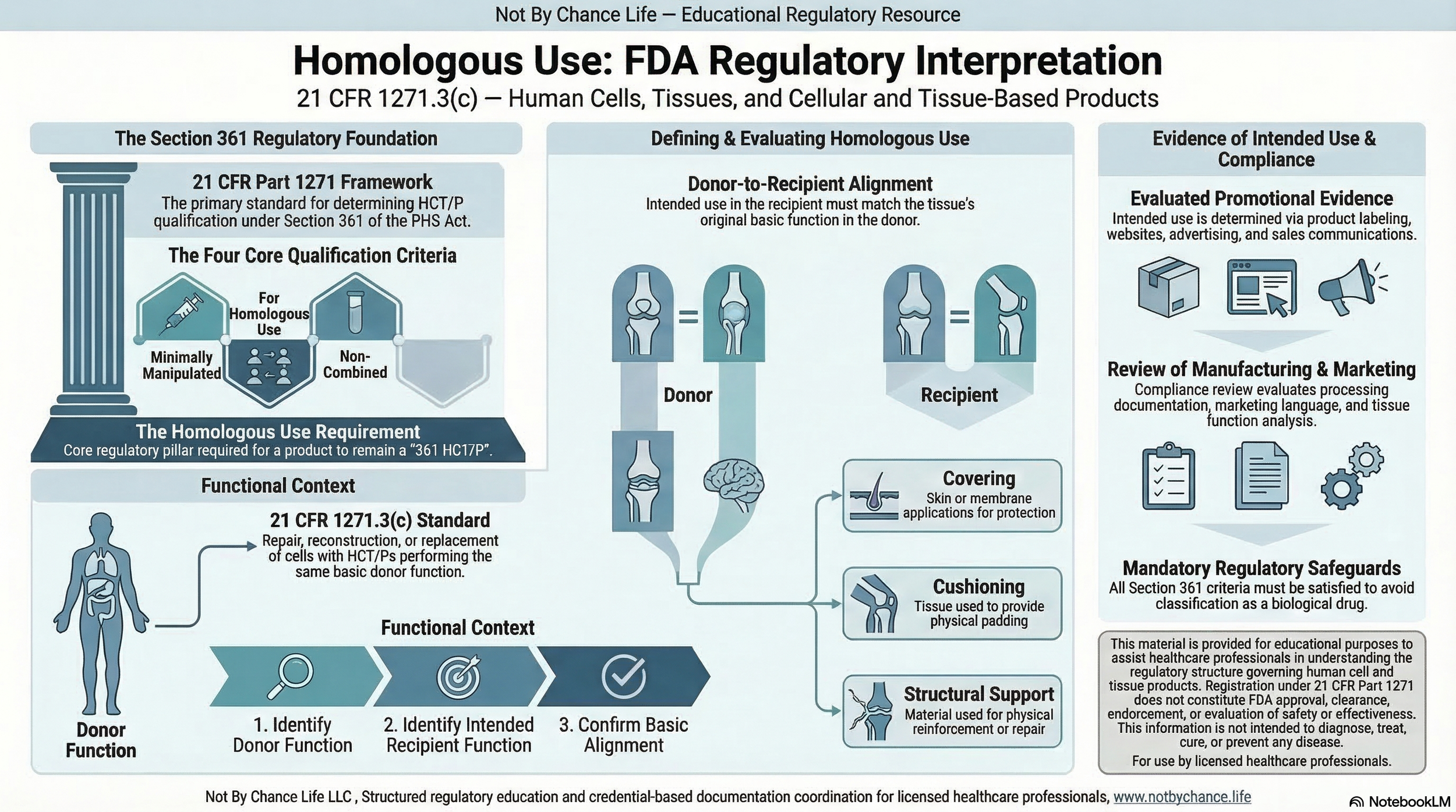
Under 21 CFR 1271.3(c), homologous use means the repair, reconstruction, replacement, or supplementation of a recipient's cells or tissues with an HCT/P that performs the same basic function or functions in the recipient as in the donor.
In simple terms, the regulatory analysis compares the basic function or functions of the donor tissue with the function or functions the HCT/P is intended to perform in the recipient.
Homologous use is one of the regulatory criteria relevant to determining whether a Human Cell, Tissue, and Cellular and Tissue-Based Product (HCT/P) satisfies the requirements in 21 CFR 1271.10(a) for regulation solely under Section 361 of the Public Health Service Act and 21 CFR Part 1271.
The concept should therefore be evaluated within the broader 21 CFR Part 1271 regulatory framework rather than as a stand-alone classification test.
Homologous use is evaluated alongside minimal manipulation and the other applicable criteria in 21 CFR 1271.10(a).
For a structured overview showing how these concepts fit together, see the HCT/P Regulatory Evaluation Pathway.
Key Regulatory Distinction
Homologous use is not determined simply by the tissue's name, source, or general biological properties.
The analysis requires identifying the HCT/P's basic function or functions in the donor and comparing them with the function or functions the HCT/P is intended to perform in the recipient.
Regulatory Definition
The definition in 21 CFR 1271.3(c) focuses on whether an HCT/P used for repair, reconstruction, replacement, or supplementation performs the same basic function or functions in the recipient as in the donor.
A structured educational analysis therefore begins with questions such as:
- What is the HCT/P's basic function or functions in the donor?
- What function or functions is the HCT/P intended to perform in the recipient?
- Do the donor and intended recipient functions represent the same basic function or functions?
For additional educational examples, see Homologous Use Interpretation Examples →
Why Intended Use Matters
Homologous use analysis requires understanding the function or functions the HCT/P is intended to perform in the recipient.
FDA's regulatory framework considers objective evidence of intended use. Depending on the circumstances, relevant information may include labeling, advertising, promotional materials, statements concerning the product's intended functions, and other evidence associated with how the HCT/P is represented or intended to be used.
This is one reason product descriptions and claims can be important during regulatory analysis. Scientific characteristics of a tissue do not, by themselves, establish the intended use of a particular product.
Understanding Basic Function or Functions
The homologous use analysis centers on the HCT/P's basic function or functions rather than on every possible biological characteristic associated with the tissue.
For structural tissues, basic functions may involve structural roles such as support, connection, cushioning, covering, or protection, depending on the tissue being evaluated.
For cells or nonstructural tissues, the relevant basic function or functions depend on the biological role of the cells or tissues in the donor.
The analysis should therefore be specific to the HCT/P and its intended use rather than relying on broad assumptions about an entire tissue category.
Homologous Use and Supplier Documentation
Supplier documentation may provide information relevant to understanding a product's source, characteristics, processing, labeling, intended use, and other documented information.
That documentation can support a structured professional evaluation, but documentation alone does not determine whether the homologous use criterion has been satisfied.
Regulatory analysis must remain grounded in the applicable regulation, relevant FDA guidance and interpretations, and the facts associated with the particular HCT/P.
For documentation-focused educational resources, see the Supplier Evaluation Process and HCT/P Documentation Checklist.
Homologous Use and Scientific Evidence
Scientific literature can provide useful context for understanding tissue structure, biological characteristics, and basic biological or structural functions.
Scientific evidence, however, does not independently determine regulatory classification or establish that a particular intended use satisfies the homologous use criterion.
Scientific information should therefore be used for scientific education while regulatory conclusions remain grounded in the applicable statutory and regulatory framework and the facts associated with the particular HCT/P.
Explore related scientific material in Scientific Education & Peer-Reviewed References.
Role in the 21 CFR 1271.10(a) Criteria
Homologous use is one component of the broader regulatory analysis under 21 CFR 1271.10(a). The applicable criteria must be considered together rather than treating homologous use as an independent determination of Section 361 status.
- Minimal manipulation
- Homologous use
- The applicable restrictions concerning combination with another article
- The applicable criteria concerning systemic effect and dependence on the metabolic activity of living cells for primary function
For the broader evaluation sequence, see the HCT/P Regulatory Evaluation Pathway .
Related Regulatory Topics
Regulatory Sources vs. Documentation vs. Scientific Evidence
Homologous use is an important example of why different information sources should remain distinct during professional evaluation.
- Regulatory sources establish the applicable definitions, criteria, and regulatory requirements.
- Supplier documentation may provide product-specific information relevant to understanding source, processing, labeling, intended use, and other documented characteristics.
- Scientific literature may provide biological and scientific context concerning tissue structure, characteristics, and functions.
Supplier documentation and scientific literature can support understanding, but neither independently determines whether a particular HCT/P satisfies the homologous use criterion or otherwise qualifies for a particular regulatory pathway.
Continue Learning
Professional Evaluation Through NBCL Connect
The Not By Chance Life Knowledge Center provides public regulatory, documentation, and scientific education. Qualified healthcare professionals who are ready to move from education into structured professional evaluation and communication with participating organizations may use NBCL Connect.
Knowledge Center → Learn & Understand
Use the Knowledge Center to study regulatory foundations, supplier documentation principles, and scientific context.
NBCL Connect → Evaluate & Connect
Use NBCL Connect for structured professional evaluation, documentation requests to participating organizations, professional communication, meeting coordination, and ongoing relationship management.
NBCL Connect does not determine whether a product satisfies the homologous use criterion, determine regulatory classification, approve supplier documentation, recommend participating organizations, or make clinical or purchasing decisions.
Regulatory Notice
This page is provided for educational purposes and is intended to support regulatory literacy concerning homologous use and the HCT/P regulatory framework.
Regulatory classification depends on applicable law and regulations and the facts associated with the particular product, including its characteristics, processing, intended use, labeling, claims, and other relevant considerations. Satisfaction of one criterion does not independently establish that all applicable requirements under 21 CFR 1271.10(a) have been satisfied.
Supplier documentation and scientific literature may provide relevant information and educational context but do not independently determine regulatory classification or compliance.
Not By Chance Life LLC provides regulatory education, documentation guidance, scientific education, and professional evaluation infrastructure. It does not provide medical care, legal advice, regulatory determinations, diagnosis, treatment recommendations, or clinical protocols.