

Extracellular Vesicle & Exosome Biology
Extracellular vesicles (EVs) are naturally released membrane-bound particles produced by cells throughout the body. They are widely studied because they participate in intercellular communication and transport a variety of biological molecules between cells. As research into extracellular vesicles has expanded, they have become an important area of investigation within cell biology, developmental biology, immunology, molecular communication, and tissue science.
This educational resource explains the biology of extracellular vesicles, including exosomes, microvesicles, their mechanisms of formation, biological cargo, and their role in normal cellular communication. The discussion is limited to established biological concepts presented throughout the scientific literature and does not address clinical applications or product-specific characteristics.
Although extracellular vesicle research is frequently discussed alongside regenerative medicine, scientific understanding of extracellular vesicle biology should not be confused with regulatory classification. Biological research improves scientific knowledge, whereas regulatory oversight depends upon applicable statutes, regulations, manufacturing methods, intended use, and product-specific characteristics. Understanding this distinction is essential when interpreting scientific publications and supplier documentation.
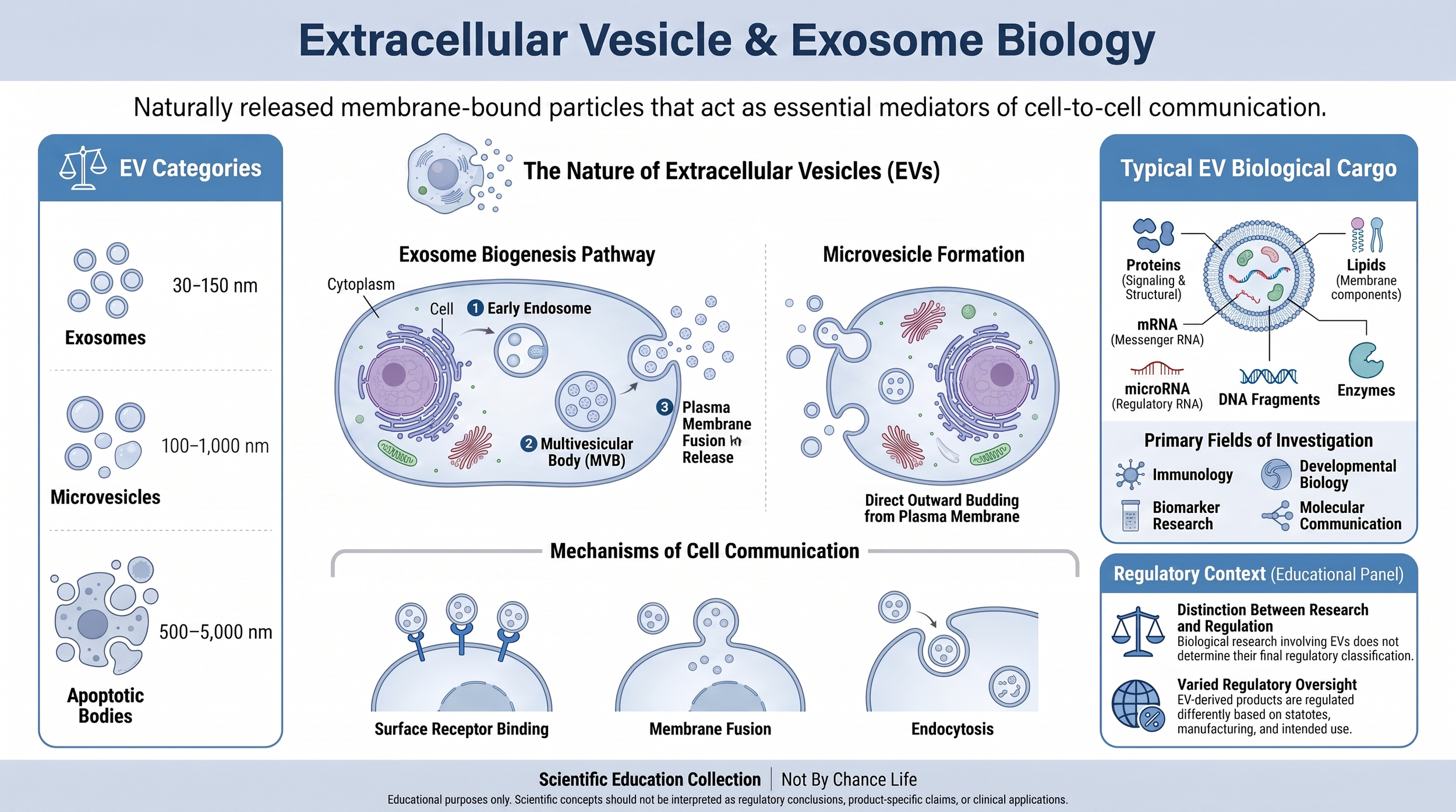
What Are Extracellular Vesicles?
Extracellular vesicles (EVs) are small membrane-bound particles naturally released by virtually all cell types into the extracellular environment. Unlike intact cells, extracellular vesicles do not contain a complete cellular structure capable of independent function. Instead, they serve as biological carriers that transport molecular components between cells and contribute to normal physiological communication throughout the body.
The term extracellular vesicle encompasses several categories of naturally occurring particles that differ in their size, method of formation, and biological characteristics. The two principal categories most frequently discussed throughout the scientific literature are exosomes and microvesicles, while larger apoptotic bodies are typically associated with the normal process of programmed cell death.
Although these particles vary in origin, they share several common characteristics. Each is enclosed by a lipid membrane derived from the parent cell and may contain proteins, lipids, nucleic acids, enzymes, and other biological molecules that reflect the physiological state of the cell from which it originated. Their composition and biological activity remain active areas of scientific investigation.
Extracellular vesicles have been identified throughout numerous tissues and biological fluids, including blood, lymph, saliva, urine, breast milk, amniotic fluid, and other extracellular environments. Their widespread distribution has made them an important subject of investigation across multiple scientific disciplines, including developmental biology, immunology, neuroscience, oncology, cardiovascular biology, and tissue science.
Modern extracellular vesicle research focuses primarily on understanding how these naturally occurring particles participate in normal biological communication, tissue homeostasis, and molecular signaling. While scientific publications continue to expand knowledge in these areas, ongoing biological research should not be interpreted as establishing regulatory classification, clinical application, or product-specific characteristics.
Classification of Extracellular Vesicles
Scientists generally classify extracellular vesicles according to their mechanism of formation rather than solely by their size. Although size ranges are commonly reported throughout the scientific literature, the biological pathway through which a vesicle is produced provides a more accurate basis for distinguishing one category from another.
The three major extracellular vesicle categories most frequently described include exosomes, microvesicles, and apoptotic bodies. Each originates through a different biological process and exhibits distinct structural and functional characteristics that continue to be investigated through ongoing research.
-
Exosomes
Typically measuring approximately 30–150 nanometers in diameter, exosomes originate within the cell through the endosomal pathway before being released into the extracellular environment following fusion of multivesicular bodies with the plasma membrane. -
Microvesicles
Generally ranging from approximately 100–1,000 nanometers, microvesicles are formed by direct outward budding of the plasma membrane, allowing portions of the cell membrane and associated intracellular components to become enclosed within newly released vesicles. -
Apoptotic Bodies
Usually larger than other extracellular vesicles, apoptotic bodies are generated during programmed cell death as cells naturally fragment into membrane-bound structures that are subsequently cleared by surrounding tissues and immune cells.
Although these categories are widely recognized, investigators continue to study areas of overlap in vesicle size, molecular composition, isolation techniques, and biological function. As analytical methods improve, extracellular vesicle classification continues to evolve alongside advances in cell biology and molecular research.
Exosome Biogenesis
Exosomes are produced through a highly organized intracellular pathway known as the endosomal pathway. Rather than forming directly from the cell surface, exosomes originate inside the cell through a series of membrane trafficking events that culminate in their release into the extracellular environment. This process distinguishes exosomes from other extracellular vesicle populations and represents one of the defining characteristics used in their biological classification.
The process begins when a portion of the plasma membrane folds inward, forming an early endosome. As the endosome matures, inward budding of its limiting membrane produces numerous small intraluminal vesicles within a larger intracellular compartment known as a multivesicular body (MVB). These intraluminal vesicles eventually become exosomes if the multivesicular body fuses with the plasma membrane.
When fusion occurs, the intraluminal vesicles are released into the extracellular space, where they are subsequently referred to as exosomes. Alternatively, some multivesicular bodies are directed toward intracellular degradation pathways rather than extracellular release. The factors that influence these different cellular pathways remain an active area of scientific investigation.
Because exosomes originate through intracellular membrane trafficking, their molecular composition often reflects both the parent cell and the biological processes occurring during vesicle formation. Researchers continue to investigate how different cell types selectively package proteins, lipids, nucleic acids, enzymes, and other molecular components into exosomes prior to their release.
Understanding exosome biogenesis provides important scientific context for interpreting extracellular vesicle research. However, biological mechanisms of vesicle formation should not be interpreted as determining regulatory classification or product characteristics, which depend upon separate regulatory considerations beyond the biological processes themselves.
Microvesicle Formation
Unlike exosomes, microvesicles form through direct outward budding of the plasma membrane. During this process, localized changes occur within the cell membrane and underlying cytoskeleton, allowing a portion of the membrane to protrude outward before separating from the parent cell as an independent extracellular vesicle.
This outward budding mechanism produces membrane-bound vesicles that typically contain portions of the plasma membrane together with intracellular proteins, lipids, enzymes, and nucleic acids located near the site of release. Because microvesicles originate directly from the cell surface, their membrane composition often differs from that of exosomes formed through the endosomal pathway.
Microvesicles are generally larger than exosomes, although the reported size ranges frequently overlap. For this reason, investigators increasingly emphasize mechanisms of formation and molecular characterization rather than size alone when classifying extracellular vesicle populations.
The biological processes regulating microvesicle formation remain an area of ongoing investigation. Numerous factors—including changes in intracellular calcium concentration, cytoskeletal remodeling, membrane organization, and cellular activation—have been associated with vesicle release in different experimental systems. These mechanisms continue to be refined as extracellular vesicle research advances.
Together, exosomes and microvesicles illustrate the biological diversity of extracellular vesicles and demonstrate why precise scientific terminology is important when interpreting published research and comparing experimental findings across different studies.
Biological Cargo of Extracellular Vesicles
Extracellular vesicles transport a diverse collection of biological molecules commonly referred to as vesicle cargo. The composition of this cargo reflects both the characteristics of the parent cell and the physiological conditions present when the vesicle was formed. As analytical technologies have improved, researchers have identified thousands of molecular components associated with different extracellular vesicle populations.
Among the most frequently studied cargo molecules are proteins involved in cellular structure, membrane organization, intracellular transport, and biological signaling. Many extracellular vesicles also contain membrane lipids that contribute to vesicle stability while influencing interactions with surrounding cells and tissues.
Extracellular vesicles may also carry nucleic acids, including messenger RNA (mRNA), microRNA (miRNA), and fragments of DNA. These molecules have become a major focus of scientific investigation because they may participate in normal intercellular communication and provide insight into the physiological state of the originating cell. Their precise biological roles, however, continue to be investigated across numerous research disciplines.
Enzymes, signaling molecules, adhesion proteins, and other bioactive components have likewise been identified within extracellular vesicles. The specific composition varies considerably depending upon the originating tissue, cell type, developmental stage, and biological environment. Consequently, extracellular vesicles should be viewed as a heterogeneous population rather than a single uniform biological entity.
Current scientific research continues to investigate how cells selectively package molecular cargo into extracellular vesicles, how that cargo is transported throughout the extracellular environment, and how recipient cells recognize and interact with different vesicle populations. These biological questions remain active areas of investigation within modern cell biology and molecular research.
Extracellular Vesicles in Cell-to-Cell Communication
One of the defining biological characteristics of extracellular vesicles is their ability to participate in communication between cells. Rather than functioning as independent cells, extracellular vesicles serve as membrane-bound carriers capable of transporting biological molecules from one cell to another throughout the extracellular environment.
Scientific literature describes several mechanisms through which extracellular vesicles may interact with recipient cells. In some situations, proteins located on the vesicle surface bind directly to receptors expressed by neighboring cells, initiating intracellular signaling pathways without transferring the vesicle's internal contents. In other circumstances, extracellular vesicles may fuse with the plasma membrane or be internalized through endocytosis, allowing portions of their molecular cargo to enter the recipient cell.
These communication pathways are actively investigated across numerous biological systems because they contribute to normal cellular organization, tissue homeostasis, developmental processes, and physiological adaptation. Researchers continue to study the factors that regulate vesicle targeting, uptake, intracellular trafficking, and the downstream biological responses that may follow extracellular vesicle interaction.
Although extracellular vesicle communication represents an important area of biological research, the mechanisms described throughout scientific publications should be understood as observations within cell biology rather than evidence of regulatory classification or clinical application. Scientific investigation explains how biological systems function; it does not independently establish the regulatory status of products derived from those systems.
Scientific Importance of Extracellular Vesicle Research
Extracellular vesicle research has expanded rapidly over the past two decades and now represents one of the most active areas of investigation within cell biology. Scientists continue to study how extracellular vesicles contribute to normal physiological processes, tissue organization, cellular communication, and molecular transport across a wide range of biological systems.
Current research explores extracellular vesicles in developmental biology, immunology, neuroscience, cardiovascular biology, reproductive biology, tissue engineering, and numerous other scientific disciplines. Improvements in analytical technologies have allowed investigators to better characterize vesicle populations, identify molecular cargo, and examine the complex biological pathways involved in extracellular vesicle production and function.
Despite substantial scientific progress, many aspects of extracellular vesicle biology remain incompletely understood. Questions regarding vesicle heterogeneity, standardized isolation methods, molecular characterization, biological variability, and reproducibility continue to be investigated throughout the scientific community. As a result, extracellular vesicle research remains an evolving field in which new discoveries frequently refine or expand current understanding.
Readers should therefore interpret extracellular vesicle literature within the broader context of scientific investigation. Individual studies often examine specific experimental models, laboratory conditions, or narrowly defined biological questions that may not be directly comparable across different publications. Careful interpretation requires consideration of study design, methodology, analytical techniques, and the limitations acknowledged by the investigators themselves.
For these reasons, understanding extracellular vesicle biology requires more than reading individual publications. It requires developing the ability to critically evaluate scientific evidence while recognizing that biological research, regulatory evaluation, and product characterization each represent distinct disciplines with different objectives and standards of evidence.
Scientific Biology and Regulatory Classification
Extracellular vesicle biology and regulatory classification should not be viewed as interchangeable concepts. Scientific literature explains how extracellular vesicles are formed, their molecular composition, and their role in normal biological processes. Regulatory classification, however, depends upon applicable statutes, regulations, FDA guidance documents, intended use, manufacturing methods, and the documented characteristics of a specific product.
Accordingly, biological descriptions of extracellular vesicles do not independently establish whether a particular product qualifies as a Human Cell, Tissue, or Cellular and Tissue-Based Product (HCT/P), a biological drug, or another regulatory category. These determinations require evaluation under the applicable regulatory framework rather than scientific observations alone.
Within the United States, products derived from extracellular vesicles or commonly referred to as exosomes have generally been the subject of FDA communications indicating that such products may be regulated as biological drugs requiring the appropriate premarket authorization pathway. Readers should therefore distinguish carefully between the scientific biology of extracellular vesicles and the regulatory oversight applicable to products derived from those biological materials.
Understanding this distinction helps readers interpret scientific publications more accurately while avoiding the common misconception that biological mechanisms, published research, or molecular composition alone determine regulatory status. Scientific evidence informs biological understanding, whereas regulatory classification requires independent evaluation under the applicable legal framework.
Related Scientific Education Resources
- Extracellular Matrix Biology
- Placental & Perinatal Tissue Biology
- Secretome Biology
- Tissue Preservation Science
- Cell Viability & Post-Thaw Assessment
- Reading Scientific Literature
- Scientific Glossary
- Scientific Education Hub
This educational resource explains the biological principles of extracellular vesicles and exosomes as described throughout the scientific literature. It is intended solely to improve scientific literacy and should not be interpreted as evidence of regulatory classification, FDA authorization, clinical effectiveness, or product-specific performance. Regulatory determinations depend upon applicable statutes, regulations, FDA guidance documents, intended use, manufacturing methods, and the documented characteristics of the individual product.