
21 CFR Part 1271 Regulatory Framework for HCT/P Products
What is the 21 CFR Part 1271 regulatory framework?
21 CFR Part 1271 establishes the federal regulatory framework governing many Human Cells, Tissues, and Cellular and Tissue-Based Products (HCT/Ps). It defines regulatory requirements for product classification, donor eligibility, establishment registration, and Current Good Tissue Practice (cGTP).
In simple terms, 21 CFR Part 1271 explains how qualifying HCT/Ps are regulated and what documentation, safeguards, and regulatory criteria apply.
The U.S. Food and Drug Administration regulates human cell and tissue products through the regulatory framework established in 21 CFR Part 1271. These regulations govern Human Cells, Tissues, and Cellular and Tissue-Based Products (HCT/Ps) and are designed to reduce the risk of communicable disease transmission while establishing manufacturing and handling safeguards.
Understanding the regulatory structure helps healthcare professionals, tissue establishments, compliance teams, and supplier evaluation personnel interpret documentation within the broader federal framework governing Human Cells, Tissues, and Cellular and Tissue-Based Products (HCT/Ps).
Additional regulatory education materials are available in the Regulatory Resource Library.
For a structured overview showing how the regulatory framework is applied during documentation review, see the HCT/P Regulatory Evaluation Pathway .
The following visual summarizes key regulatory concepts used in evaluating Human Cells, Tissues, and Cellular and Tissue-Based Products (HCT/Ps) under 21 CFR Part 1271, including classification criteria and regulatory safeguards.
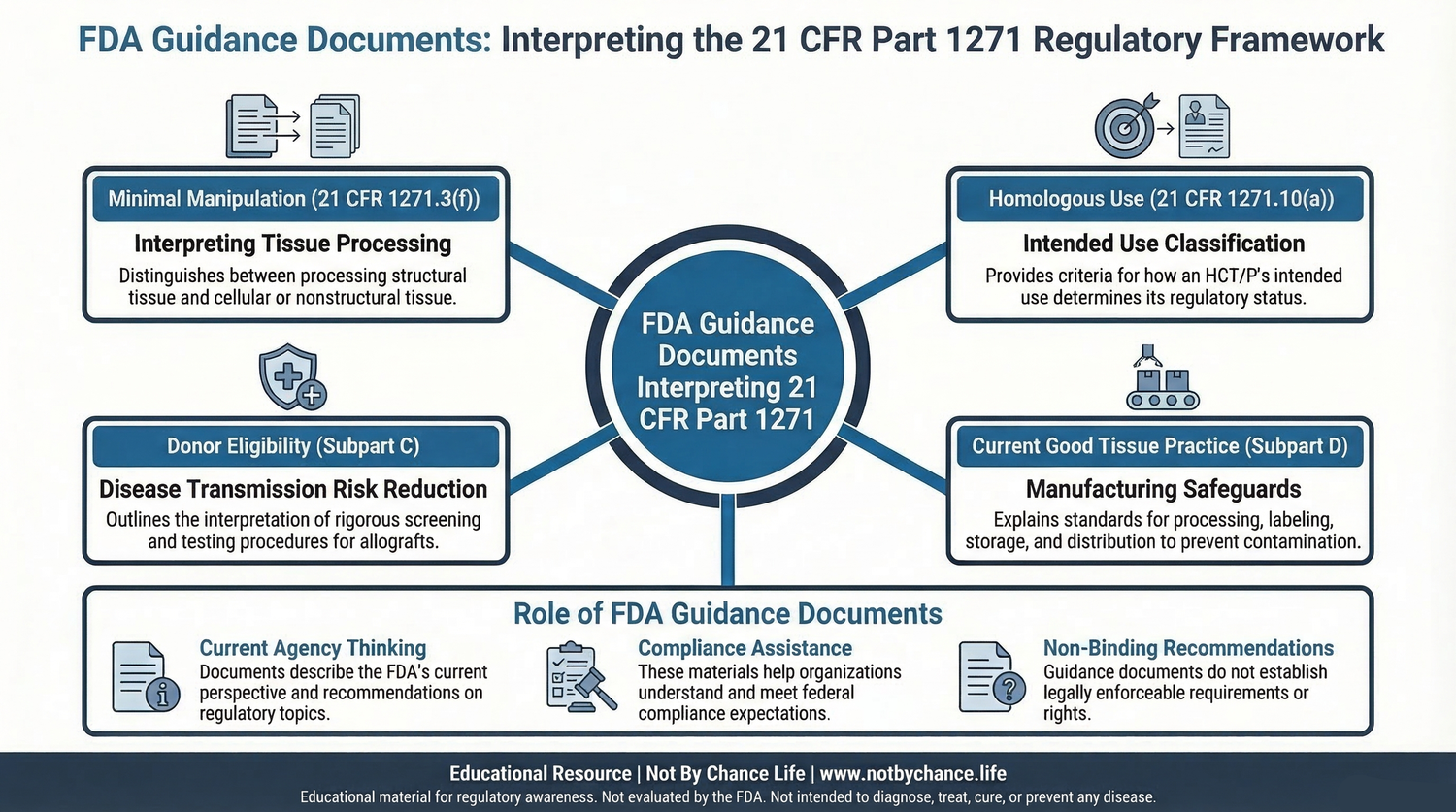
Educational infographic summarizing regulatory evaluation criteria and safeguards under 21 CFR Part 1271.
This visual is provided for educational purposes only and does not represent clinical protocols, product specifications, or treatment frameworks.
Overview of the HCT/P Regulatory Structure
The regulatory framework for HCT/Ps is built upon multiple interrelated evaluation criteria. These criteria are considered collectively when determining the applicable regulatory pathway for a Human Cell, Tissue, or Cellular and Tissue-Based Product under federal law.
Products that meet all regulatory criteria outlined in 21 CFR 1271.10(a) may be regulated solely under Section 361 of the Public Health Service Act. Products that do not meet these criteria may require evaluation under the biologics licensing pathway associated with Section 351.
These classification criteria are further detailed under 21 CFR 1271.10(a) classification criteria .
Further explanation of these regulatory pathways is available in the page discussing Section 361 vs Section 351 classification.
For applied evaluation of these regulatory criteria in real-world documentation review, see the Structured Supplier Evaluation Process.
Core Regulatory Evaluation Criteria
Minimal Manipulation
Evaluation of whether processing alters the original relevant characteristics of the tissue. See Minimal Manipulation.
Homologous Use
Assessment of whether the intended use performs the same basic function in the recipient as in the donor. See Homologous Use.
Structural vs Cellular Tissue
Classification of tissue types influencing minimal manipulation standards. See Structural vs Cellular Tissue.
Donor Eligibility
Donor screening and testing safeguards. See Donor Eligibility.
Current Good Tissue Practice (cGTP)
Manufacturing safeguards governing recovery, processing, storage, labeling, and distribution. See Current Good Tissue Practice.
Regulatory Oversight
FDA inspection programs and enforcement actions. See FDA Enforcement Overview.
Related Regulatory Topics
Educational Purpose of This Regulatory Framework
This regulatory overview is provided as an educational resource describing the federal framework governing Human Cells, Tissues, and Cellular and Tissue-Based Products under 21 CFR Part 1271.
Further terminology definitions are available in the Regulatory Glossary.
Professional Access & Regulatory Documentation
Licensed healthcare professionals and institutional representatives may request additional educational materials related to regulatory interpretation, donor eligibility standards, and documentation practices referenced within this framework.
- Provider Credential Verification Portal
- Schedule a Professional Consultation
- General Information Requests
Access to documentation is subject to credential verification and is limited to qualified professionals operating within applicable regulatory frameworks.
This information is for educational purposes only. Documentation access does not imply FDA approval, product authorization, or clinical endorsement.
This information is provided for educational purposes only.
Certain referenced materials may be regulated as Human Cells, Tissues, and Cellular and Tissue-Based Products (HCT/Ps) under 21 CFR Part 1271. Registration under 21 CFR Part 1271 does not constitute FDA approval, clearance, endorsement, or evaluation of safety or effectiveness.
This information is not intended to diagnose, treat, cure, or prevent any disease.