

Extracellular Matrix (ECM) Biology
Estimated reading time: 10–12 minutes
The extracellular matrix (ECM) is the complex three-dimensional network of structural proteins, glycoproteins, proteoglycans, glycosaminoglycans, and other extracellular molecules that surrounds cells throughout the human body. Far more than passive material between cells, the extracellular matrix provides the structural framework that supports tissue architecture while contributing to mechanical stability, cellular organization, and the normal physical environment in which cells exist.
A thorough understanding of extracellular matrix biology provides an essential foundation for interpreting peer-reviewed scientific literature involving connective tissues, developmental biology, tissue engineering, biomaterials, preservation science, and regenerative medicine research. Because extracellular matrix terminology appears throughout modern tissue science, developing scientific literacy in this area helps readers better evaluate research publications and technical documentation without confusing biological concepts with regulatory conclusions.
This educational resource examines the extracellular matrix from a biological perspective by explaining its molecular composition, structural organization, major components, biological functions, and tissue-specific variation. It is intended to strengthen scientific understanding only. It does not discuss product performance, clinical applications, or regulatory classification. Those topics are addressed separately throughout the Regulatory Foundations and Supplier Evaluation Process collections.
As the cornerstone article within the Scientific Education collection, this page establishes the biological framework for many of the concepts explored throughout the Knowledge Center, including placental and perinatal tissue biology, extracellular vesicles, tissue preservation science, proteomics, and post-thaw viability. Throughout this collection, biological science is presented as educational context that complements—but never replaces—regulatory requirements and documentation evaluation.
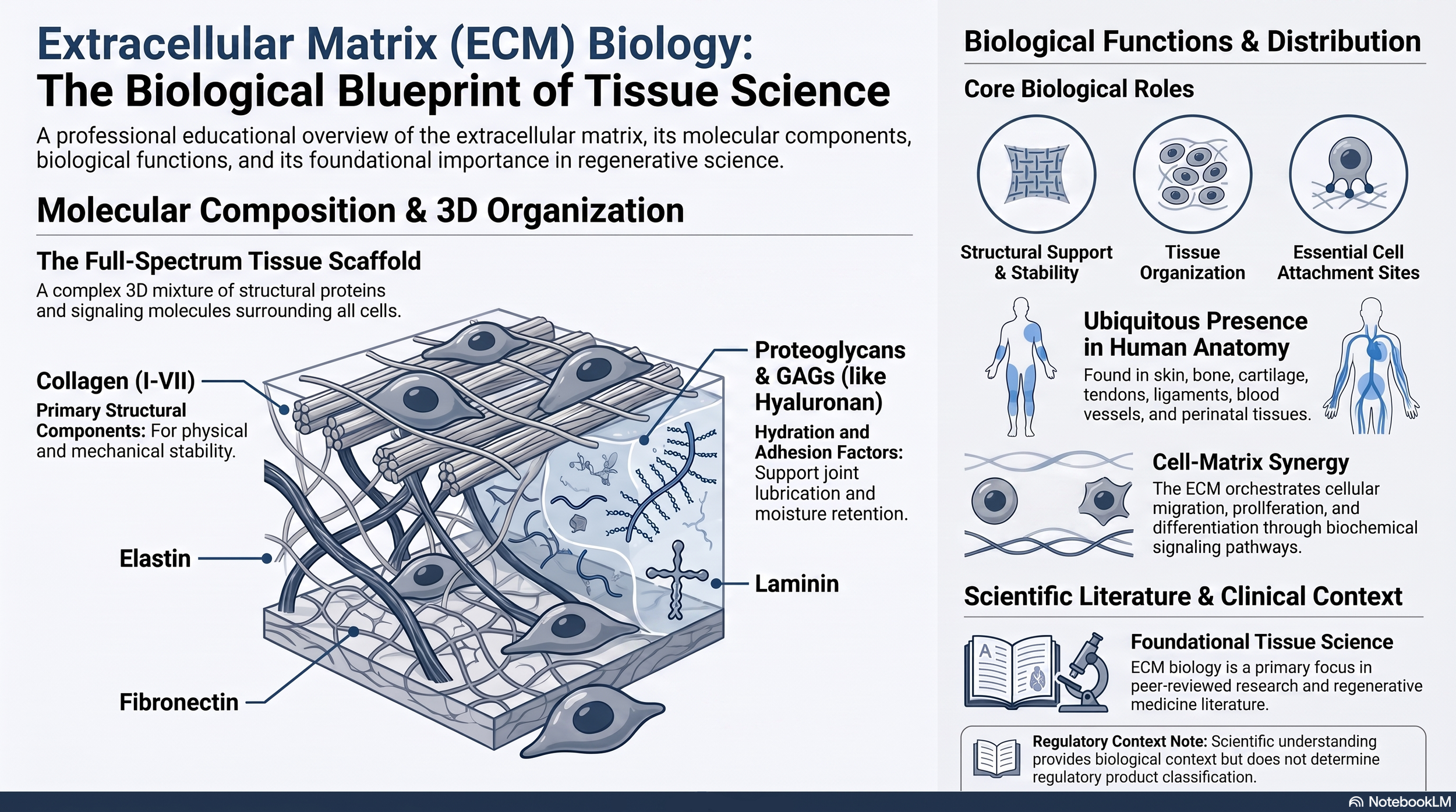
What Is the Extracellular Matrix?
The extracellular matrix is a highly organized three-dimensional network of molecules located outside cells that provides the structural framework for virtually every tissue in the human body. Rather than existing as an isolated collection of fibers, the extracellular matrix forms an integrated biological system that surrounds cells, maintains tissue architecture, and contributes to the organization, stability, and physical properties of organs throughout the body.
Every tissue contains an extracellular matrix uniquely organized to meet its specific biological and mechanical requirements. Although the composition of the matrix differs among tissues such as skin, cartilage, bone, tendons, blood vessels, placenta, and perinatal tissues, the extracellular matrix consistently provides structural support while creating the extracellular environment in which cells normally reside. This organization allows tissues to maintain their characteristic architecture despite continual growth, remodeling, and physiological stress.
The extracellular matrix should not be viewed as a single substance but as an integrated network composed of structural proteins, adhesive glycoproteins, proteoglycans, glycosaminoglycans (GAGs), specialized basement membrane components, water, minerals, and numerous extracellular molecules. Together these components create a dynamic framework that contributes to tissue integrity, mechanical performance, and normal biological organization.
Scientific literature frequently describes the extracellular matrix as both a structural scaffold and a biologically active environment because its molecular organization influences tissue architecture, mechanical properties, and the extracellular environment surrounding cells. Understanding these concepts provides important context when interpreting peer-reviewed publications involving tissue biology, extracellular matrix research, biomaterials, developmental biology, preservation science, and regenerative medicine.
Throughout the Scientific Education collection, extracellular matrix biology serves as the foundation for understanding many related scientific topics. Appreciating how the extracellular matrix is constructed naturally leads to a deeper understanding of the individual molecular components that create its remarkable structural organization.
Major Components of the Extracellular Matrix
The extracellular matrix is not composed of a single material. Instead, it is built from several families of molecules that work together to create the structural framework of human tissues. Each molecular component contributes unique physical and biological characteristics, while their combined organization determines the overall properties of the extracellular matrix within each tissue.
Although the relative abundance of individual molecules varies throughout the body, the same principal components appear repeatedly across extracellular matrix biology. Understanding the function of each component provides a foundation for interpreting scientific literature involving tissue architecture, developmental biology, biomechanics, biomaterials, and extracellular matrix research.
Collagen
Collagen is the most abundant structural protein within the extracellular matrix and serves as its primary source of tensile strength. More than twenty-eight collagen types have been identified, each contributing to the specialized architecture of tissues including skin, bone, tendons, cartilage, blood vessels, basement membranes, and numerous connective tissues. The organization, orientation, and density of collagen fibers largely determine the mechanical strength and structural integrity of many extracellular matrices.
Elastin
Elastin provides elasticity and resilience, allowing tissues to stretch and return to their original shape following normal mechanical deformation. It is particularly abundant within tissues that experience repeated movement or cyclic mechanical stress, including large arteries, lungs, skin, and elastic ligaments. Working together with collagen, elastin helps balance flexibility with structural stability.
Fibronectin
Fibronectin is an adhesive glycoprotein that helps organize the extracellular matrix by connecting cells with surrounding matrix components. Scientific literature frequently describes fibronectin as an important participant in matrix assembly, cellular attachment, migration, and maintenance of normal tissue architecture. Its ability to interact with multiple extracellular molecules makes it an important organizer of matrix structure.
Laminin
Laminin is a principal component of basement membranes and contributes to structural organization where epithelial, endothelial, and other specialized cell layers interface with underlying connective tissue. Laminin molecules help establish basement membrane architecture while supporting the organization and integrity of numerous tissues throughout the body.
Proteoglycans and Glycosaminoglycans (GAGs)
Proteoglycans consist of core proteins attached to glycosaminoglycan (GAG) chains, including molecules such as hyaluronan, chondroitin sulfate, dermatan sulfate, heparan sulfate, and keratan sulfate. These highly hydrated molecules contribute to tissue hydration, compressive resistance, molecular organization, and maintenance of the extracellular environment. Their ability to retain water significantly influences the physical properties of many connective tissues.
Although each component performs distinct biological roles, none functions independently. Instead, collagen, elastin, fibronectin, laminin, proteoglycans, and glycosaminoglycans interact continuously to form an integrated extracellular framework. The precise organization of these molecules gives every tissue its characteristic structural properties while supporting the normal biological functions discussed throughout scientific literature.
Understanding the individual components of the extracellular matrix naturally leads to the next question: how are these molecules organized into the highly ordered three-dimensional structures that distinguish one tissue from another? The answer lies in the architectural organization of the extracellular matrix itself.
How the Extracellular Matrix Is Organized
The extracellular matrix is organized as a highly structured three-dimensional network rather than a random collection of molecules. Individual extracellular matrix components interact with one another to create an integrated architectural framework that provides mechanical stability while allowing tissues to maintain their normal structure. This organization differs among tissues according to their biological and mechanical requirements, producing extracellular matrices uniquely adapted for skin, bone, cartilage, tendons, ligaments, blood vessels, placental tissues, and numerous other anatomical structures.
Within connective tissues, collagen fibers provide much of the tensile strength that resists stretching forces, while elastin contributes elasticity that allows tissues to deform and recover following normal movement. Adhesive glycoproteins such as fibronectin and laminin help organize surrounding matrix components and facilitate interactions between cells and the extracellular environment. Proteoglycans and glycosaminoglycans occupy the spaces between structural fibers, helping regulate hydration, compressive resistance, and molecular organization throughout the tissue.
Many tissues also contain specialized extracellular matrix structures known as basement membranes. These thin yet highly organized layers separate epithelial and endothelial tissues from the underlying connective tissue while contributing to structural support and tissue organization. Basement membranes contain characteristic extracellular matrix components—including laminins, type IV collagen, nidogens, and heparan sulfate proteoglycans—arranged in a highly ordered architecture.
Although extracellular matrices throughout the body share many of the same molecular building blocks, their organization reflects the functional requirements of each tissue. Dense connective tissues emphasize tensile strength through highly organized collagen fibers. Cartilage contains an extracellular matrix adapted to resist compressive forces. Bone incorporates a mineralized extracellular matrix that provides rigidity, while elastic tissues contain greater concentrations of elastin to accommodate repeated expansion and recoil.
Scientific literature frequently examines extracellular matrix organization because changes in molecular architecture can significantly influence the physical characteristics of tissues. Understanding how extracellular matrix components assemble into organized structures provides important context when interpreting studies involving tissue biology, developmental biology, biomaterials, biomechanics, and extracellular matrix research.
A fundamental principle of extracellular matrix biology is that organization is equally as important as composition. Two tissues may contain many of the same molecular components while exhibiting dramatically different structural properties because those molecules are arranged differently within the extracellular environment. This relationship between composition and organization provides the foundation for understanding how the extracellular matrix performs its many biological functions throughout the human body.
Biological Functions of the Extracellular Matrix
The remarkable organization of the extracellular matrix allows it to perform numerous biological functions that support the normal structure and physical characteristics of human tissues. While often recognized for providing mechanical support, the extracellular matrix also establishes the extracellular environment surrounding cells, maintains tissue architecture, distributes mechanical forces, and contributes to the specialized properties that distinguish one tissue from another.
These functions arise from the coordinated interaction of structural proteins, adhesive glycoproteins, proteoglycans, glycosaminoglycans, basement membrane components, water, minerals, and numerous extracellular molecules. Rather than functioning independently, these components work together as an integrated system whose organization determines how each tissue performs its normal biological role.
Providing Structural Support
The extracellular matrix forms the structural framework that supports tissues throughout the human body. By surrounding cells with a highly organized three-dimensional network, the extracellular matrix helps maintain tissue shape, distributes mechanical forces, and preserves the architecture required for normal anatomical organization. Without this supporting framework, tissues would not maintain their characteristic structure.
Maintaining Tissue Organization
Cells do not exist independently within tissues. Instead, they are positioned within a carefully organized extracellular environment that helps establish the normal spatial arrangement of specialized cell populations. The extracellular matrix contributes to this organization by providing the physical framework that maintains tissue architecture while supporting structural continuity throughout organs and connective tissues.
Supporting Mechanical Properties
Different extracellular matrix compositions provide tissues with mechanical characteristics appropriate for their biological function. Collagen contributes tensile strength, elastin provides elasticity, while proteoglycans and glycosaminoglycans support hydration and resistance to compressive forces. Together these components enable tissues to withstand the mechanical demands encountered during normal physiological activity.
Creating the Extracellular Environment
The extracellular matrix also establishes the environment surrounding cells by organizing structural molecules, water, ions, and numerous extracellular components throughout tissues. This highly organized environment contributes to tissue stability and provides the structural context in which normal cellular activity occurs. Scientific literature frequently describes this extracellular environment as an essential component of normal tissue biology.
Supporting Cell–Matrix Interactions
Cells continuously interact with the surrounding extracellular matrix through specialized surface receptors that connect intracellular structures with extracellular matrix proteins. These interactions contribute to normal tissue organization and represent an important area of ongoing scientific investigation. Throughout the scientific literature, cell–matrix interactions are studied as part of normal tissue biology and should be interpreted independently from regulatory classification or product-specific applications.
Together, these biological functions illustrate an important principle of extracellular matrix biology: the extracellular matrix is far more than structural material between cells. It is an organized biological system whose composition and architecture support the normal structure and physical characteristics of tissues throughout the human body.
Although these biological functions are common throughout the body, the extracellular matrix is not identical in every tissue. Its molecular composition and structural organization vary considerably according to the unique mechanical and biological requirements of each anatomical location.
Tissue-Specific Variation of the Extracellular Matrix
Although the extracellular matrix is present throughout virtually every tissue in the human body, its composition and structural organization vary considerably according to normal biological function. Rather than existing as a uniform material, the extracellular matrix adapts to the mechanical and structural requirements of each tissue through differences in molecular composition, fiber organization, hydration, mineralization, and overall architecture.
These tissue-specific variations are extensively described throughout peer-reviewed scientific literature because they help explain why different tissues possess distinct physical characteristics. Understanding these differences allows readers to interpret scientific publications more effectively while appreciating how extracellular matrix organization supports normal human anatomy.
Bone
Bone contains a highly specialized mineralized extracellular matrix composed primarily of collagen fibers reinforced with calcium phosphate minerals. This organization provides exceptional rigidity and compressive strength while supporting the structural framework of the skeletal system.
Cartilage
Cartilage contains an extracellular matrix rich in proteoglycans and glycosaminoglycans that retain large amounts of water. This highly hydrated matrix allows cartilage to resist compressive forces while providing flexibility and shock absorption within joints and other cartilaginous structures.
Tendons and Ligaments
Tendons and ligaments are characterized by densely aligned collagen fibers that provide remarkable tensile strength. This highly ordered extracellular matrix enables these tissues to efficiently transmit mechanical forces while maintaining stability during normal movement.
Skin
The dermal extracellular matrix contains abundant collagen and elastin arranged in an interwoven network that provides both strength and elasticity. This balanced organization allows skin to resist mechanical stress while remaining sufficiently flexible to accommodate normal movement and changes in body position.
Blood Vessels
The extracellular matrix of blood vessels contains varying proportions of collagen and elastin depending upon vessel type and physiological function. Elastic arteries contain greater concentrations of elastin that permit repeated expansion and recoil during the cardiac cycle, while other vascular tissues emphasize structural support through different extracellular matrix organization.
Placental and Perinatal Tissues
Placental and perinatal tissues—including the amnion, chorion, umbilical tissue, placenta, and Wharton's Jelly—also possess highly specialized extracellular matrix organization. These tissues contain structural proteins, glycoproteins, proteoglycans, and glycosaminoglycans arranged according to their normal biological roles during fetal development. Their extracellular matrix composition represents an important area of investigation throughout developmental biology and tissue science.
These examples illustrate a fundamental principle of extracellular matrix biology: while many tissues share common molecular building blocks, their relative abundance, structural arrangement, and physical organization differ according to normal tissue function. Appreciating these tissue-specific variations provides essential context for interpreting peer-reviewed scientific literature and establishes the foundation for understanding why extracellular matrix biology remains one of the central disciplines of modern tissue science.
Extracellular Matrix Biology in Scientific Literature
Extracellular matrix biology is one of the foundational disciplines of modern tissue science and serves as a common thread throughout developmental biology, anatomy, histology, biomechanics, biomaterials, cell biology, pathology, and regenerative medicine research. Because the extracellular matrix provides the structural framework for virtually every tissue in the human body, understanding its composition and organization is essential for interpreting a broad range of scientific publications.
Researchers study the extracellular matrix to better understand how tissues develop, maintain their architecture, adapt to mechanical forces, and change throughout normal aging and physiological remodeling. Investigations commonly examine the relationship between extracellular matrix composition, molecular organization, mechanical properties, and tissue-specific function using biochemical analysis, microscopy, molecular biology, proteomics, imaging technologies, and engineered tissue models.
Recent advances in proteomic technologies have significantly expanded scientific understanding of extracellular matrix composition by allowing researchers to identify hundreds of structural proteins, adhesive molecules, signaling proteins, and extracellular components within individual tissues. These analytical methods continue to reveal the remarkable complexity of extracellular matrix organization while improving scientific understanding of tissue-specific molecular architecture.
Because extracellular matrix biology spans numerous scientific disciplines, readers should carefully evaluate the purpose, methodology, and limitations of each publication. Individual studies are frequently designed to answer highly specific biological questions under controlled laboratory conditions. As with all scientific literature, findings should be interpreted within the context of study design, reproducibility, experimental limitations, and the broader body of available evidence rather than in isolation.
Equally important is recognizing the distinction between scientific investigation and regulatory evaluation. Scientific literature explains biological principles, explores experimental observations, and advances understanding of tissue biology. Regulatory classification, however, is determined through applicable federal statutes, regulations, FDA guidance, intended use, processing methods, and documented product characteristics—not by scientific publications alone.
Throughout the Scientific Education collection, peer-reviewed literature is presented to improve scientific literacy and provide biological context. Scientific publications strengthen understanding of normal tissue biology and extracellular matrix science, but they should not be interpreted as establishing regulatory status, demonstrating regulatory compliance, or supporting clinical claims for any Human Cell, Tissue, or Cellular and Tissue-Based Product (HCT/P).
Why Extracellular Matrix Biology Matters During Documentation Review
Developing a strong understanding of extracellular matrix biology improves a reader's ability to interpret supplier documentation, peer-reviewed publications, technical specifications, and educational materials related to Human Cells, Tissues, and Cellular and Tissue-Based Products (HCT/Ps). Scientific literacy provides important context for understanding the biological terminology frequently encountered throughout documentation while helping readers distinguish biological concepts from regulatory requirements.
For example, supplier documentation may describe extracellular matrix components such as collagen, laminin, fibronectin, elastin, proteoglycans, or glycosaminoglycans when discussing the normal characteristics of human tissues. Understanding the biological roles of these molecules allows readers to interpret technical descriptions more accurately without assuming they establish product performance, regulatory status, or clinical outcomes.
Similarly, peer-reviewed publications often examine extracellular matrix architecture, molecular composition, tissue-specific organization, or extracellular signaling when investigating normal tissue biology. These studies provide valuable scientific context but should not be interpreted as determining whether a specific Human Cell, Tissue, or Cellular and Tissue-Based Product (HCT/P) satisfies applicable regulatory requirements.
Regulatory evaluation under 21 CFR Part 1271 depends upon applicable federal regulations, intended use, processing methods, and documented product characteristics—not solely upon the presence, absence, or description of extracellular matrix components. Scientific literature, supplier documentation, and regulatory requirements each serve distinct educational purposes and should always be evaluated within their appropriate context.
For this reason, the Not By Chance Life Knowledge Center intentionally separates Scientific Education, Regulatory Foundations, and Supplier Documentation into three complementary educational collections. Together they provide a comprehensive framework that helps readers improve scientific literacy, strengthen regulatory understanding, and perform more informed documentation reviews without confusing the role of biology, regulation, or documentation.
Key Takeaways
Extracellular matrix biology provides the scientific foundation for understanding tissue structure, extracellular organization, and many of the biological concepts discussed throughout modern tissue science. Before continuing to related topics, the following principles summarize the most important concepts presented throughout this educational resource.
- The extracellular matrix is a highly organized three-dimensional biological system. Rather than existing as passive material between cells, the extracellular matrix provides the structural framework that supports the organization, stability, and physical characteristics of tissues throughout the human body.
- Multiple molecular components work together to create the extracellular matrix. Collagen, elastin, laminin, fibronectin, proteoglycans, glycosaminoglycans, and numerous additional extracellular molecules function as an integrated network rather than as isolated structures.
- Organization is just as important as composition. The way extracellular matrix components are assembled determines the unique mechanical and structural properties of individual tissues. Similar molecules can produce dramatically different tissue characteristics depending on their three-dimensional organization.
- Extracellular matrix composition varies according to normal tissue function. Bone, cartilage, tendons, skin, blood vessels, placenta, and perinatal tissues each possess specialized extracellular matrices adapted to their normal biological roles.
- Scientific literature explains biology—not regulatory status. Peer-reviewed publications improve scientific understanding of extracellular matrix biology but should not be interpreted as determining regulatory classification, demonstrating compliance, or supporting clinical claims for Human Cells, Tissues, and Cellular and Tissue-Based Products (HCT/Ps).
- Scientific literacy strengthens documentation review. Understanding extracellular matrix biology enables readers to interpret scientific terminology, evaluate technical documentation more effectively, and distinguish biological concepts from regulatory requirements throughout the Not By Chance Life Knowledge Center.
Continue Your Scientific Education
Extracellular matrix biology serves as the scientific foundation for many of the topics explored throughout the Scientific Education collection. Continue expanding your understanding of tissue biology by exploring the resources below, then connect that scientific knowledge with the Regulatory Foundations and Supplier Documentation collections to develop a comprehensive understanding of Human Cells, Tissues, and Cellular and Tissue-Based Products (HCT/Ps).
Continue Exploring Scientific Education
Build upon the biological concepts introduced in this page by exploring additional resources covering tissue biology, extracellular signaling, preservation science, and scientific literature interpretation.
- Placental & Perinatal Tissue Biology
- Extracellular Vesicle & Exosome Biology
- Secretome Biology
- Tissue Preservation Science
- Cell Viability & Post-Thaw Assessment
- Reading Scientific Literature
- Scientific Glossary
Continue Into Regulatory Foundations
Once you understand the underlying biology, continue learning how federal regulations govern Human Cells, Tissues, and Cellular and Tissue-Based Products (HCT/Ps) under 21 CFR Part 1271.
Strengthen Your Documentation Review Skills
Scientific knowledge becomes most valuable when combined with a structured documentation review methodology. Explore the Supplier Documentation collection to learn how biological concepts, regulatory requirements, and supplier documentation work together during educational evaluation.
Educational Notice
This educational resource is intended to improve scientific literacy by explaining the biology, composition, organization, and functions of the extracellular matrix (ECM). The information presented throughout this page is based upon established biological principles and peer-reviewed scientific literature and is provided solely for educational purposes.
Scientific publications contribute to understanding normal tissue biology, extracellular matrix organization, and related areas of research. Scientific literature should not be interpreted as determining the regulatory classification of any Human Cell, Tissue, or Cellular and Tissue-Based Product (HCT/P), nor should it be considered evidence of regulatory compliance, product performance, safety, effectiveness, or clinical outcomes.
Throughout the Not By Chance Life Knowledge Center, Scientific Education, Regulatory Foundations, and Supplier Documentation are intentionally presented as separate—but complementary—educational disciplines. Readers are encouraged to evaluate scientific evidence, regulatory requirements, and supplier documentation independently while understanding how each contributes to a comprehensive educational review.
This information is provided for educational purposes only. It is not intended to diagnose, treat, cure, or prevent any disease, does not constitute medical or legal advice, and should not replace independent professional judgment. Regulatory determinations and clinical decisions should always be based upon applicable federal regulations, FDA guidance, product-specific documentation, and qualified professional judgment.