

What Is a Section 361 HCT/P?
Section 361 Human Cells, Tissues, and Cellular and Tissue-Based Products (HCT/Ps) are frequently discussed throughout regenerative medicine, supplier documentation, and FDA regulatory education. Although the term is widely used, it is often presented without sufficient regulatory context, making it one of the most misunderstood concepts within the HCT/P regulatory framework.
This educational guide explains how Section 361 fits within the federal regulatory structure governing certain Human Cells, Tissues, and Cellular and Tissue-Based Products. Rather than focusing on marketing language or product-specific claims, this page explains the regulatory concepts established through the Public Health Service Act and FDA regulations contained within 21 CFR Part 1271.
Quick Answer
A Section 361 HCT/P is a Human Cell, Tissue, or Cellular and Tissue-Based Product that satisfies the applicable qualification criteria established under 21 CFR 1271.10(a). Products meeting those applicable criteria may be regulated solely under Section 361 of the Public Health Service Act, where the primary regulatory objective is helping prevent the introduction, transmission, and spread of communicable diseases.
Qualification depends upon the complete regulatory framework established under 21 CFR Part 1271. It is not determined by marketing language, scientific publications alone, FDA establishment registration, or supplier claims viewed independently.
Key Takeaways
- Section 361 is a federal regulatory pathway rather than a product category.
- Qualification depends upon the applicable criteria established in 21 CFR 1271.10(a).
- Minimal manipulation and homologous use are only two components of the overall qualification framework.
- FDA establishment registration does not constitute FDA approval.
- Scientific literature provides educational context but does not determine regulatory classification.
- Supplier documentation should always be interpreted within the complete federal regulatory framework.
Why Understanding Section 361 Matters
Healthcare providers, procurement professionals, manufacturers, distributors, compliance personnel, and regulatory reviewers frequently encounter Section 361 terminology when evaluating HCT/P documentation. Understanding the regulatory framework helps distinguish between statutory authority, FDA regulations, supplier documentation, scientific education, and marketing language. Each plays a different role and should be interpreted accordingly.
Throughout the Not By Chance Life Knowledge Center, regulatory requirements, supplier documentation, and scientific education are intentionally presented as separate educational pillars. Understanding how these pillars relate to one another provides a stronger foundation for evaluating HCT/P documentation than relying on any individual source alone.
Contents
- What Is Section 361?
- Statutory Authority
- 21 CFR Part 1271
- Qualification Criteria
- Minimal Manipulation
- Homologous Use
- Combination With Another Article
- Systemic Effect & Metabolic Activity
- Donor Eligibility
- FDA Establishment Registration
- Current Good Tissue Practice (cGTP)
- Section 361 vs. Section 351
- Documentation Evaluation
- Common Misconceptions
- Frequently Asked Questions
- Continue Learning
What Is Section 361?
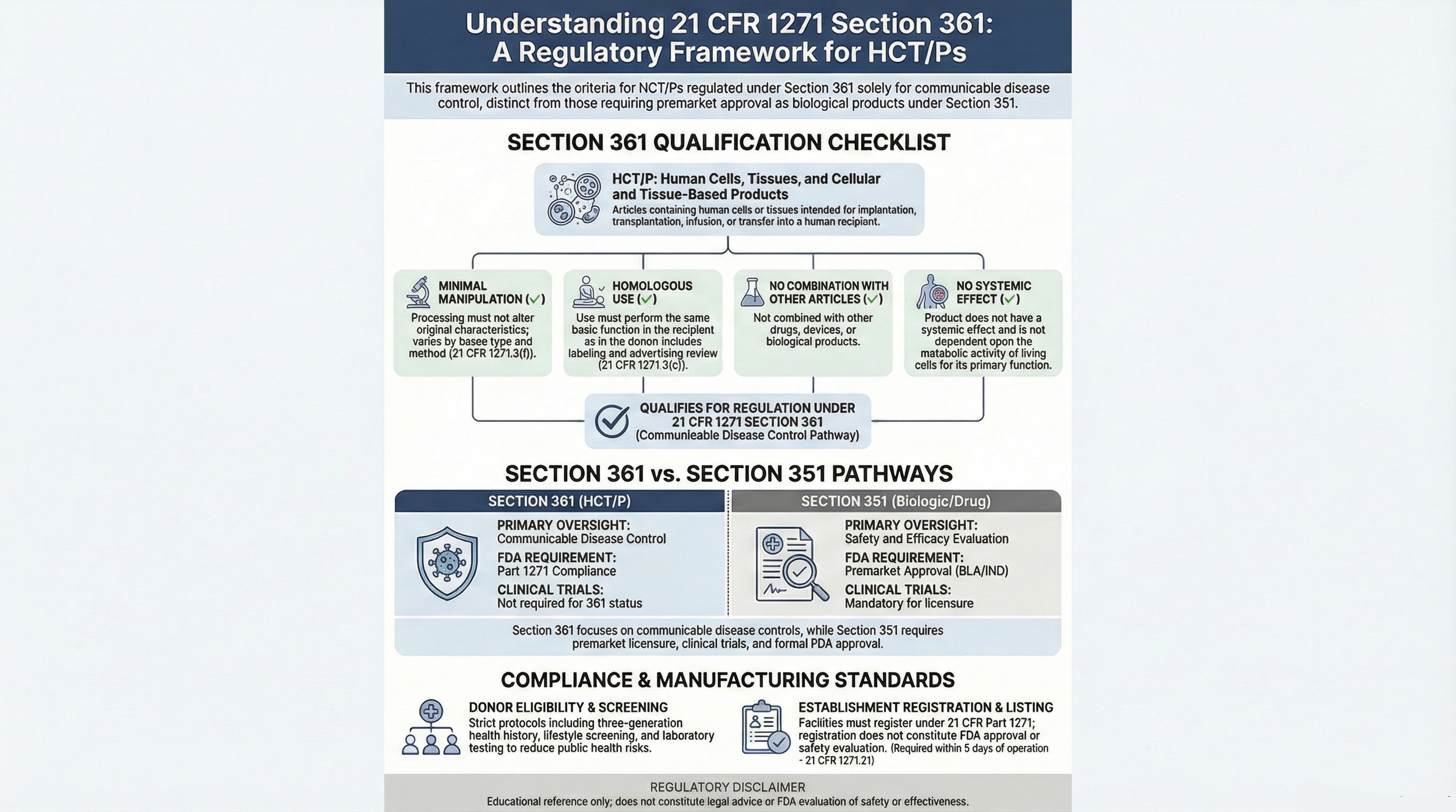
Section 361 refers to Section 361 of the Public Health Service Act, which provides federal authority for regulations intended to help prevent the introduction, transmission, and spread of communicable diseases. For qualifying Human Cells, Tissues, and Cellular and Tissue-Based Products (HCT/Ps), this statutory authority serves as the legal foundation for the FDA regulatory framework established within 21 CFR Part 1271.
Section 361 itself does not contain the detailed operational requirements governing HCT/Ps. Instead, it provides the statutory authority under which the Food and Drug Administration (FDA) established the regulations contained within 21 CFR Part 1271. Those regulations define the qualification criteria, donor eligibility requirements, establishment registration requirements, Current Good Tissue Practice (cGTP), and other safeguards that apply to qualifying HCT/Ps.
Understanding the relationship between the statute and the regulations is essential. The Public Health Service Act provides the legal authority, while 21 CFR Part 1271 establishes the detailed regulatory framework used to implement that authority. Throughout this guide, references to a Section 361 HCT/P should therefore be understood within the context of both the statute and the FDA regulations that implement it.
21 CFR Part 1271
21 CFR Part 1271 establishes the federal regulatory framework governing certain Human Cells, Tissues, and Cellular and Tissue-Based Products (HCT/Ps). The regulation addresses multiple areas of regulatory oversight, including establishment registration, donor eligibility, Current Good Tissue Practice (cGTP), recordkeeping, labeling, reporting, and the qualification criteria commonly associated with Section 361 HCT/Ps.
Rather than focusing on a single requirement, Part 1271 establishes an integrated regulatory system intended to reduce communicable disease risks while providing a consistent regulatory framework for qualifying HCT/Ps. Each component supports the others, and no single provision should be interpreted in isolation.
One of the most frequently discussed portions of Part 1271 is 21 CFR 1271.10(a), which establishes the applicable qualification criteria used when determining whether an HCT/P may be regulated solely under Section 361.
Qualification Criteria Under 21 CFR 1271.10(a)
Qualification under Section 361 depends upon evaluating the applicable criteria established in 21 CFR 1271.10(a). These criteria function together as a single regulatory framework. Meeting one criterion does not independently determine whether an HCT/P qualifies under Section 361.
Although the regulation contains specific legal language, the qualification framework is commonly understood through four primary regulatory concepts that appear throughout FDA educational materials and regulatory discussions.
The Four Primary Qualification Concepts
- Minimal Manipulation
- Homologous Use
- Combination With Another Article
- Systemic Effect or Dependence Upon the Metabolic Activity of Living Cells
These concepts are explained individually below. Together they form the core of the educational framework used throughout the Regulatory Foundations collection.
Minimal Manipulation
Minimal manipulation is one of the central regulatory concepts within 21 CFR Part 1271. The applicable regulatory definition depends upon whether the HCT/P is considered structural tissue or cells and nonstructural tissues. Because different regulatory definitions apply, evaluating minimal manipulation begins with understanding the type of tissue being assessed.
FDA regulations focus on whether processing alters the relevant characteristics identified within the applicable regulatory definition. As a result, discussions of minimal manipulation should always be grounded in the regulatory language rather than generalized descriptions of processing methods.
Educational Perspective
Minimal manipulation is a regulatory determination based upon the applicable definitions established within 21 CFR Part 1271. It is not determined by marketing terminology, commercial product descriptions, or scientific publications viewed independently.
Homologous Use
Homologous use evaluates whether an HCT/P is intended to perform the same basic function or functions in the recipient as it performed in the donor. Like minimal manipulation, homologous use represents one component of the broader qualification framework and should always be interpreted within the complete regulatory context.
Homologous use focuses on intended function rather than commercial descriptions or generalized biological properties. The FDA evaluates whether the HCT/P is intended to perform the same basic function or functions in the recipient as it performed in the donor, using the applicable regulatory definitions and guidance.
Like every other qualification criterion, homologous use should not be evaluated independently. An HCT/P that satisfies homologous use requirements must also satisfy the remaining applicable criteria established under 21 CFR 1271.10(a) before it may qualify under the Section 361 regulatory framework.
Why Homologous Use Is Frequently Misunderstood
Discussions of homologous use often become confused because scientific literature, marketing materials, and intended clinical applications may use similar terminology while referring to different concepts. Regulatory evaluation is based upon the applicable federal definitions rather than promotional language or isolated scientific observations.
Combination With Another Article
Another qualification criterion considers whether an HCT/P is combined with another article. The applicable regulation provides limited exceptions for certain substances whose purpose is limited to preserving, storing, or handling the HCT/P, provided those substances do not introduce new clinical safety concerns.
Because this determination depends upon the complete regulatory context, it should not be simplified into a single yes-or-no question. Instead, evaluation requires consideration of the applicable regulatory language together with the characteristics of the HCT/P being reviewed.
Understanding this criterion becomes particularly important when reviewing supplier documentation, product processing summaries, and technical specifications that describe how an HCT/P has been prepared prior to distribution.
Systemic Effect or Dependence Upon the Metabolic Activity of Living Cells
The final major qualification concept evaluates whether an HCT/P has a systemic effect or depends upon the metabolic activity of living cells for its primary function, except under the circumstances specifically described within the regulation. Like the other qualification criteria, this requirement is evaluated within the complete regulatory framework rather than in isolation.
Educational discussions frequently oversimplify this concept by treating it as a stand-alone test. In practice, FDA evaluates the complete regulatory framework together with the characteristics of the HCT/P and its intended use.
Understanding how these four qualification concepts interact provides a stronger foundation for interpreting supplier documentation than attempting to evaluate any individual criterion independently.
Donor Eligibility
Donor eligibility requirements represent another essential component of the HCT/P regulatory framework. These requirements are intended to reduce the risk of transmitting communicable diseases through appropriate donor screening, donor testing, review of relevant medical records, and formal donor eligibility determinations where applicable.
Donor eligibility documentation commonly includes screening questionnaires, laboratory testing, medical history reviews, recovery documentation, and donor eligibility determinations. Together these records help establish traceability and documentation transparency throughout the HCT/P recovery process.
Documentation Perspective
Donor eligibility documentation should be viewed as one component of a comprehensive documentation package. While these records are important for regulatory transparency, they do not independently determine whether an HCT/P qualifies under Section 361.
FDA Establishment Registration
Organizations performing certain activities involving HCT/Ps may be subject to FDA establishment registration and listing requirements under 21 CFR Part 1271. Registration enables FDA oversight of regulated establishments and supports the broader regulatory framework established for qualifying HCT/Ps.
One of the most common misconceptions encountered throughout the regenerative medicine industry is confusing establishment registration with FDA approval. These concepts are fundamentally different and should never be used interchangeably.
Important Distinction
FDA Establishment Registration does not constitute FDA approval, product clearance, product licensing, or confirmation that any individual HCT/P qualifies under Section 361.
Registration identifies an establishment to FDA under the applicable regulations. Regulatory classification depends upon the complete statutory and regulatory framework—not registration status alone.
Current Good Tissue Practice (cGTP)
Current Good Tissue Practice (cGTP) establishes manufacturing requirements intended to help prevent the introduction, transmission, and spread of communicable diseases associated with Human Cells, Tissues, and Cellular and Tissue-Based Products (HCT/Ps). These requirements address quality systems, facilities, environmental controls, equipment, processing controls, storage, labeling, distribution, complaint files, and recordkeeping.
While cGTP is an essential component of the overall HCT/P regulatory framework, it serves a different purpose than the qualification criteria contained within 21 CFR 1271.10(a). Qualification determines the applicable regulatory pathway, whereas cGTP establishes operational requirements designed to support communicable disease control throughout manufacturing and distribution activities.
Organizations reviewing supplier documentation often evaluate cGTP-related documentation alongside donor eligibility records, establishment registration information, and product-specific documentation to better understand manufacturing quality systems and documentation transparency.
Educational Perspective
Compliance with Current Good Tissue Practice requirements should not be interpreted as independently determining whether an HCT/P qualifies under Section 361. Qualification and manufacturing compliance represent different components of the overall regulatory framework.
Read the complete guide to Current Good Tissue Practice (cGTP) →
Section 361 vs. Section 351
Section 361 and Section 351 represent different regulatory pathways established under the Public Health Service Act. Whether an HCT/P falls within one regulatory pathway or another depends upon the applicable statutes, regulations, FDA guidance, intended use, and the characteristics of the specific product being evaluated.
Products that satisfy the applicable qualification criteria established under 21 CFR 1271.10(a) may be regulated solely under Section 361. Products that do not satisfy those applicable criteria may instead be regulated under other applicable statutory authorities, including Section 351, depending upon the complete regulatory evaluation.
Educational discussions should avoid reducing this distinction to simplified marketing statements. Regulatory classification requires careful evaluation of the applicable legal framework rather than reliance upon isolated documentation, scientific publications, or commercial product descriptions.
Comparison Overview
- Section 361 focuses on the regulatory framework applicable to qualifying HCT/Ps under 21 CFR Part 1271.
- Qualification depends upon satisfying the applicable criteria established under 21 CFR 1271.10(a).
- Products that do not satisfy those criteria may be regulated under different FDA authorities, including Section 351 where applicable.
- Regulatory classification should always be evaluated within the complete statutory and regulatory framework.
Explore the complete comparison of Section 361 and Section 351 →
Documentation Evaluation
One of the primary goals of the Not By Chance Life Knowledge Center is to improve documentation literacy. Understanding the Section 361 regulatory framework allows providers and healthcare organizations to evaluate documentation more consistently while recognizing the purpose and limitations of individual documents.
A comprehensive documentation review may include establishment registration information, donor eligibility documentation, processing summaries, quality system information, certificates, product specifications, traceability records, and other supporting materials. No individual document independently determines regulatory status. Instead, documentation should be interpreted collectively within the applicable federal regulatory framework.
This documentation-first approach encourages readers to distinguish between regulatory requirements, supplier documentation, scientific evidence, and educational interpretation rather than relying on isolated claims or promotional materials.
The Documentation-First Approach
Understanding regulations comes first. Documentation is then evaluated within that regulatory framework. Scientific literature provides additional educational context but should not be used as a substitute for the applicable statutes, regulations, or FDA guidance.
Scientific Literature and Regulatory Interpretation
Peer-reviewed scientific literature plays an important role in improving scientific literacy and understanding tissue biology, preservation science, extracellular matrix biology, cell signaling, and related research. Throughout the Not By Chance Life Knowledge Center, scientific publications are presented as educational resources intended to strengthen scientific understanding.
Scientific publications, however, do not independently determine regulatory classification. Regulatory status is established through the applicable statutes, regulations, FDA guidance, intended use, and the characteristics of the specific HCT/P being evaluated. Scientific evidence should therefore be interpreted alongside—not in place of—the applicable regulatory framework.
This distinction is fundamental to maintaining a documentation-first educational approach and reflects the separation between the three educational pillars of the Knowledge Center: Regulatory Foundations, Supplier Documentation, and Scientific Education.
Common Misconceptions
Misunderstandings surrounding Section 361 HCT/Ps often arise when regulatory concepts, supplier documentation, scientific literature, and marketing language are treated as though they serve the same purpose. They do not. Each provides a different type of information and should be interpreted within its appropriate context.
- FDA establishment registration is not FDA approval.
- Scientific publications do not determine regulatory classification.
- Supplier documentation alone does not establish compliance.
- Minimal manipulation is not determined solely by the type of processing performed.
- Homologous use is evaluated using applicable regulatory definitions rather than promotional language.
- No single qualification criterion independently determines whether an HCT/P qualifies under Section 361.
Frequently Asked Questions
What is a Section 361 HCT/P?
A Section 361 HCT/P is a Human Cell, Tissue, or Cellular and Tissue-Based Product that satisfies the applicable qualification criteria established under 21 CFR 1271.10(a). Products meeting those applicable criteria may be regulated solely under Section 361 of the Public Health Service Act.
Does FDA establishment registration mean FDA approval?
No. FDA establishment registration identifies an establishment to FDA under the applicable regulations. It does not constitute FDA approval, product clearance, product licensing, or confirmation that any individual HCT/P qualifies under Section 361.
What determines whether an HCT/P qualifies under Section 361?
Qualification depends upon evaluating the applicable regulatory framework established under 21 CFR Part 1271, including the qualification criteria contained within 21 CFR 1271.10(a), together with other applicable regulatory requirements.
Does scientific literature determine regulatory classification?
No. Scientific literature provides educational context regarding biology and tissue science but does not independently determine regulatory classification. Regulatory status depends upon the applicable statutes, regulations, FDA guidance, intended use, and the characteristics of the HCT/P being evaluated.
Why is supplier documentation important?
Supplier documentation improves transparency and supports documentation review. However, no individual document independently determines regulatory status. Documentation should always be interpreted within the complete federal regulatory framework.
Continue Learning
Section 361 represents only one portion of the broader federal regulatory framework governing Human Cells, Tissues, and Cellular and Tissue-Based Products (HCT/Ps). The following educational resources expand upon the concepts introduced throughout this guide.
- 21 CFR Part 1271 Explained
- 21 CFR 1271.10(a) Qualification Criteria
- Minimal Manipulation
- Homologous Use
- Structural vs. Cellular Tissue
- Current Good Tissue Practice (cGTP)
- Donor Eligibility
- Section 361 vs. Section 351
- Supplier Evaluation Process
- HCT/P Documentation Checklist
- Documentation Transparency
- Scientific Education Collection
- Knowledge Center Resources
Primary Regulatory Sources
This educational resource is based on publicly available federal regulatory materials and is intended to improve understanding of the regulatory framework governing certain Human Cells, Tissues, and Cellular and Tissue-Based Products (HCT/Ps).
- Public Health Service Act — Section 361
- 21 CFR Part 1271 — Human Cells, Tissues, and Cellular and Tissue-Based Products
- FDA Guidance Documents relating to HCT/Ps
- FDA Current Good Tissue Practice (cGTP) regulations
- FDA Donor Eligibility Requirements applicable to HCT/Ps
Readers should consult the complete regulatory text and applicable FDA guidance when performing regulatory evaluations.
Regulatory Notice
This page is intended solely for educational purposes. It explains federal regulatory concepts associated with certain Human Cells, Tissues, and Cellular and Tissue-Based Products (HCT/Ps) and should not be interpreted as legal advice, regulatory consulting, medical advice, or clinical guidance.
Regulatory classification depends upon the applicable statutes, regulations, FDA guidance, intended use, and the specific characteristics of the HCT/P being evaluated. References to supplier documentation, scientific literature, or FDA establishment registration should always be interpreted within their appropriate regulatory context.
Educational Disclaimer
Not By Chance Life is a documentation-first educational platform dedicated to improving regulatory literacy, scientific literacy, and documentation transparency related to Human Cells, Tissues, and Cellular and Tissue-Based Products (HCT/Ps).
Nothing contained within this educational resource should be interpreted as medical advice, legal advice, regulatory consulting, product endorsement, or a determination regarding the regulatory status of any specific product. Scientific publications are presented as educational resources only and do not independently determine regulatory classification.
FDA establishment registration does not constitute FDA approval, product clearance, product licensing, or confirmation that an individual HCT/P qualifies under Section 361. Healthcare professionals should independently evaluate applicable statutes, regulations, FDA guidance, and product-specific documentation before making procurement or clinical decisions.