

HCT/P Documentation Glossary
Understanding the terminology used throughout Human Cells, Tissues, and Cellular and Tissue-Based Products (HCT/Ps) is essential for interpreting supplier documentation, FDA regulatory references, and educational resources related to 21 CFR Part 1271. This glossary serves as the central terminology reference for the Not By Chance Life Knowledge Center, providing concise educational definitions together with regulatory context and direct links to more comprehensive educational resources.
Rather than functioning as a simple dictionary, this glossary explains why each term matters during documentation review. Every definition is placed within the broader regulatory framework governing HCT/Ps while reinforcing how terminology relates to donor eligibility, documentation transparency, traceability, Current Good Tissue Practice (cGTP), supplier evaluation, and structured documentation review.
Whether you are reviewing supplier documentation for the first time or using this page as a professional reference, the goal is to improve regulatory literacy through clear, consistent terminology grounded in publicly available FDA regulations and educational guidance.
HCT/P Regulatory & Documentation Overview
The infographic below summarizes many of the regulatory and documentation concepts defined throughout this glossary. It illustrates how regulatory terminology, donor documentation, quality systems, processing records, and supplier documentation work together during a structured HCT/P documentation review.
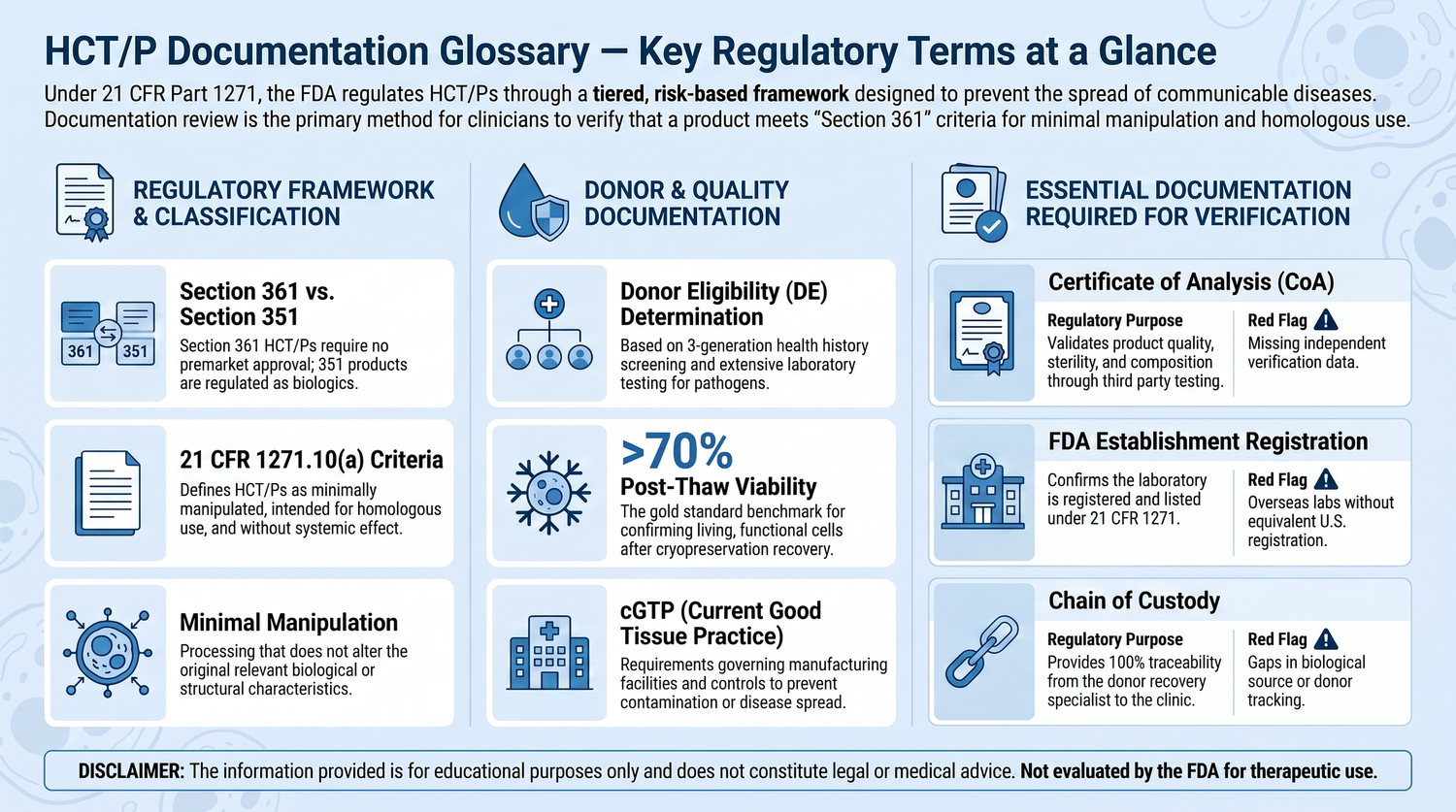
This infographic is provided for educational purposes and summarizes terminology discussed throughout publicly available FDA regulations, guidance documents, and the Not By Chance Life Knowledge Center.
Start Here — Ten Foundational Terms
If you are new to HCT/P regulatory education, begin with these ten foundational concepts before exploring the complete glossary. Together they establish the terminology used throughout supplier documentation, FDA regulations, and the educational resources within the Knowledge Center.
Once these concepts are understood, the remaining glossary entries become significantly easier to interpret because many regulatory and documentation terms build upon these foundational principles.
How to Use This Glossary
This glossary is designed to function as both an educational learning resource and a professional reference guide. Rather than presenting isolated definitions, each term is explained within the broader context of Human Cells, Tissues, and Cellular and Tissue-Based Products (HCT/Ps), supplier documentation, and the FDA regulatory framework established under 21 CFR Part 1271.
Every glossary entry follows the same structure to help readers move beyond memorizing definitions and toward understanding how regulatory terminology fits into a structured documentation review.
- Definition — A concise explanation of the term.
- Why It Matters — Why the concept is important during supplier documentation review.
- Common Misconception — Clarification of frequently misunderstood regulatory concepts, where applicable.
- Related Terms — Additional concepts that expand understanding of the topic.
- Learn More — Direct links to comprehensive educational resources throughout the Knowledge Center.
Using the glossary in this format allows it to serve as more than a dictionary—it becomes the central terminology reference supporting every regulatory education page throughout the Not By Chance Life Knowledge Center.
Documentation Review Learning Path
Healthcare professionals new to HCT/P regulatory education often encounter unfamiliar terminology while reviewing supplier documentation. The learning pathway below follows the same progression used throughout the Knowledge Center and provides a structured approach for understanding documentation within the broader regulatory framework.
-
Understand the Regulatory Framework
Begin with Section 361, 21 CFR Part 1271, and 21 CFR 1271.10(a). -
Learn the Classification Concepts
Study Minimal Manipulation, Homologous Use, and Section 361 vs. Section 351. -
Review Donor Documentation
Understand Donor Eligibility, donor screening, chain of custody, and traceability documentation. -
Review Quality & Processing Documentation
Become familiar with Certificates of Analysis, Current Good Tissue Practice (cGTP), quality systems, validation, and Standard Operating Procedures. -
Apply These Concepts During Supplier Evaluation
Complete the educational pathway using the Supplier Documentation Evaluation Framework, Documentation Checklist, Documentation Comparison Guide, and Common Documentation Review Mistakes.
Following this progression helps readers understand how individual documents fit within a complete supplier documentation package rather than viewing regulatory terminology in isolation.
Regulatory Framework Terminology
21 CFR Part 1271
Definition
Title 21, Code of Federal Regulations, Part 1271 establishes the federal regulatory framework governing Human Cells, Tissues, and Cellular and Tissue-Based Products (HCT/Ps). It includes provisions addressing establishment registration, donor eligibility, Current Good Tissue Practice (cGTP), and other regulatory requirements applicable to certain HCT/Ps.
Why It Matters
Many supplier documentation packages reference 21 CFR Part 1271 because it provides the regulatory framework surrounding donor documentation, quality systems, manufacturing practices, and documentation requirements. Understanding these references improves interpretation of supplier documentation and strengthens overall regulatory literacy.
Common Misconception
21 CFR Part 1271 is frequently mistaken for a product approval pathway. It establishes a regulatory framework governing certain HCT/P activities and should not be interpreted as FDA approval of individual products.
Related Terms
Section 361 • 21 CFR 1271.10(a) • cGTP • Donor Eligibility • HCT/P
Learn More
21 CFR 1271.10(a)
Definition
21 CFR 1271.10(a) establishes the regulatory criteria used to determine whether certain Human Cells, Tissues, and Cellular and Tissue-Based Products (HCT/Ps) may be regulated solely under Section 361 of the Public Health Service Act and 21 CFR Part 1271. The regulation outlines criteria related to minimal manipulation, homologous use, combination with other articles, and systemic effect or metabolic activity.
Why It Matters
Supplier documentation frequently references these criteria because they provide important context for understanding regulatory classification. During documentation review, healthcare professionals should evaluate how documentation addresses these concepts rather than relying on summaries or marketing language.
Common Misconception
Meeting a single criterion does not independently determine regulatory status. The criteria are considered collectively within the applicable regulatory framework.
Related Terms
21 CFR Part 1271 • Section 361 • Minimal Manipulation • Homologous Use
Learn More
21 CFR 1271.10(a) Classification Criteria →
Section 361
Definition
Section 361 of the Public Health Service Act provides statutory authority for regulations intended to help prevent the introduction, transmission, and spread of communicable disease. Within HCT/P regulatory education, it is closely associated with 21 CFR Part 1271 because the regulations implemented under this authority govern many aspects of HCT/P oversight.
Why It Matters
Section 361 is one of the most frequently referenced concepts throughout supplier documentation and FDA educational materials. Understanding its purpose helps healthcare professionals interpret documentation within the appropriate regulatory context.
Common Misconception
Section 361 should not be interpreted as FDA approval or product authorization. It provides statutory authority supporting portions of the HCT/P regulatory framework.
Related Terms
21 CFR Part 1271 • Section 351 • 21 CFR 1271.10(a)
Learn More
Section 351
Definition
Section 351 of the Public Health Service Act establishes the statutory framework governing biological products. Within HCT/P regulatory education, it is commonly discussed alongside Section 361 to explain the distinctions between different regulatory pathways.
Why It Matters
Understanding the relationship between Section 351 and Section 361 helps readers interpret supplier documentation and regulatory terminology without confusing separate statutory frameworks.
Common Misconception
Section 361 and Section 351 are not competing classifications. They represent different legal frameworks that may apply under different regulatory circumstances.
Related Terms
Section 361 • 21 CFR Part 1271 • Biologics
Learn More
Human Cells, Tissues, and Cellular and Tissue-Based Products (HCT/Ps)
Definition
Human Cells, Tissues, and Cellular and Tissue-Based Products (HCT/Ps) are defined within FDA regulations as human cells or tissues intended for implantation, transplantation, infusion, or transfer into a human recipient, subject to applicable regulatory definitions and exclusions. The term appears throughout FDA regulations, guidance documents, and supplier documentation.
Why It Matters
Understanding the meaning of HCT/P is fundamental because virtually every document discussed throughout the Knowledge Center—including donor eligibility records, processing documentation, quality records, and regulatory references—relates to this regulatory category.
Common Misconception
HCT/P is a broad regulatory category rather than a specific product type. Different HCT/Ps may be subject to different regulatory requirements depending on their characteristics and intended use.
Related Terms
21 CFR Part 1271 • Section 361 • Donor Eligibility • Current Good Tissue Practice (cGTP)
Learn More
Donor Documentation Terminology
Donor Eligibility
Definition
Donor eligibility is the documented determination that a donor meets applicable regulatory requirements for donation based on donor screening, review of relevant medical records, communicable disease testing, and other evaluations required under applicable portions of 21 CFR Part 1271.
Why It Matters
Donor eligibility documentation is one of the foundational components of supplier documentation. Understanding how donor qualification is documented helps healthcare professionals interpret documentation packages more effectively while supporting documentation transparency and regulatory literacy.
Common Misconception
Donor eligibility documentation alone does not provide a complete understanding of an HCT/P. It should always be reviewed alongside processing documentation, traceability records, Certificates of Analysis, quality documentation, and other supporting materials.
Related Terms
Donor Screening • Relevant Medical Records • Traceability • Chain of Custody
Learn More
Donor Eligibility Under 21 CFR Part 1271 →
Donor Screening
Definition
Donor screening is the documented evaluation of donor suitability using medical history, behavioral risk assessment, relevant medical records, and other information required under applicable FDA regulations. Screening helps determine whether additional evaluation or testing is necessary during donor eligibility determination.
Why It Matters
Supplier documentation frequently references donor screening because it represents an important step in the donor qualification process. Understanding its purpose helps readers better interpret donor eligibility documentation within the broader regulatory framework.
Common Misconception
Donor screening and donor eligibility are not interchangeable terms. Screening is one component of the broader donor eligibility determination process.
Related Terms
Donor Eligibility • Relevant Medical Records • Communicable Disease Testing
Learn More
Donor Screening & Traceability →
Chain of Custody
Definition
Chain of custody documents the movement and handling of human tissue from donor recovery through processing, storage, distribution, and final delivery. These records establish documented accountability throughout the lifecycle of the tissue.
Why It Matters
Maintaining documented chain of custody supports accountability and provides important context when reviewing supplier documentation. These records demonstrate how products remain associated with their documented history throughout processing and distribution.
Common Misconception
Chain of custody is often confused with traceability. Although closely related, chain of custody documents physical possession and transfer events, while traceability links records throughout the documented lifecycle of an HCT/P.
Related Terms
Traceability • Lot Number • Documentation Transparency
Learn More
Chain of Custody & Tissue Traceability →
Traceability
Definition
Traceability refers to the ability to connect donor information, processing records, product identification, distribution history, and supporting documentation throughout the lifecycle of an HCT/P. Effective traceability supports documentation continuity and facilitates retrieval of records when appropriate.
Why It Matters
Traceability is a core principle of documentation transparency. Understanding traceability helps healthcare professionals recognize how multiple documents work together to create a complete documentation package rather than functioning as isolated records.
Common Misconception
Traceability extends beyond shipping records. It encompasses the documented relationship between donor records, processing records, quality documentation, storage records, and distribution history.
Related Terms
Chain of Custody • Donor Eligibility • Documentation Transparency • Lot Number
Learn More
Quality & Processing Terminology
Certificate of Analysis (COA)
Definition
A Certificate of Analysis (COA) is a technical document that summarizes information associated with a specific manufacturing lot. Depending on the product and manufacturer, a COA may include analytical testing results, product specifications, lot identification, storage information, or other documented characteristics.
Why It Matters
Certificates of Analysis are frequently included within supplier documentation packages. Understanding what a COA represents—and equally important, what it does not represent—helps place the document within the broader context of supplier documentation.
Common Misconception
A Certificate of Analysis is not the complete regulatory record for a product. It represents one component of a comprehensive documentation package that may also include donor documentation, processing records, quality documentation, and traceability records.
Related Terms
Certificate of Conformance • Quality System • Lot Number • Documentation Package
Learn More
Certificate of Conformance (CoC)
Definition
A Certificate of Conformance (CoC) is documentation provided by a manufacturer stating that a product or manufacturing lot conforms to specified manufacturing, quality, or release requirements. Unlike a Certificate of Analysis, which typically summarizes analytical or testing information, a Certificate of Conformance documents conformity with predetermined specifications or quality standards established by the manufacturer.
Why It Matters
Healthcare professionals reviewing supplier documentation may encounter both Certificates of Analysis and Certificates of Conformance. Understanding the distinction between these documents helps reviewers recognize that each serves a different purpose within the overall documentation package.
Common Misconception
A Certificate of Conformance is not a replacement for donor eligibility documentation, processing records, or analytical testing. It should be interpreted as one component of a complete documentation package.
Related Terms
Certificate of Analysis • Quality System • Documentation Package
Learn More
Comparing HCT/P Supplier Documentation →
Current Good Tissue Practice (cGTP)
Definition
Current Good Tissue Practice (cGTP) refers to the quality system requirements established under Subpart D of 21 CFR Part 1271. These requirements address manufacturing controls, environmental conditions, labeling, storage, recordkeeping, complaint handling, and other operational activities intended to help prevent the introduction, transmission, and spread of communicable disease.
Why It Matters
Supplier documentation frequently references cGTP because it provides the operational framework supporting manufacturing quality systems and documentation practices. Understanding cGTP helps readers interpret quality documentation within its proper regulatory context.
Common Misconception
Current Good Tissue Practice does not evaluate clinical outcomes or product effectiveness. Instead, it establishes manufacturing and documentation requirements intended to support quality and communicable disease control.
Related Terms
Quality System • Standard Operating Procedure • Validation • Documentation Transparency
Learn More
Current Good Tissue Practice (cGTP) →
Quality System
Definition
A quality system consists of documented policies, procedures, operational controls, and records that support consistent manufacturing activities and documentation practices. Within supplier documentation, quality systems may include standard operating procedures, validation records, personnel training, document control, corrective actions, and quality assurance activities.
Why It Matters
Understanding quality systems helps reviewers appreciate how individual records fit within a broader framework of documented operational controls rather than functioning as isolated documents.
Related Terms
Current Good Tissue Practice (cGTP) • Validation • Standard Operating Procedure • Documentation Package
Validation
Definition
Validation refers to documented activities demonstrating that specified processes, equipment, systems, or procedures consistently perform as intended according to predetermined acceptance criteria. Validation records may be included within supplier documentation to support manufacturing processes and quality systems.
Why It Matters
Validation documentation provides additional context regarding manufacturing consistency and documented quality controls. During documentation review, these records should be interpreted alongside other supporting documentation.
Related Terms
Quality System • Current Good Tissue Practice (cGTP) • Standard Operating Procedure
Standard Operating Procedure (SOP)
Definition
A Standard Operating Procedure (SOP) is a written document describing how specific operational activities are performed consistently within an organization. SOPs are fundamental components of quality systems because they promote standardized processes, operational consistency, and controlled documentation practices.
Why It Matters
Healthcare professionals reviewing supplier documentation may encounter references to SOPs within quality documentation or manufacturing records. Their presence helps demonstrate documented operational processes within a tissue establishment.
Related Terms
Quality System • Validation • Current Good Tissue Practice (cGTP)
Frequently Confused Regulatory Terms
Many regulatory concepts appear similar but serve different purposes within HCT/P documentation. Understanding these distinctions can improve documentation review and reduce common misunderstandings.
- Section 361 vs. Section 351
Different statutory frameworks that govern different regulatory pathways. Learn more → - FDA Establishment Registration vs. FDA Approval
Registration identifies an establishment with the FDA. It does not constitute FDA approval, clearance, certification, or endorsement. - Certificate of Analysis vs. Certificate of Conformance
A Certificate of Analysis summarizes analytical or testing information, while a Certificate of Conformance documents conformity with specified manufacturing or quality requirements. - Chain of Custody vs. Traceability
Chain of custody documents physical possession and transfer of tissue. Traceability connects documentation throughout the lifecycle of an HCT/P. - Donor Screening vs. Donor Eligibility
Donor screening is one component of the broader donor eligibility determination process. - Minimal Manipulation vs. Processing
Processing describes manufacturing activities, while minimal manipulation is a defined regulatory concept used during HCT/P classification.
Continue Building Your Regulatory Knowledge
The glossary introduces terminology commonly encountered during supplier documentation review, but many concepts warrant more detailed discussion. The educational resources below expand on these definitions and explain how they fit within the broader HCT/P regulatory framework established under 21 CFR Part 1271.
Supplier Documentation Knowledge Center
- HCT/P Supplier Documentation Evaluation Framework
- HCT/P Supplier Documentation Checklist
- Documentation Transparency for HCT/Ps
- Requesting HCT/P Supplier Documentation
- Questions to Ask an HCT/P Supplier
- Comparing HCT/P Supplier Documentation
- Common HCT/P Documentation Review Mistakes
- HCT/P Documentation FAQ
- Complete Regulatory Resource Library
Core Regulatory Education
Professional Documentation Resources
Not By Chance Life provides educational resources intended to improve understanding of HCT/P regulatory terminology, supplier documentation, documentation transparency, and structured documentation evaluation. These materials are based on publicly available FDA regulations, guidance documents, and educational references and are designed to support informed regulatory review by licensed healthcare professionals.
Healthcare professionals seeking additional educational resources, documentation guidance, or access to manufacturer documentation may continue through the Knowledge Center or request provider-specific educational materials following credential verification.
Regulatory & Compliance Notice
This glossary is provided for educational purposes to improve understanding of terminology commonly encountered when reviewing Human Cells, Tissues, and Cellular and Tissue-Based Products (HCT/Ps) regulated under 21 CFR Part 1271. Definitions are intended to support regulatory literacy and documentation transparency and should be interpreted alongside publicly available FDA regulations, FDA guidance documents, and independent professional judgment.
References to FDA establishment registration, regulatory classifications, quality systems, or supplier documentation do not constitute FDA approval, product clearance, certification, endorsement, or a determination regarding product safety or effectiveness.
This information has not been evaluated by the U.S. Food and Drug Administration and is not intended to diagnose, treat, cure, or prevent any disease. It is provided for educational purposes only and is intended for licensed healthcare professionals and others seeking a better understanding of HCT/P regulatory terminology and documentation.