

21 CFR Part 1271 Subparts A–D — Understanding the Regulatory Structure
What are the Subparts of 21 CFR Part 1271?
The Subparts of 21 CFR Part 1271 organize the federal regulatory requirements governing many Human Cells, Tissues, and Cellular and Tissue-Based Products (HCT/Ps). Each Subpart addresses a different area of regulatory oversight, including definitions, establishment registration, donor eligibility, and Current Good Tissue Practice (cGTP).
In simple terms, the Subparts work together to establish the overall regulatory framework for many HCT/Ps regulated under 21 CFR Part 1271.
21 CFR Part 1271 provides the federal regulatory framework governing many Human Cells, Tissues, and Cellular and Tissue-Based Products (HCT/Ps). Rather than functioning as a single regulation, Part 1271 is organized into multiple Subparts that establish different regulatory responsibilities for tissue establishments, manufacturers, and healthcare professionals involved in the recovery, processing, storage, labeling, distribution, and documentation of HCT/Ps.
Together, these Subparts define regulatory concepts, establishment registration requirements, donor eligibility safeguards, and Current Good Tissue Practice (cGTP) requirements intended to reduce the risk of communicable disease transmission while supporting documentation integrity and regulatory oversight.
Understanding how these Subparts work together helps healthcare professionals interpret supplier documentation within the broader HCT/P regulatory framework rather than viewing individual regulatory requirements in isolation.
For a structured overview showing how the individual Subparts fit within the complete regulatory review process, see the HCT/P Regulatory Evaluation Pathway .
Documentation and Regulatory Education
Not sure how these regulatory requirements fit into your supplier evaluation or documentation review process?
Licensed healthcare professionals and healthcare organizations may request educational materials discussing regulatory structure, supplier documentation, donor eligibility, Current Good Tissue Practice (cGTP), and documentation transparency referenced throughout this educational resource.
Credential verification may be required before provider-specific educational materials are made available.
Request Regulatory Information
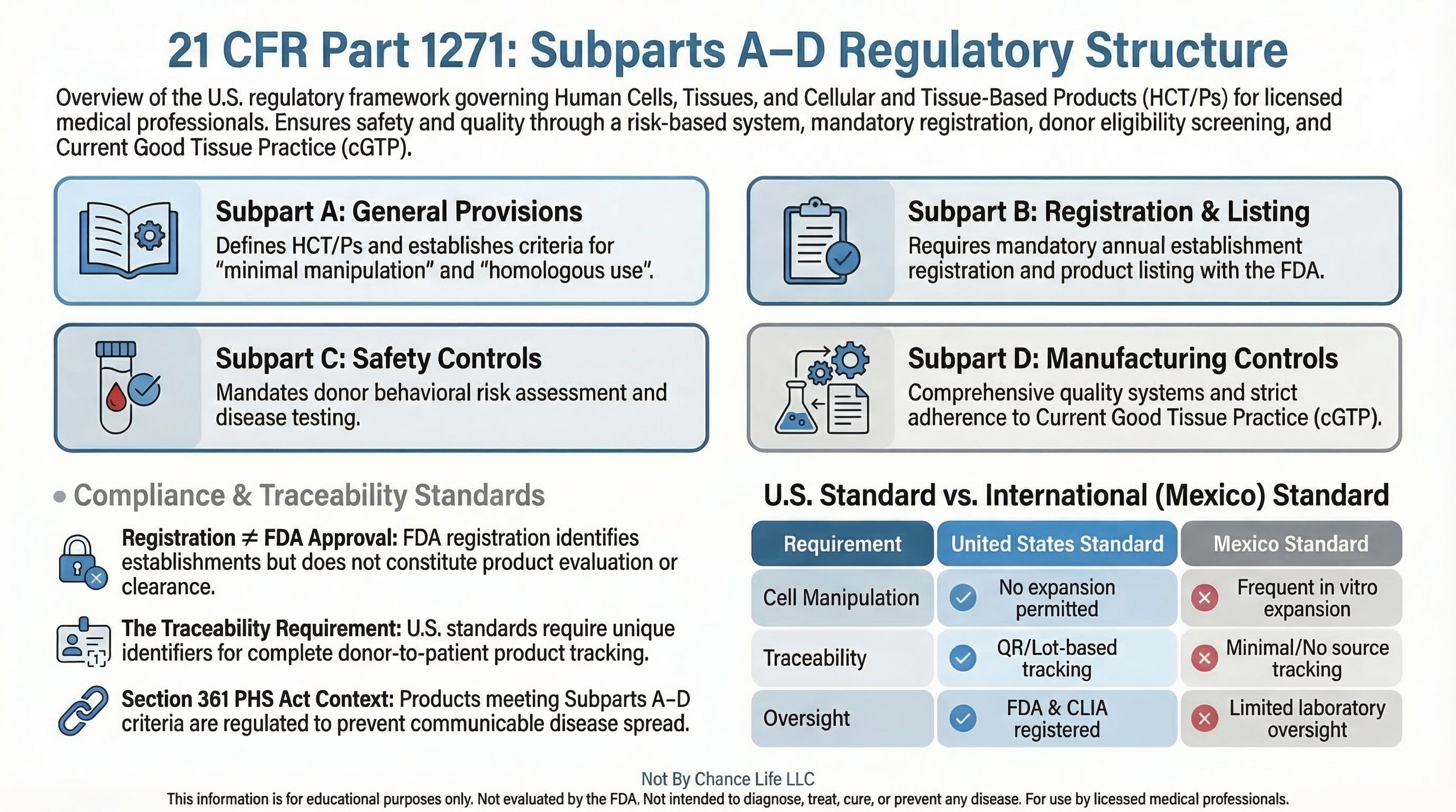
Overview of the Regulatory Framework
The federal regulatory framework established under 21 CFR Part 1271 is organized into four primary Subparts that collectively govern many Human Cells, Tissues, and Cellular and Tissue-Based Products (HCT/Ps). Rather than functioning independently, these Subparts work together to establish regulatory definitions, registration requirements, donor eligibility safeguards, and manufacturing quality requirements throughout the HCT/P lifecycle.
- Subpart A — General Provisions and Regulatory Definitions
- Subpart B — Establishment Registration and Product Listing
- Subpart C — Donor Eligibility Requirements
- Subpart D — Current Good Tissue Practice (cGTP)
These Subparts operate alongside the classification criteria established under 21 CFR 1271.10(a) , including minimal manipulation , homologous use , combination limitations, and systemic effect considerations.
Products that satisfy the applicable regulatory criteria may qualify for regulation under Section 361 of the Public Health Service Act.
Subpart A — General Provisions
Subpart A establishes the foundational regulatory definitions used throughout 21 CFR Part 1271. These definitions provide the terminology necessary to interpret the remainder of the regulation and serve as the basis for evaluating Human Cells, Tissues, and Cellular and Tissue-Based Products (HCT/Ps).
Several of the most frequently referenced concepts within the HCT/P regulatory framework originate in Subpart A, including definitions relating to minimal manipulation, homologous use, structural tissue, cellular or nonstructural tissue, and the classification criteria found in 21 CFR 1271.10(a).
- Definitions of Human Cells, Tissues, and Cellular and Tissue-Based Products (HCT/Ps)
- Minimal Manipulation (21 CFR 1271.3(f))
- Homologous Use (21 CFR 1271.3(c))
- Structural vs Cellular Tissue Classification
- 21 CFR 1271.10(a) Classification Criteria
Because many later regulatory requirements rely upon these definitions, understanding Subpart A provides an essential foundation before evaluating donor eligibility, manufacturing practices, or supplier documentation.
Subpart B — Establishment Registration and Listing
Subpart B establishes registration and listing requirements for certain establishments involved in the manufacture of Human Cells, Tissues, and Cellular and Tissue-Based Products (HCT/Ps). Registration helps the FDA identify regulated establishments and maintain information regarding applicable manufacturing activities.
Registration under 21 CFR Part 1271 is an administrative regulatory requirement. It should not be interpreted as FDA approval, product clearance, certification, endorsement, or a determination regarding clinical safety or effectiveness.
- FDA establishment registration
- HCT/P product listing
- Registration updates
- Reporting requirements
- Regulatory identification of tissue establishments
Additional information regarding establishment registration is available in: FDA Establishment Registration for HCT/Ps .
Subpart C — Donor Eligibility Determination
Subpart C establishes donor eligibility requirements intended to reduce the risk of communicable disease transmission associated with Human Cells, Tissues, and Cellular and Tissue-Based Products (HCT/Ps). These requirements apply donor screening, laboratory testing, and formal eligibility determinations before certain HCT/Ps may be distributed.
Donor eligibility represents one component of the broader regulatory framework established under 21 CFR Part 1271 and operates together with establishment registration, Current Good Tissue Practice (cGTP), and product classification requirements.
- Medical history review
- Behavioral risk assessment
- Communicable disease testing
- Formal donor eligibility determination
- Required documentation and record retention
A more detailed explanation is available in Donor Eligibility Requirements Under 21 CFR Part 1271 .
Subpart D — Current Good Tissue Practice (cGTP)
Subpart D establishes Current Good Tissue Practice (cGTP) requirements intended to prevent the introduction, transmission, or spread of communicable disease during the manufacture of Human Cells, Tissues, and Cellular and Tissue-Based Products (HCT/Ps).
Current Good Tissue Practice requirements address quality systems throughout recovery, processing, storage, labeling, packaging, distribution, and recordkeeping activities.
- Quality system controls
- Environmental controls
- Equipment qualification and maintenance
- Process validation where applicable
- Complaint investigation and corrective actions
- Deviation investigation
- Traceability and record retention
For a complete overview of these requirements, visit Current Good Tissue Practice (cGTP) .
For a structured overview showing how Current Good Tissue Practice fits within the complete regulatory review process, see the HCT/P Regulatory Evaluation Pathway .
How the Four Subparts Work Together
Although each Subpart addresses a different regulatory responsibility, they function together as an integrated regulatory framework for qualifying Human Cells, Tissues, and Cellular and Tissue-Based Products (HCT/Ps).
- Subpart A establishes regulatory definitions.
- Subpart B establishes establishment registration and product listing requirements.
- Subpart C establishes donor eligibility safeguards.
- Subpart D establishes Current Good Tissue Practice (cGTP) manufacturing controls.
These requirements work alongside the classification criteria found in 21 CFR 1271.10(a) to determine how qualifying HCT/Ps are regulated under the federal framework.
Related Regulatory Topics
Regulatory Notice
This information is provided for educational purposes only.
Registration under 21 CFR Part 1271 does not constitute FDA approval, clearance, or evaluation of safety or effectiveness.
Not evaluated by the FDA. Not intended to diagnose, treat, cure, or prevent any disease.
For use by licensed medical professionals.