

Scientific Glossary
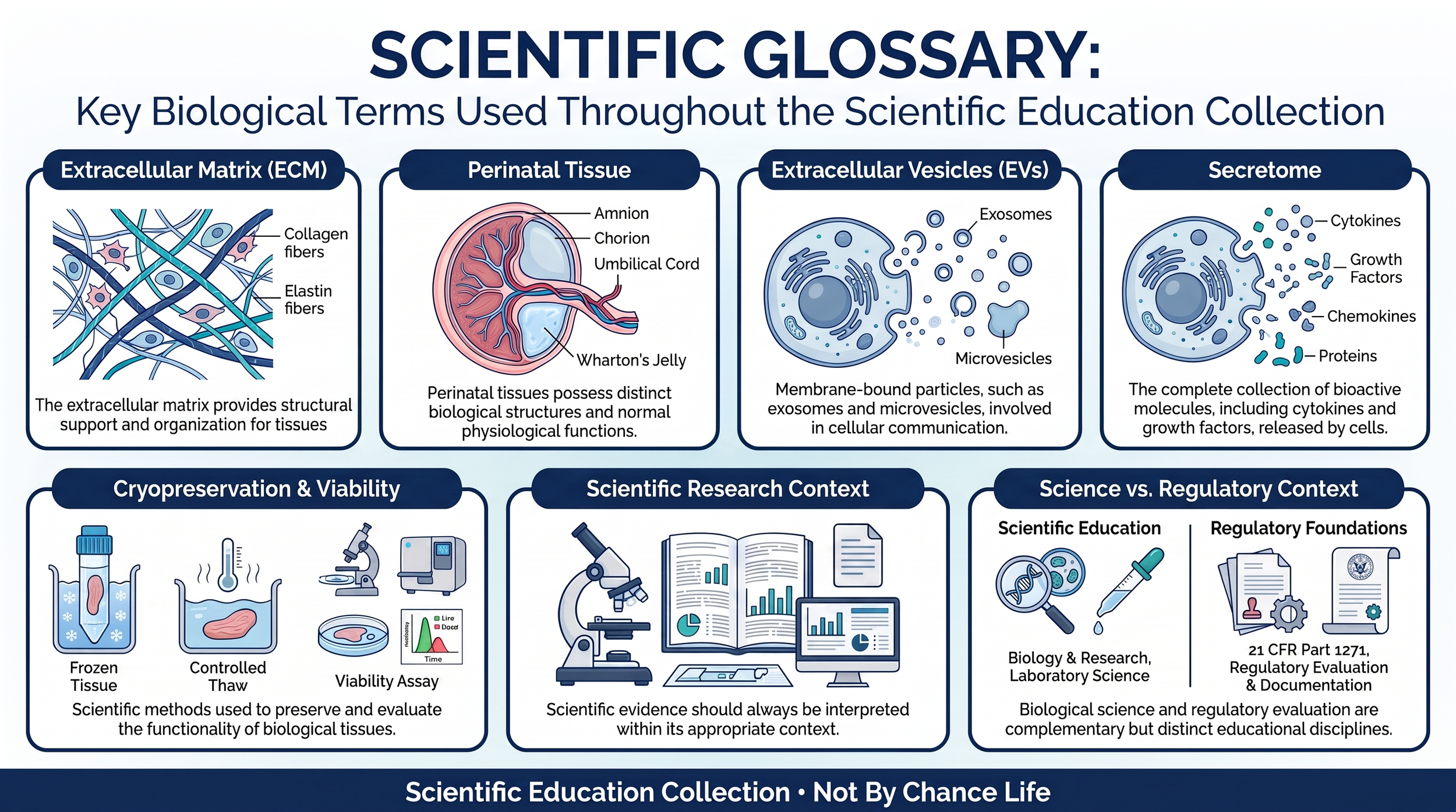
The Scientific Glossary provides concise educational definitions for the biological terminology used throughout the Not By Chance Life Scientific Education collection. These definitions are intended to strengthen scientific literacy by explaining commonly encountered terms related to extracellular matrix biology, perinatal tissue biology, extracellular vesicles, secretome biology, tissue preservation science, cell viability, cryobiology, and scientific research methodology.
Each glossary entry introduces a scientific concept while linking to the corresponding educational resource where readers can explore the topic in greater depth. Together, the glossary and the Scientific Education collection create an interconnected framework that supports responsible interpretation of scientific literature and a clearer understanding of the biological concepts frequently encountered throughout tissue science.
Scientific terminology presented throughout this glossary is provided exclusively for educational purposes. Definitions describe biological concepts as they are discussed within the scientific literature and should not be interpreted as regulatory conclusions, product-specific claims, clinical recommendations, or evidence of FDA authorization. Scientific education and regulatory evaluation are complementary but distinct disciplines that are addressed separately throughout the Knowledge Center.
Glossary of Scientific Terms
Apoptosis
A naturally regulated biological process through which cells undergo programmed cell death as part of normal development, tissue maintenance, and cellular turnover. Apoptosis differs from uncontrolled cell death because it occurs through organized molecular pathways that help maintain tissue homeostasis. See Cell Viability & Post-Thaw Assessment.
Bioactive Molecules
Naturally occurring biological substances that participate in cellular communication and biological processes. Examples include cytokines, chemokines, growth factors, proteins, lipids, and other signaling molecules discussed throughout the scientific literature. See Secretome Biology.
Cell Viability
A laboratory measurement describing the proportion of cells that remain biologically intact under defined analytical conditions. Cell viability is influenced by numerous biological and technical variables and should always be interpreted within the context of the specific laboratory methodology used. See Cell Viability & Post-Thaw Assessment.
Chemokines
A family of signaling proteins involved in directing the movement and communication of cells. Chemokines participate in numerous normal biological processes and represent one category of molecules commonly included within the cellular secretome. See Secretome Biology.
Collagen
The most abundant structural protein within the extracellular matrix. Collagen provides tensile strength and structural organization throughout connective tissues and serves as one of the principal components of the extracellular matrix. See Extracellular Matrix Biology.
Cryobiology
The scientific study of biological systems at low temperatures, including freezing, thawing, cryopreservation, and the biological effects of temperature on cells and tissues. See Tissue Preservation Science.
Cryopreservation
A scientific preservation method that stores biological tissues or cells at extremely low temperatures to reduce biological activity while maintaining measurable biological characteristics for future laboratory evaluation or appropriate scientific use. See Tissue Preservation Science.
Cytokines
Small signaling proteins involved in communication between cells. Cytokines participate in numerous normal biological processes and are frequently discussed within studies of tissue biology, immunology, and secretome research. See Secretome Biology.
Extracellular Matrix (ECM)
The complex structural network of proteins, glycoproteins, proteoglycans, and other extracellular components that provides physical support, organization, and biochemical signaling throughout tissues. See Extracellular Matrix Biology.
Extracellular Vesicles (EVs)
Membrane-bound particles naturally released by cells that participate in cellular communication through the transport of biological materials. Extracellular vesicles include several categories, including exosomes and microvesicles. See Extracellular Vesicle & Exosome Biology.
Exosomes
A subtype of extracellular vesicle formed within intracellular compartments before being released from cells. Exosomes are actively investigated throughout the scientific literature for their role in cellular communication and molecular transport. See Extracellular Vesicle & Exosome Biology.
Flow Cytometry
A laboratory analytical technique used to examine individual cells or particles by measuring physical and biological characteristics as they pass through a focused beam of light. Flow cytometry is widely used in scientific research to evaluate cell populations and viability. See Cell Viability & Post-Thaw Assessment.
Growth Factors
Naturally occurring signaling proteins that participate in normal biological communication between cells. Growth factors are frequently discussed throughout tissue biology and secretome research as components of complex biological signaling environments. See Secretome Biology.
Histology
The scientific study of the microscopic structure and organization of biological tissues. Histological evaluation helps researchers understand tissue architecture, cellular organization, and structural relationships within normal biological systems. See Placental & Perinatal Tissue Biology.
Homeostasis
The process by which biological systems maintain relatively stable internal conditions despite changes in the external environment. Homeostasis supports normal cellular function, tissue organization, and physiological balance. See Extracellular Matrix Biology.
Microvesicles
A category of extracellular vesicles formed through outward budding of the cellular membrane. Microvesicles represent one of several naturally occurring extracellular vesicle populations involved in cellular communication. See Extracellular Vesicle & Exosome Biology.
Microscopy
A collection of laboratory techniques used to visualize cells, tissues, and biological structures that cannot be observed with the unaided eye. Microscopy is widely used throughout tissue biology, histology, preservation science, and cell viability research. See Cell Viability & Post-Thaw Assessment.
Paracrine Signaling
A form of cellular communication in which signaling molecules released by one cell influence nearby cells within the surrounding tissue environment. Paracrine signaling represents one mechanism frequently discussed throughout secretome biology. See Secretome Biology.
Peer Review
The scientific evaluation of research by independent subject-matter experts before publication. Peer review helps assess study design, methodology, interpretation, and scientific quality while recognizing that scientific knowledge continues to evolve through ongoing investigation. See Reading Scientific Literature.
Perinatal Tissue
Biological tissues associated with pregnancy and birth, including the placenta, amnion, chorion, umbilical cord, and Wharton's Jelly. These tissues possess distinct anatomical structures and normal physiological functions that are widely studied throughout tissue biology. See Placental & Perinatal Tissue Biology.
Post-Thaw Assessment
Scientific laboratory evaluation performed after controlled thawing to examine measurable biological characteristics using standardized analytical methods. Post-thaw assessment may include cell viability testing, microscopy, biochemical analysis, and additional laboratory evaluations depending upon the objectives of the investigation. See Cell Viability & Post-Thaw Assessment.
Proteoglycans
Large extracellular matrix molecules composed of proteins linked to glycosaminoglycan chains. Proteoglycans contribute to tissue hydration, structural organization, and the physical properties of the extracellular matrix. See Extracellular Matrix Biology.
Scientific Literacy
The ability to locate, evaluate, interpret, and appropriately apply scientific information while understanding study design, evidence quality, methodology, statistical limitations, and the distinction between scientific findings and regulatory evaluation. See Reading Scientific Literature.
Secretome
The complete collection of biologically active molecules released by cells, including proteins, cytokines, chemokines, growth factors, lipids, extracellular vesicles, and other signaling molecules involved in cellular communication. See Secretome Biology.
Signal Transduction
The biological process through which cells receive, interpret, and respond to molecular signals. Signal transduction allows cells to communicate with one another and coordinate normal physiological activities. See Secretome Biology.
Tissue Integrity
The preservation of normal structural organization, extracellular matrix architecture, and measurable biological characteristics within a tissue. Tissue integrity is frequently evaluated throughout preservation science and laboratory research. See Tissue Preservation Science.
Viability Assay
A laboratory method used to evaluate specific biological characteristics associated with cell viability under defined analytical conditions. Different viability assays measure different biological properties and should be interpreted according to the methodology employed. See Cell Viability & Post-Thaw Assessment.
Wharton's Jelly
A specialized connective tissue located within the umbilical cord that surrounds and protects the umbilical blood vessels. Wharton's Jelly possesses a distinctive extracellular matrix composition and is frequently discussed throughout perinatal tissue biology. See Placental & Perinatal Tissue Biology.
Continue Exploring the Scientific Education Collection
The Scientific Glossary serves as a central reference for the terminology introduced throughout the Scientific Education collection. While each educational page explores a specific scientific discipline in greater depth, the glossary provides concise definitions that readers can revisit whenever unfamiliar terminology is encountered.
Readers who are new to tissue biology may find it helpful to begin with the Scientific Education hub before exploring the individual educational resources listed below. Together, these pages provide a structured foundation for understanding the biological concepts most frequently discussed throughout peer-reviewed scientific literature.
- Extracellular Matrix Biology
- Placental & Perinatal Tissue Biology
- Extracellular Vesicle & Exosome Biology
- Secretome Biology
- Tissue Preservation Science
- Cell Viability & Post-Thaw Assessment
- Reading Scientific Literature
Readers interested in understanding how these scientific concepts relate to the federal regulatory framework governing Human Cells, Tissues, and Cellular and Tissue-Based Products (HCT/Ps) are encouraged to continue with the Regulatory Foundations collection. Those evaluating supplier information may also benefit from the Supplier Evaluation Process, which demonstrates how scientific knowledge and documentation review complement one another while serving distinct educational purposes.
This Scientific Glossary is provided exclusively for educational purposes. Definitions are intended to improve scientific literacy and understanding of biological terminology commonly encountered throughout peer-reviewed scientific literature. The inclusion of scientific terms and concepts should not be interpreted as evidence of regulatory classification, FDA authorization, clinical effectiveness, or product-specific performance. Regulatory determinations should always be based upon applicable statutes, regulations, FDA guidance documents, intended use, processing methods, and the documented characteristics of the individual Human Cell, Tissue, or Cellular and Tissue-Based Product (HCT/P).