
FDA Guidance for HCT/P Regulation Under 21 CFR Part 1271
What is FDA guidance for HCT/Ps?
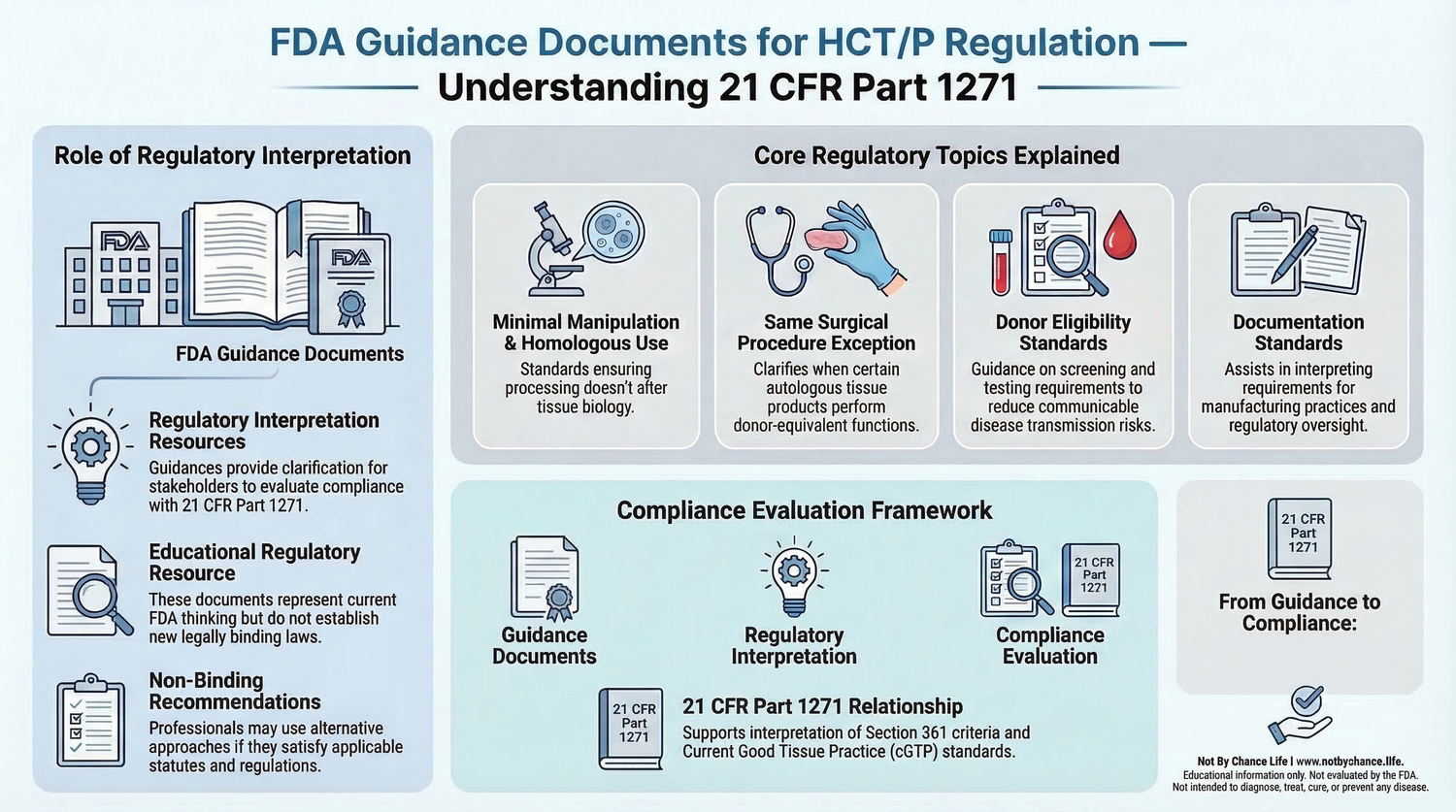
FDA guidance documents explain the agency's current thinking on the interpretation and application of regulatory requirements governing Human Cells, Tissues, and Cellular and Tissue-Based Products (HCT/Ps). While guidance documents do not establish legally enforceable requirements, they provide important context for understanding FDA's regulatory approach.
In simple terms, FDA guidance helps explain how existing regulations may be interpreted and applied in practice.
The United States Food and Drug Administration (FDA) publishes guidance documents to assist healthcare professionals, tissue establishments, researchers, and regulatory stakeholders in understanding the regulatory framework governing Human Cells, Tissues, and Cellular and Tissue-Based Products (HCT/Ps).
These guidance documents provide educational insight into regulatory interpretation related to 21 CFR Part 1271, including topics such as minimal manipulation, homologous use, donor eligibility, and Current Good Tissue Practice (cGTP).
FDA guidance documents should be considered together with applicable statutes, regulations, and product-specific facts when evaluating HCT/P regulatory classification.
For a structured overview showing how FDA guidance fits within the complete regulatory review process, see the HCT/P Regulatory Evaluation Pathway .
Documentation and Regulatory Education
Not sure how FDA guidance relates to your current sourcing or documentation review process?
Licensed medical professionals and organizations may request educational materials related to FDA guidance documents, regulatory interpretation, supplier documentation, and HCT/P compliance considerations referenced throughout this resource.
Credential verification may be required prior to documentation access.
Request Regulatory Information
Minimal Manipulation & Homologous Use Guidance
Regulatory Considerations for Human Cells, Tissues, and Cellular and Tissue-Based Products: Minimal Manipulation and Homologous Use
This FDA guidance document explains how the agency interprets the regulatory concepts of minimal manipulation and homologous use when evaluating whether a product may qualify for regulation solely under Section 361 of the Public Health Service Act.
Official FDA guidance document:
FDA Guidance — Minimal Manipulation & Homologous Use
Educational explanations of these regulatory concepts are available here:
Same Surgical Procedure Exception
Same Surgical Procedure Exception Under 21 CFR 1271.15(b)
This FDA guidance document discusses regulatory interpretation of the same surgical procedure exception. Under certain circumstances, this exception may apply when human cells or tissues are removed from a patient and implanted back into the same patient during the same surgical procedure.
Official FDA guidance document:
HCT/P Regulatory Classification Guidance
Regulatory Considerations for Human Cells, Tissues, and Cellular and Tissue-Based Products
This guidance document provides additional regulatory clarification regarding classification considerations under Section 361 and Section 351 of the Public Health Service Act.
Official FDA guidance document:
FDA Guidance — Regulatory Considerations for HCT/Ps
Educational overview of the regulatory classification framework:
Donor Eligibility Guidance
Eligibility Determination for Donors of Human Cells, Tissues, and Cellular and Tissue-Based Products
FDA guidance documents related to donor eligibility determination describe procedures used to evaluate communicable disease risks associated with tissue donors. These procedures include medical history evaluation, risk assessment, laboratory testing, and documentation of donor eligibility.
Educational explanation of donor eligibility requirements:
This information is provided for educational purposes only.
Certain referenced materials may be regulated as Human Cells, Tissues, and Cellular and Tissue-Based Products (HCT/Ps) under 21 CFR Part 1271.
Establishment registration under 21 CFR Part 1271 does not constitute FDA approval, clearance, or evaluation of safety or effectiveness.
This information is not intended to diagnose, treat, cure, or prevent any disease.