
Requesting HCT/P Supplier Documentation
A well-organized documentation request can be an important first step in developing a structured understanding of supplier documentation. Rather than requesting individual records one at a time, healthcare professionals may benefit from organizing documentation requests into clearly defined categories that reflect the regulatory concepts discussed throughout 21 CFR Part 1271.
Educational documentation requests can help organize information relating to regulatory classification, donor eligibility, processing documentation, Current Good Tissue Practice (cGTP), chain of custody, traceability, and supporting records. Requesting documentation by category promotes consistency, simplifies review, and helps identify areas where additional clarification may be appropriate.
This educational resource complements the HCT/P Supplier Documentation Evaluation Framework, the HCT/P Supplier Documentation Checklist, and Documentation Transparency for HCT/Ps by explaining how documentation requests may be organized before documentation review begins.
On This Page
Requesting documentation in a structured and organized manner can help healthcare professionals prepare for review by grouping supporting records into logical documentation categories. This guide explains why documentation requests matter, introduces major documentation categories commonly encountered during review, and provides practical guidance for organizing supplier documentation before evaluation begins.
Why Request Supplier Documentation?
Supplier documentation provides information that may help healthcare professionals understand how an organization describes its products, processing, quality systems, donor eligibility practices, traceability, and regulatory position.
Rather than relying exclusively on brochures, presentations, product summaries, or individual claims, requesting supporting documentation allows professionals to organize available information into consistent categories before beginning a detailed review.
Organized documentation requests can also improve consistency between evaluations. By requesting similar categories of information when appropriate, healthcare professionals can more easily identify what documentation has been provided, what information remains unavailable, and what questions may require clarification.
The objective is not to collect the greatest possible number of documents. The objective is to obtain and organize information relevant to the particular evaluation while understanding the source, scope, methodology, and limitations of the documentation provided.
Educational Documentation Request Guide
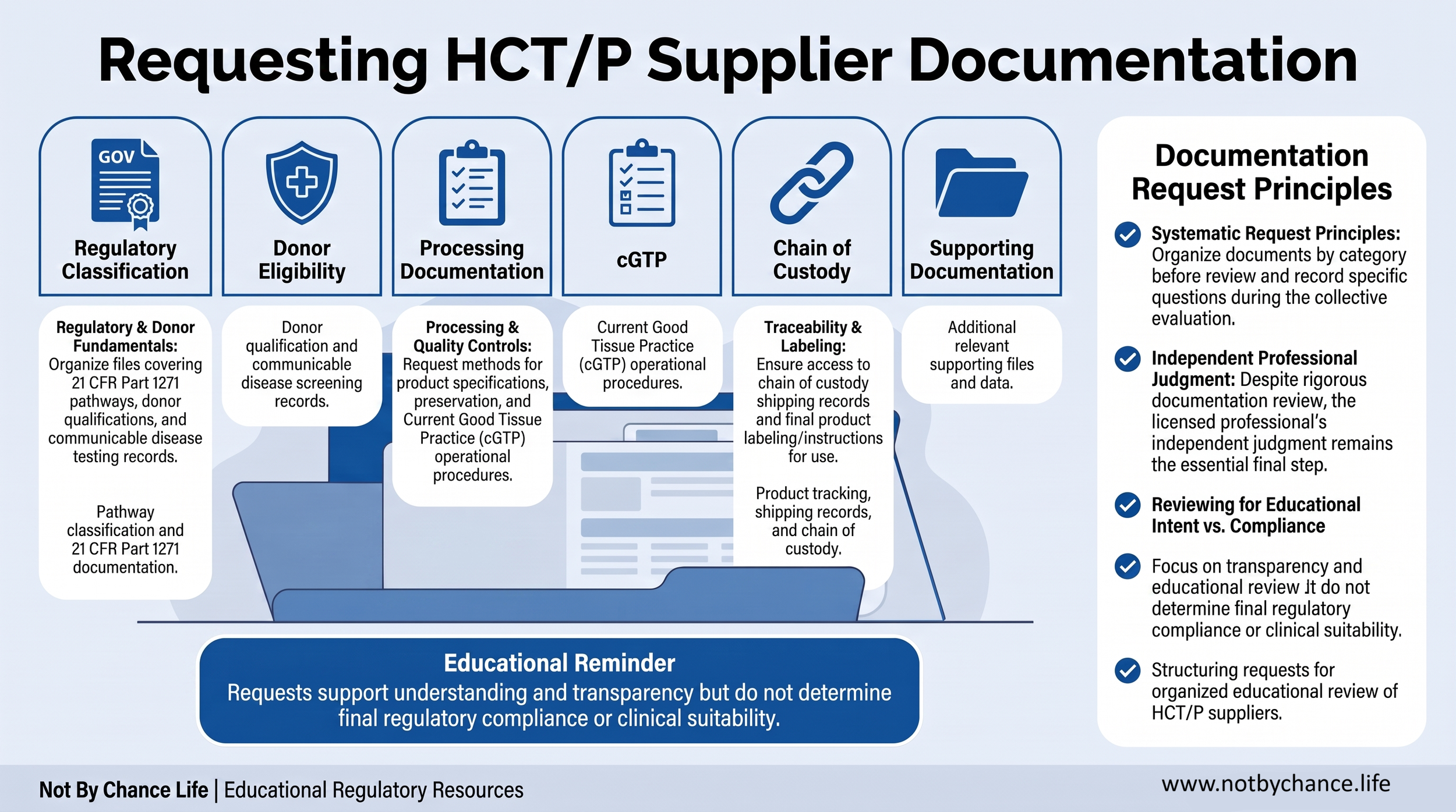
The infographic below summarizes six major documentation categories that healthcare professionals may consider when organizing supplier documentation requests. These categories correspond to the broader documentation framework discussed throughout the Not By Chance Life Knowledge Center.
Documentation Categories Commonly Requested During Review
Organizing documentation into consistent categories can help healthcare professionals develop a structured understanding of supplier information before evaluating individual records. Each category provides a different type of information and should be interpreted within its appropriate regulatory and documentation context.
Regulatory Classification Documentation
Regulatory classification documentation may provide information about how an organization represents a product within the applicable regulatory framework. This information can provide useful context for further review, but a supplier's stated regulatory position should not be treated by itself as a regulatory determination.
Related Resources: 21 CFR Part 1271 Regulatory Framework | 21 CFR 1271.10(a) | Section 361 vs. Section 351
Donor Eligibility Documentation
Donor eligibility documentation may contain information relating to donor screening, testing for relevant communicable disease agents and diseases, donor eligibility determinations, and related records. Review should focus on understanding what documentation has been provided and how it relates to the applicable regulatory requirements.
Related Resource: Donor Eligibility
Processing Documentation
Processing documentation may describe how tissue is recovered, processed, preserved, packaged, stored, or prepared for distribution. These records can provide important factual context when evaluating processing-related regulatory concepts and documentation transparency.
Related Resources: Minimal Manipulation | Homologous Use
Current Good Tissue Practice (cGTP)
Documentation related to Current Good Tissue Practice may provide information about quality systems, procedures, facilities, environmental controls, storage, tracking, recordkeeping, and other practices addressed within the applicable requirements of 21 CFR Part 1271.
Related Resource: Current Good Tissue Practice (cGTP)
Chain of Custody & Traceability
Chain of custody and traceability documentation may help explain how an HCT/P is identified, tracked, stored, transported, and distributed. These records can support an understanding of documentation continuity and traceability throughout relevant portions of the product lifecycle.
Related Resource: Chain of Custody & Traceability
Supporting Documentation
Supporting documentation may include labeling, instructions for use, product specifications, storage information, certificates, test reports, or other records relevant to the particular evaluation. The significance of each document depends on its source, purpose, methodology, scope, and limitations.
Questions to Ask Suppliers During Documentation Requests
Documentation requests can be organized around questions that help identify what information is available for review. The examples below are educational prompts rather than a mandatory regulatory checklist.
- What documentation supports the organization's stated regulatory position for the product?
- What donor eligibility documentation is available for review?
- What information is available regarding donor screening and testing?
- What documentation describes relevant processing methods?
- What documentation is available regarding applicable Current Good Tissue Practice procedures or quality systems?
- What chain of custody and traceability information is available?
- What product specifications are available?
- What storage and handling information is provided?
- Are instructions for use or other use-related materials available?
- What product labeling is available for review?
- Are relevant testing reports, certificates, or supporting records available?
- What information identifies the source, date, version, or scope of the documents provided?
- Who should be contacted when documentation requires additional clarification?
For a broader discussion framework, continue to Questions to Ask an HCT/P Supplier.
Best Practices for Documentation Requests
A structured documentation request can establish a more organized review process before detailed evaluation begins. The following practices support consistency and documentation transparency.
- Begin with the regulatory and documentation questions relevant to the evaluation.
- Request documentation by logical category rather than collecting unrelated records without structure.
- Identify the source, date, version, and purpose of documents when that information is available.
- Organize received documentation before beginning detailed review.
- Record questions and unresolved issues as documentation is reviewed.
- Distinguish between supplier statements and independent regulatory sources.
- Distinguish between regulatory documentation and scientific literature.
- Consider the complete documentation package rather than relying on a single document.
- Request clarification when documentation appears incomplete, inconsistent, or unclear.
- Record unavailable or outstanding information rather than assuming what missing documentation would show.
- Apply a consistent review methodology when comparing documentation from different organizations.
Requesting Documentation Through NBCL Connect
This Knowledge Center page teaches the principles and methodology behind organizing supplier documentation requests. The actual professional workflow for requesting available documentation from participating organizations is separate from the public educational library.
Qualified healthcare professionals can use NBCL Connect to evaluate participating organizations and, within the applicable professional workflow, request available documentation directly from those organizations.
NBCL Connect also provides structured tools for professional communication, meeting coordination, documentation activity, tasks, and ongoing relationship management.
The platform facilitates the documentation-request process but does not determine whether documentation is sufficient, establish regulatory classification, approve supplier documentation, recommend an organization, or make clinical or purchasing decisions.
Frequently Asked Questions
Why should documentation be requested before beginning a detailed supplier evaluation?
Requesting relevant documentation before beginning detailed review can help organize available information into consistent categories. This allows healthcare professionals to understand the scope of the available documentation package, identify outstanding information, and establish questions before evaluating individual records.
Does this guide identify every document that should be requested?
No. This guide introduces categories and principles that can help organize documentation requests. The documents relevant to a particular evaluation may vary according to the product, organization, regulatory questions, available information, and purpose of the review.
Does requesting documentation determine regulatory compliance?
No. The existence, absence, or collection of documentation does not by itself determine regulatory compliance, FDA classification, product quality, or clinical suitability.
Does supplier documentation determine whether an HCT/P qualifies under Section 361?
No. Supplier documentation may provide information relevant to understanding a product and its regulatory position, but regulatory classification depends on the applicable statutes and regulations and the facts relevant to the product, processing, intended use, and other applicable criteria.
Does NBCL Connect approve the documentation provided by participating organizations?
No. NBCL Connect facilitates structured professional evaluation and documentation exchange. Not By Chance Life does not approve supplier documentation or represent platform participation as evidence that a documentation package, regulatory position, organization, or product has been approved or endorsed.
Can scientific literature substitute for regulatory documentation?
No. Peer-reviewed scientific literature can provide biological and scientific context, but scientific publications do not independently establish regulatory classification or replace applicable regulatory requirements.
How does this page relate to the Documentation Transparency guide?
The Documentation Transparency for HCT/Ps resource explains why the source, scope, organization, and limitations of documentation matter during professional review. This page focuses specifically on how documentation requests may be organized before and during an evaluation.
How does this page relate to the Supplier Documentation Checklist?
The HCT/P Supplier Documentation Checklist provides an educational structure for organizing and reviewing documentation. This guide focuses on the earlier process of determining what information to request and how to organize those requests.
What should I do if requested documentation is unavailable?
Record what information has been provided, identify what remains unavailable or outstanding, and document questions that may require clarification. Missing information should remain identified as unavailable rather than being inferred or assumed.
Where can qualified professionals request documentation from participating organizations?
Qualified professionals may use NBCL Connect to conduct structured evaluations and request available documentation from participating organizations within the platform workflow.
Related Educational Resources
Continue building your understanding of HCT/P supplier documentation through the following educational resources.
Documentation Resources
- Supplier Evaluation Process
- HCT/P Supplier Documentation Evaluation Framework
- HCT/P Supplier Documentation Checklist
- Documentation Transparency for HCT/Ps
- Questions to Ask an HCT/P Supplier
- Comparing HCT/P Supplier Documentation
- Common HCT/P Documentation Review Mistakes
- HCT/P Documentation FAQ
- HCT/P Documentation Glossary
Regulatory Foundations
- 21 CFR Part 1271 Regulatory Framework
- 21 CFR 1271.10(a) Classification Criteria
- Section 361 vs. Section 351 Classification
- Minimal Manipulation
- Homologous Use
Supporting Documentation Topics
From Documentation Education to Professional Evaluation
The Not By Chance Life educational system separates public education from professional evaluation activity.
The Knowledge Center provides regulatory education, supplier documentation guidance, and scientific education. It is designed to help professionals understand how information may be evaluated and how different sources of evidence should be interpreted.
NBCL Connect provides the separate professional environment where qualified healthcare professionals can evaluate participating organizations, request available documentation, communicate with organizations, coordinate meetings, and manage ongoing professional relationships.
Documentation Evaluation Principles
Documentation should be evaluated according to what it actually supports. Different documents may provide information about processing, donor eligibility, testing, quality systems, traceability, labeling, storage, intended use, or other aspects of an HCT/P or related product.
The existence of a document should not be confused with the conclusion that might be drawn from it. Review should consider the document's source, date, version, methodology, scope, limitations, internal consistency, and relationship to other available information.
When regulatory questions are involved, authoritative regulatory sources should remain distinct from supplier-generated documentation. Federal statutes and regulations establish legal requirements; FDA guidance and official FDA publications provide additional regulatory context; supplier documentation provides information about the supplier, product, processes, or position being evaluated.
Scientific publications serve a different purpose. Peer-reviewed literature may provide scientific and biological context, but scientific evidence should not be presented as though it independently determines regulatory classification.
Continue Learning
Requesting documentation is one part of a broader documentation-first evaluation process. Continue through the Supplier Documentation Knowledge Center to learn how documentation can be organized, reviewed, compared, and interpreted consistently.
- Supplier Evaluation Process
- HCT/P Supplier Documentation Evaluation Framework
- HCT/P Supplier Documentation Checklist
- Documentation Transparency for HCT/Ps
- Questions to Ask an HCT/P Supplier
- Comparing HCT/P Supplier Documentation
- Common HCT/P Documentation Review Mistakes
- HCT/P Documentation FAQ
- HCT/P Documentation Glossary
For foundational regulatory education, return to the 21 CFR Part 1271 Regulatory Framework.
For the complete educational library, visit the Not By Chance Life Knowledge Center.
Regulatory & Educational Notice
The Not By Chance Life Knowledge Center is provided for educational purposes and is intended to improve regulatory literacy, documentation literacy, and scientific understanding related to Human Cells, Tissues, and Cellular and Tissue-Based Products (HCT/Ps).
Regulatory classification depends on the applicable legal and regulatory framework and the facts associated with a particular product, including characteristics, processing, intended use, and other relevant considerations.
FDA establishment registration does not constitute FDA approval, clearance, certification, endorsement, or a determination regarding the safety or effectiveness of a product.
Supplier documentation should be evaluated according to its source, scope, methodology, limitations, and applicable regulatory context. Documentation alone does not determine regulatory status.
Scientific publications provide educational context and should not be interpreted as independently establishing regulatory classification, product suitability, or clinical appropriateness.
Not By Chance Life provides regulatory education, documentation guidance, scientific education, provider education, educational resources, and professional evaluation infrastructure. Not By Chance Life does not provide medical treatment, patient care, legal advice, regulatory determinations, or clinical recommendations.
NBCL Connect facilitates structured professional evaluation and communication. Participation in NBCL Connect does not constitute approval, endorsement, certification, recommendation, or validation of an organization, product, documentation package, regulatory position, or clinical use.