

Secretome Biology
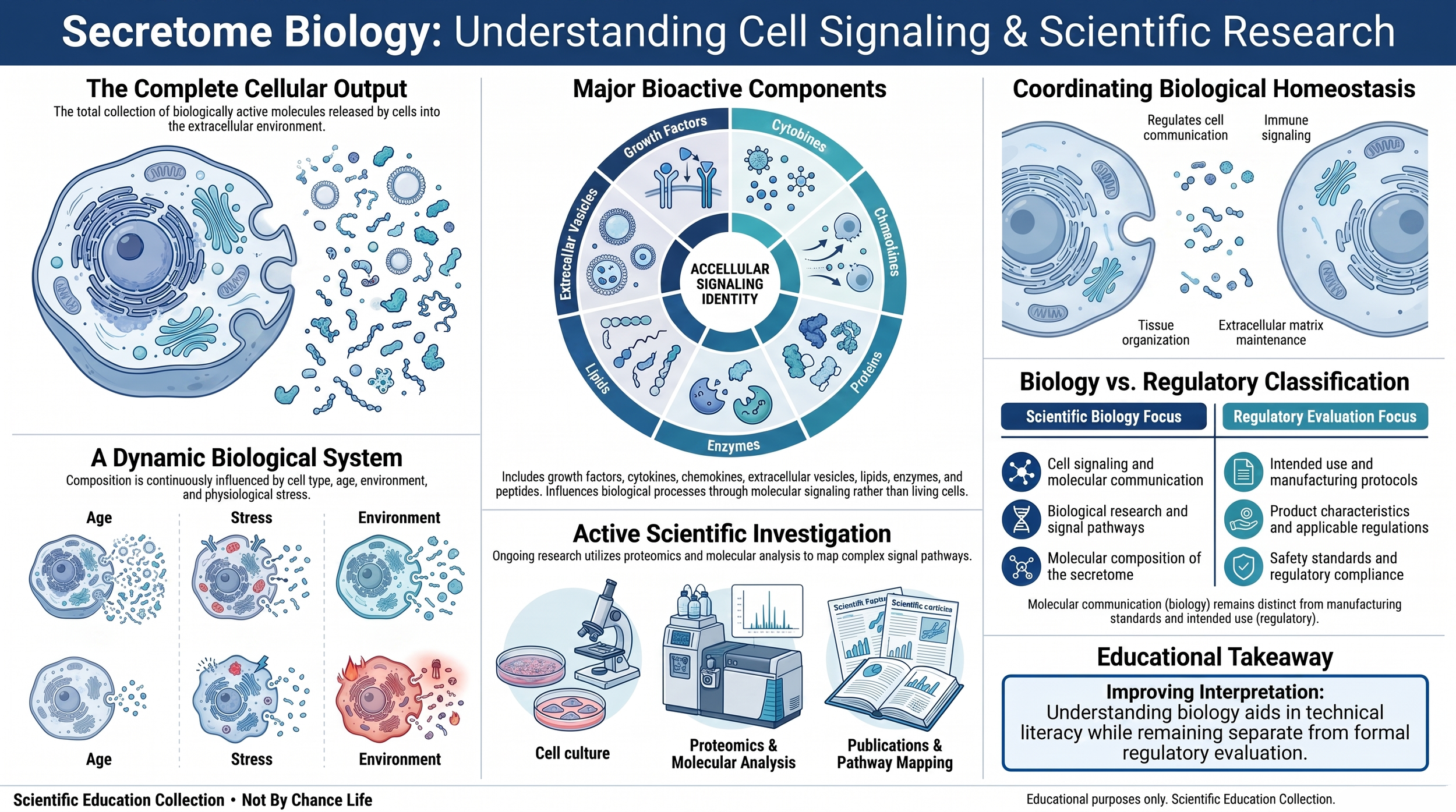
The secretome is the complete collection of biologically active molecules released by cells into the extracellular environment. Rather than representing a single substance or structure, the secretome consists of numerous proteins, signaling molecules, extracellular vesicles, lipids, enzymes, peptides, and other bioactive components that participate in normal biological communication throughout the body. Because virtually every cell continuously releases molecular signals, secretome biology has become an important area of investigation across cell biology, developmental biology, immunology, molecular signaling, and tissue science.
This educational resource explains the biological principles underlying the cellular secretome, including its major components, biological functions, dynamic composition, and role in normal intercellular communication. The discussion focuses exclusively on established scientific concepts presented throughout the peer-reviewed literature and does not address clinical applications or product-specific characteristics.
Although the secretome is frequently discussed throughout regenerative medicine research, biological understanding of secreted molecules should remain separate from regulatory evaluation. Scientific investigation explains how cells communicate and coordinate biological processes, whereas regulatory classification depends upon applicable statutes, regulations, manufacturing methods, intended use, and product-specific characteristics. Recognizing this distinction is essential when interpreting scientific publications and technical documentation.
What Is the Secretome?
The term secretome refers to the complete collection of biologically active molecules released by a cell into the surrounding extracellular environment. Rather than describing a single molecule or structure, the secretome encompasses a diverse mixture of proteins, signaling molecules, extracellular vesicles, enzymes, lipids, peptides, nucleic acids, and other soluble factors that collectively contribute to normal biological communication between cells and tissues.
Every cell type possesses its own characteristic secretome. The specific composition varies according to the type of cell, its stage of development, the surrounding biological environment, and the physiological conditions under which secretion occurs. As a result, the secretome should be viewed as a dynamic biological system that continuously changes in response to normal cellular activity rather than as a fixed molecular profile.
The secretome serves as one of the body's primary mechanisms for coordinating communication between neighboring and distant cells. By releasing signaling molecules into the extracellular environment, cells influence numerous biological processes that help maintain normal tissue organization, physiological homeostasis, and cellular interaction throughout the body. Scientific investigation continues to expand understanding of these complex communication networks across many fields of biology.
Although the secretome is often discussed alongside extracellular vesicles, the two concepts are not synonymous. Extracellular vesicles represent one component of the broader secretome. In addition to extracellular vesicles, the secretome includes soluble proteins, cytokines, chemokines, growth factors, enzymes, lipids, and numerous other molecules that participate in normal biological signaling.
Understanding the secretome provides important scientific context for interpreting modern cell biology and tissue science literature. However, biological descriptions of secreted molecules should not be interpreted as evidence of regulatory classification, product characteristics, or clinical application. Scientific understanding and regulatory evaluation represent separate educational concepts that should be considered independently.
Major Components of the Secretome
The secretome consists of numerous classes of biologically active molecules that work together to support normal cellular communication. Although the precise composition differs among tissues and cell types, several categories of molecules are consistently described throughout the scientific literature because of their widespread roles in normal biological processes.
-
Growth Factors
Growth factors are signaling proteins that participate in normal cellular communication and help regulate numerous physiological processes throughout development, tissue organization, and normal biological function. -
Cytokines
Cytokines are small signaling proteins that facilitate communication between cells, particularly within immune and inflammatory signaling networks, while contributing to coordination of normal physiological responses. -
Chemokines
Chemokines are a specialized family of signaling molecules that help direct cell movement and cellular communication within normal biological systems through concentration-dependent signaling pathways. -
Extracellular Vesicles
Extracellular vesicles, including exosomes and microvesicles, represent membrane-bound components of the secretome that transport molecular cargo between cells. Learn more in Extracellular Vesicle & Exosome Biology. -
Proteins, Enzymes, Lipids, and Peptides
Numerous structural proteins, enzymes, lipids, and peptide molecules are also released into the extracellular environment, where they contribute to normal biological communication and extracellular interactions.
Rather than functioning independently, these bioactive components interact within complex molecular networks that continue to be investigated through ongoing scientific research. The diversity of secreted molecules illustrates why the secretome is best understood as an integrated biological communication system rather than a collection of isolated signaling factors.
Cell Signaling and Biological Communication
Cells communicate continuously through highly coordinated molecular signaling networks. Rather than functioning in isolation, neighboring and distant cells exchange biochemical information by releasing signaling molecules into the extracellular environment, allowing tissues to coordinate normal physiological processes. The secretome represents one of the primary mechanisms through which this communication occurs.
Many molecules within the secretome bind to receptors located on the surface of nearby cells or interact with components of the extracellular matrix. These interactions initiate intracellular signaling pathways that influence normal cellular activities such as migration, proliferation, differentiation, metabolism, extracellular matrix organization, and communication with neighboring cells. The specific biological response depends upon the receiving cell type, receptor availability, molecular concentration, and surrounding biological environment.
Scientific investigations continue to explore the complexity of these signaling pathways using molecular biology, proteomics, genomics, transcriptomics, and systems biology. Researchers recognize that cellular communication rarely depends upon a single signaling molecule. Instead, biological responses typically result from coordinated interactions among numerous proteins, cytokines, chemokines, extracellular vesicles, enzymes, lipids, and other bioactive components acting simultaneously within dynamic biological systems.
The composition of the secretome is also influenced by numerous physiological variables. Cell type, developmental stage, tissue location, age, environmental conditions, oxygen availability, metabolic activity, and other biological factors may all affect the quantity and composition of molecules released into the extracellular environment. Consequently, scientific studies frequently report differences in secretome composition under varying experimental conditions.
Understanding these principles helps readers interpret the scientific literature more accurately. Variations observed between studies often reflect differences in experimental design, biological models, laboratory conditions, analytical methods, or tissue sources rather than contradictory scientific findings. Appreciating the dynamic nature of cellular signaling is therefore essential when evaluating published research.
Scientific Investigation of the Secretome
The secretome has become an important area of investigation across numerous scientific disciplines because it provides insight into how cells communicate, coordinate biological activity, and interact with surrounding tissues. Researchers study the composition of secreted molecules to better understand normal physiology, developmental biology, extracellular matrix organization, immunology, molecular signaling pathways, and other areas of basic biological research.
Modern analytical techniques such as proteomics, transcriptomics, metabolomics, mass spectrometry, molecular sequencing, and advanced bioinformatics allow investigators to identify and characterize thousands of molecules released by cells under different biological conditions. These technologies continue to improve scientific understanding of complex molecular communication networks while revealing how secretome composition may vary according to cell type and physiological environment.
Much of the published literature focuses on describing molecular composition, identifying signaling pathways, and investigating biological mechanisms under controlled laboratory conditions. Many studies are conducted using cultured cells, isolated tissues, or experimental animal models that provide valuable biological insight while also introducing important limitations that should be considered when interpreting research findings.
As with all areas of biomedical science, individual studies should be interpreted within the broader context of the available evidence. Differences in laboratory methods, experimental models, analytical techniques, and biological systems may influence reported findings. For this reason, conclusions should be based upon the collective body of peer-reviewed evidence rather than any single publication.
Biology and Regulatory Classification Are Separate Concepts
The scientific study of the secretome and the regulatory evaluation of human tissue products represent two distinct areas of analysis. Scientific publications investigate biological mechanisms, molecular signaling, extracellular communication, and the composition of secreted molecules. Regulatory agencies, by contrast, evaluate products according to applicable statutes, regulations, intended use, manufacturing methods, processing characteristics, and supporting documentation.
For Human Cells, Tissues, and Cellular and Tissue-Based Products (HCT/Ps), regulatory classification under 21 CFR Part 1271 is determined through established regulatory criteria rather than the biological properties of molecules discussed within scientific publications. Scientific literature contributes to biological understanding but does not independently establish whether a particular product satisfies applicable regulatory requirements.
Similarly, publications describing growth factors, cytokines, extracellular vesicles, molecular signaling pathways, or secreted proteins should not be interpreted as evidence of product performance, clinical effectiveness, FDA authorization, or regulatory status. These studies are designed to improve scientific knowledge and frequently investigate normal biological processes under controlled experimental conditions rather than evaluate specific commercial products.
Maintaining this distinction is essential when reviewing supplier documentation or scientific literature. Biological science explains how cells and tissues function under normal physiological conditions, while regulatory evaluation determines whether an individual product satisfies applicable federal requirements based upon its documented characteristics, intended use, processing methods, and supporting records.
Readers interested in the regulatory framework governing HCT/Ps should continue with the Regulatory Foundations collection, while those evaluating supplier information should explore the Supplier Evaluation Process. Together with Scientific Education, these collections provide complementary perspectives that support informed interpretation of both biology and documentation.
Related Scientific Education Resources
Secretome biology represents one component of a broader scientific understanding of tissue biology, extracellular communication, and regenerative science. The following educational resources examine related biological concepts that frequently appear throughout peer-reviewed scientific literature and technical documentation.
- Scientific Education
- Extracellular Matrix (ECM) Biology
- Placental & Perinatal Tissue Biology
- Extracellular Vesicle & Exosome Biology
- Tissue Preservation Science
- Cell Viability & Post-Thaw Assessment
- Reading Scientific Literature
- Scientific Glossary
Readers seeking additional regulatory context may also benefit from the Regulatory Foundations collection and the Supplier Evaluation Process, which explain how biological science, federal regulations, and documentation review complement one another while serving distinct educational purposes.
This educational resource is provided for scientific education only. Discussions of secretome biology, molecular signaling, extracellular communication, cytokines, growth factors, extracellular vesicles, proteins, enzymes, and related biological concepts are intended solely to improve scientific literacy. They should not be interpreted as evidence of regulatory classification, FDA authorization, clinical effectiveness, or product-specific performance. Regulatory determinations should always be based upon applicable statutes, regulations, FDA guidance documents, intended use, processing methods, and the documented characteristics of the individual Human Cell, Tissue, or Cellular and Tissue-Based Product (HCT/P).