
Comparing HCT/P Supplier Documentation
Healthcare professionals frequently receive documentation from multiple Human Cells, Tissues, and Cellular and Tissue-Based Product (HCT/P) suppliers. Comparing documentation using a consistent educational framework promotes organization, improves regulatory literacy, and supports objective documentation review throughout the supplier evaluation process.
Rather than comparing marketing materials, promotional claims, or isolated documents, documentation comparison focuses on reviewing the same documentation categories across every supplier. Applying a consistent methodology helps professionals organize information, identify documentation gaps, document questions, and better understand supporting records without assigning rankings or making regulatory conclusions.
This educational guide builds upon the HCT/P Supplier Evaluation Process, the HCT/P Documentation Checklist, the Documentation Transparency Guide, and the Questions to Ask an HCT/P Supplier by explaining how documentation packages may be compared using the same structured documentation-first methodology.
Estimated Reading Time: 12–15 minutes
Who This Guide Is For
This educational resource is intended for licensed healthcare professionals, healthcare organizations, compliance personnel, procurement teams, researchers, and other qualified professionals comparing documentation received from multiple HCT/P suppliers.
The objective is to promote consistent documentation review, improve regulatory literacy, and encourage objective educational comparison based on supporting documentation rather than promotional materials.
Before Comparing Suppliers
Documentation comparison should begin only after each supplier's documentation package has been reviewed independently. Comparing incomplete information or using different review methods for different suppliers can reduce consistency and limit the educational value of the comparison process.
Preparation Checklist
- Complete the Supplier Evaluation Process.
- Review the HCT/P Documentation Checklist.
- Review the Documentation Transparency Guide.
- Prepare documentation-focused questions using the Questions to Ask an HCT/P Supplier guide.
- Organize documentation before beginning comparisons.
Why Compare Supplier Documentation?
Healthcare professionals frequently receive documentation from multiple suppliers that differs in organization, terminology, and supporting materials. A structured comparison methodology helps organize these documentation packages using consistent categories, allowing educational review to focus on documentation rather than presentation style or marketing language.
The objective of documentation comparison is not to determine which supplier is "better." Instead, it is to review each documentation package using the same educational process, identify similarities and differences in supporting records, and document areas where additional clarification may be appropriate.
Purpose of Documentation Comparison
Documentation comparison supports regulatory literacy by encouraging healthcare professionals to review the same documentation categories in the same order for every supplier. This structured approach promotes organization, consistency, and objective educational review while avoiding unsupported conclusions regarding regulatory status, product quality, or clinical performance.
Educational Documentation Comparison Framework
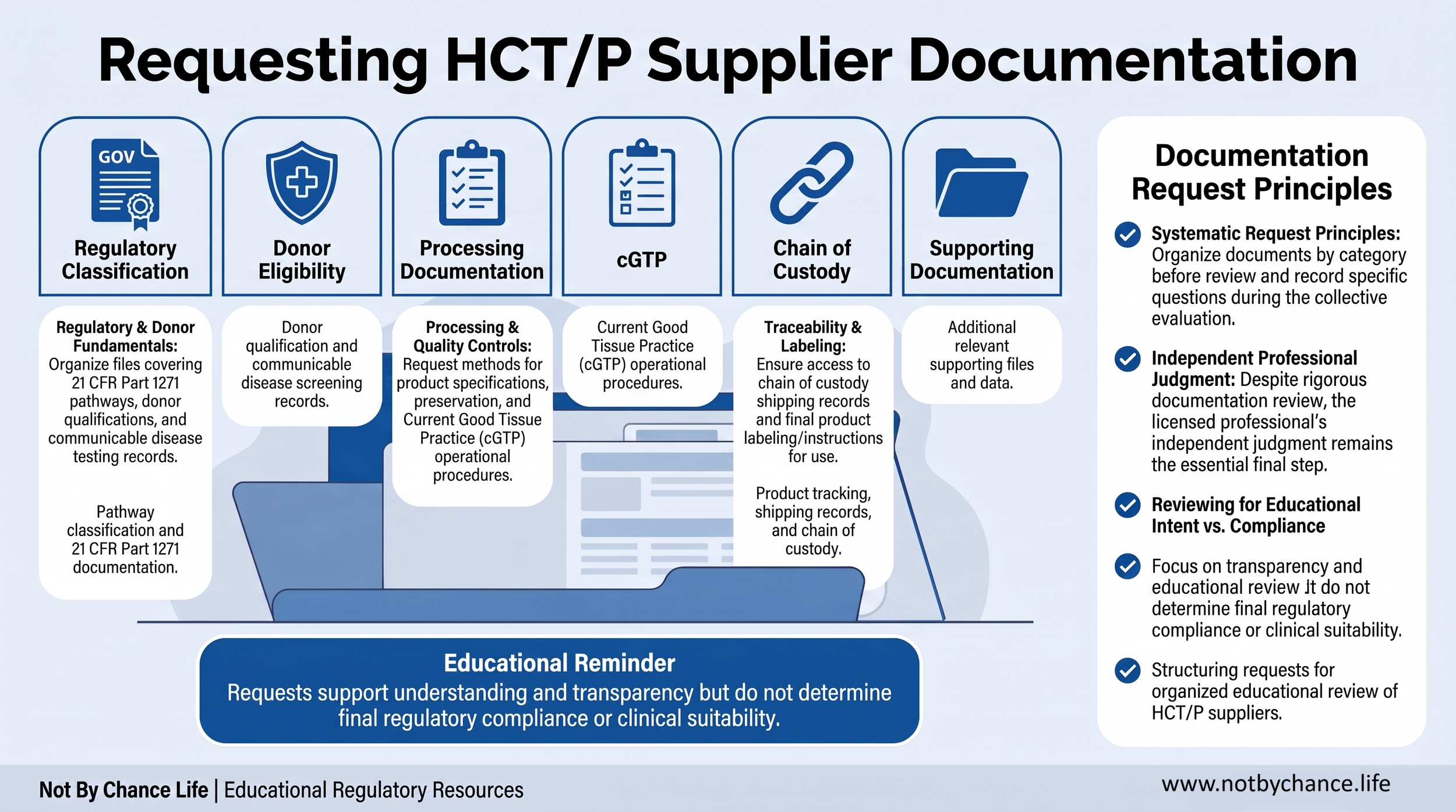
The infographic below illustrates a structured educational framework for comparing supplier documentation packages. Rather than comparing products, the framework emphasizes reviewing the same documentation categories consistently across every supplier.
Each documentation package should be evaluated independently before comparisons are made. Once individual reviews are complete, the same documentation categories can be compared to identify documentation similarities, supporting records, and opportunities for clarification.
Documentation Comparison Principle
Meaningful comparison begins with consistency. Every supplier should be reviewed using the same documentation categories, the same educational methodology, and the same objective evaluation process.
Comparing Documentation Categories
Meaningful documentation comparison begins by evaluating each documentation category independently before considering the documentation package as a whole. Using the same review sequence for every supplier promotes consistency, improves organization, and supports objective educational review.
Regulatory Documentation
Begin by comparing the publicly available regulatory references associated with each documentation package. The purpose is to understand how regulatory information is presented and supported—not to determine regulatory status or reach legal conclusions.
Compare the Following
- Applicable regulatory references.
- FDA guidance documents cited.
- Establishment registration information.
- Organization and clarity of regulatory documentation.
- Supporting educational references.
Donor Eligibility Documentation
Review donor eligibility documentation using the same educational criteria for every supplier. Focus on documentation completeness, organization, and supporting records rather than comparing individual donor characteristics.
Compare the Following
- Donor eligibility documentation.
- Donor screening records.
- Communicable disease testing documentation.
- Documentation organization.
- Supporting educational references.
Processing Documentation
Processing documentation should be reviewed to understand documented handling, preservation, storage, and technical procedures. Comparison should focus on documentation rather than evaluating manufacturing methods.
Compare the Following
- Documented processing methods.
- Storage documentation.
- Preservation documentation.
- Handling procedures.
- Supporting technical documentation.
Quality Documentation
Quality documentation provides educational insight into quality systems supporting documented operational practices. Review each documentation package using the same quality documentation categories.
Compare the Following
- Current Good Tissue Practice (cGTP) documentation.
- Quality procedures.
- Standard operating procedures (where available).
- Quality records.
- Supporting quality documentation.
Chain of Custody & Traceability
Compare traceability documentation by evaluating how supporting records remain connected throughout donor recovery, processing, storage, and distribution. Focus on documentation continuity rather than operational differences.
Compare the Following
- Chain of custody documentation.
- Lot identification records.
- Traceability documentation.
- Storage records.
- Distribution documentation.
Product Documentation
Review technical documentation consistently across suppliers. Product documentation should complement the remaining documentation package rather than be reviewed independently.
Compare the Following
- Certificates of Analysis (COAs).
- Certificates of Conformance (CoCs).
- Technical specification sheets.
- Storage and handling documentation.
- Product-specific supporting documentation.
Documentation Transparency
Finally, compare how each supplier organizes the complete documentation package. Documentation transparency is evaluated by educational clarity, organization, supporting context, and how effectively documentation categories relate to one another—not by document quantity alone.
Documentation Comparison Principle
The strongest documentation comparison evaluates every supplier using identical documentation categories, identical review methods, and identical educational criteria. Consistency is the foundation of meaningful documentation comparison.
What Not to Compare
Documentation comparison should remain focused on objective educational review. Promotional language, testimonials, marketing materials, and unsupported performance claims should not be substituted for supporting documentation. Maintaining a documentation-first approach encourages consistent evaluation and reduces the risk of drawing conclusions that are not supported by the documentation package.
Avoid Comparing
- Marketing claims or promotional language.
- Testimonials or anecdotal experiences.
- Disease-specific claims or expected clinical outcomes.
- Supplier popularity or market position.
- Product branding or marketing terminology.
- Document quantity without considering organization and context.
Instead, Compare
- Documentation completeness.
- Documentation organization.
- Regulatory references.
- Donor eligibility documentation.
- Processing documentation.
- Quality documentation.
- Chain of custody and traceability.
- Product documentation.
- Documentation transparency.
- Areas requiring clarification.
Comparison Does Not Mean Ranking
A documentation comparison framework helps professionals organize observations across multiple documentation packages. It does not establish a supplier ranking, recommendation, endorsement, regulatory determination, or conclusion regarding clinical suitability.
The professional reviewing the documentation remains responsible for interpreting the information within the appropriate regulatory, scientific, organizational, and professional context.
Documentation Comparison Principles
A structured comparison methodology improves consistency by ensuring every supplier is reviewed using the same educational framework. The following principles help maintain an objective, documentation-focused comparison process.
Five Principles for Documentation Comparison
- Review each supplier independently first. Complete an individual documentation review before making comparisons.
- Use identical documentation categories. Compare the same categories across every supplier.
- Document differences objectively. Record observations rather than conclusions.
- Request clarification when appropriate. Missing context may be addressed through additional documentation or supplier discussion.
- Separate documentation from marketing. Educational review should emphasize supporting records rather than promotional materials.
Documentation Comparison Worksheet
The following questions may be used as a final educational review before completing documentation comparisons.
Final Documentation Review Checklist
- □ Did I review every supplier using the same documentation categories?
- □ Did I compare documentation rather than marketing materials?
- □ Did I identify documentation requiring clarification?
- □ Did I document observations objectively?
- □ Did I separate educational review from regulatory conclusions?
- □ Did I avoid comparing expected clinical outcomes?
- □ Did I evaluate documentation transparency rather than document quantity alone?
- □ Did I maintain the same methodology for every supplier?
This worksheet is an educational organizational tool. Completing the questions does not establish regulatory compliance, validate a supplier, determine product quality, or replace independent professional evaluation.
Applying the Framework in NBCL Connect
The Not By Chance Life Knowledge Center teaches the methodology for evaluating and comparing supplier documentation. When qualified healthcare professionals move from public education into an actual professional evaluation of participating organizations, NBCL Connect provides a separate structured environment for that activity.
NBCL Connect — Professional Evaluation Management Platform
Qualified healthcare professionals can use NBCL Connect to evaluate participating organizations, request available documentation, communicate with organizations, coordinate meetings, manage evaluation-related tasks, and maintain ongoing professional relationships.
The documentation-first principles explained on this page may be used to support a consistent professional evaluation process. The Knowledge Center provides the educational methodology; NBCL Connect provides the professional workflow environment.
NBCL Connect does not rank or recommend participating organizations, approve documentation packages, determine regulatory classification, determine product suitability, or make clinical or purchasing decisions.
Education and Evaluation Remain Separate
Knowledge Center → Learn & Understand
NBCL Connect → Evaluate & Connect
Educational resources can inform a professional's evaluation methodology, but platform participation and documentation availability do not determine regulatory status, product quality, clinical appropriateness, or purchasing decisions.
Frequently Asked Questions
Should documentation be compared before it is reviewed individually?
No. Each supplier's documentation package should first be reviewed independently before comparisons are made using a consistent educational methodology.
Does documentation comparison determine regulatory compliance?
No. Documentation comparison supports educational review and regulatory literacy. It does not establish regulatory compliance or determine product classification.
Should every supplier provide identical documentation?
No. Documentation packages may differ depending on the product, organization, processing, procedures, and documentation available. The purpose of comparison is not to require identical packages but to review available information using consistent categories and identify differences or areas requiring clarification.
Why is consistency important during documentation comparison?
Using identical documentation categories and review methods improves organization, reduces inconsistent evaluation, and promotes a more objective educational review process.
Does a larger documentation package mean a supplier is better?
No. Document quantity alone does not establish documentation quality, regulatory compliance, product quality, or supplier suitability. Documentation should be considered according to its relevance, organization, source, scope, supporting context, and relationship to the questions being evaluated.
Can documentation comparison be used to rank suppliers?
This educational framework is not designed as a supplier ranking system. It is intended to help professionals review documentation consistently, identify differences objectively, and determine where additional information or clarification may be useful.
Can this methodology be used during an NBCL Connect evaluation?
Yes. The educational methodology described in the Knowledge Center may help qualified professionals organize their independent evaluation of documentation made available during professional interactions. NBCL Connect provides the professional evaluation and communication environment but does not perform the professional's evaluation or determine its conclusions.
Continue Your Documentation Journey
Documentation comparison represents another step within the Supplier Documentation Knowledge Center. Continue building a documentation-first review methodology using the educational resources below.
Recommended Learning Path
From Education to Professional Evaluation
The resources above explain how supplier documentation may be requested, organized, reviewed, questioned, and compared using a consistent educational methodology.
Qualified healthcare professionals who are ready to move from public education into structured professional evaluation can learn about Professional Access or access NBCL Connect directly.
You may also return to the Not By Chance Life Knowledge Center to explore Regulatory Foundations, Supplier Documentation, Scientific Education, and Provider Resources.
Regulatory & Educational Notice
Not By Chance Life LLC provides educational resources intended to improve documentation literacy, supplier documentation evaluation, scientific literacy, and regulatory understanding related to Human Cells, Tissues, and Cellular and Tissue-Based Products (HCT/Ps).
This guide presents a documentation-first educational methodology. It should not be interpreted as a supplier ranking system, regulatory determination, product endorsement, certification, legal opinion, or clinical recommendation.
Regulatory classification depends upon the applicable legal and regulatory framework and the facts associated with a particular product, including its characteristics, processing, intended use, and other relevant considerations. Supplier documentation alone does not determine regulatory status.
Registration under 21 CFR Part 1271 does not constitute FDA approval, clearance, certification, endorsement, or a determination regarding the safety or effectiveness of a product.
Scientific publications may provide biological or scientific context but do not independently determine regulatory classification, product suitability, or clinical appropriateness.
Not By Chance Life provides regulatory education, documentation guidance, scientific education, provider education, educational resources, documentation transparency resources, and professional evaluation infrastructure. Not By Chance Life does not provide medical treatment, patient care, legal advice, regulatory determinations, or clinical recommendations.
NBCL Connect facilitates structured professional evaluation and communication. Participation in NBCL Connect does not constitute approval, endorsement, certification, recommendation, or validation of an organization, product, documentation package, regulatory position, or clinical use.
This information is provided for educational purposes only and should not be interpreted as legal, regulatory, medical, or clinical advice.