
Common HCT/P Documentation Review Mistakes
Reviewing documentation for Human Cells, Tissues, and Cellular and Tissue-Based Products (HCT/Ps) involves much more than confirming that documents have been provided. A meaningful review requires understanding how individual records fit within the broader regulatory framework established under 21 CFR Part 1271 and how those records contribute to documentation transparency, regulatory literacy, and informed supplier evaluation.
Supplier documentation may include regulatory classification information, donor eligibility records, processing documentation, traceability records, quality system information, storage guidance, Certificates of Analysis, and other supporting materials. Each document provides a different perspective. Reviewing the documentation package as a complete educational record—rather than focusing on isolated documents—creates a more organized understanding of the information being presented.
Many documentation review mistakes occur because assumptions replace documentation. Healthcare professionals may unintentionally confuse FDA establishment registration with FDA approval, rely primarily on marketing materials, overlook donor eligibility documentation, or interpret a single document as representing the complete regulatory picture. Recognizing these common mistakes promotes a more consistent documentation review methodology while strengthening independent professional judgment.
This guide is part of the Not By Chance Life Supplier Documentation Knowledge Center and should be read alongside the HCT/P Supplier Documentation Evaluation Framework, the HCT/P Supplier Documentation Checklist, the Comparing HCT/P Supplier Documentation guide, and the broader HCT/P Regulatory Evaluation Pathway. Together, these educational resources explain how documentation review supports a structured understanding of publicly available regulatory information without replacing independent professional judgment.
Educational Overview
Understanding common documentation review mistakes begins with understanding how HCT/P documentation is intended to be evaluated. The infographic below summarizes several of the most frequent documentation review errors while illustrating a structured approach to documentation transparency, supplier evaluation, and regulatory literacy under 21 CFR Part 1271.
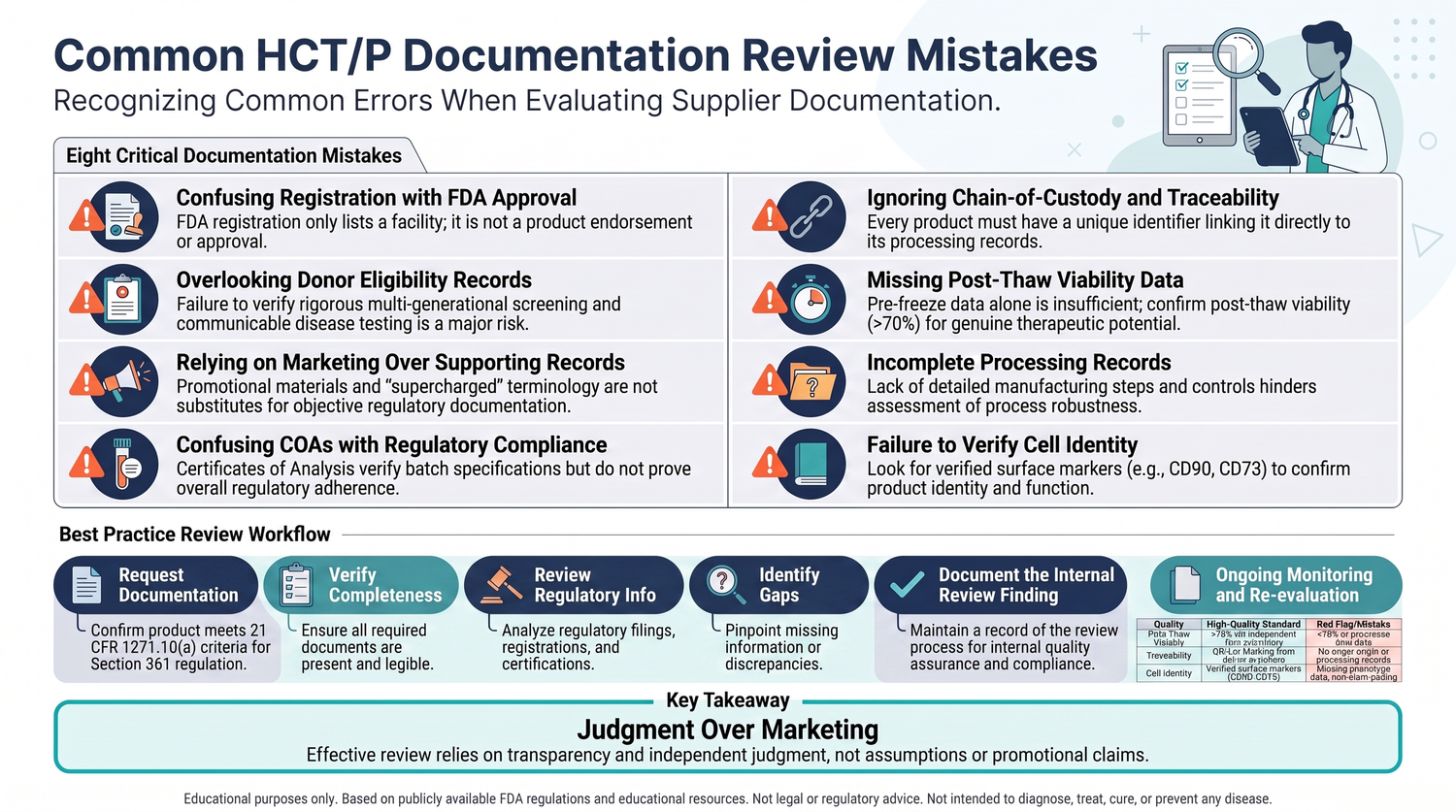
This infographic is intended to complement publicly available FDA regulations, guidance documents, and educational resources. It does not replace independent regulatory or professional judgment.
Why Documentation Review Mistakes Occur
Documentation review rarely fails because information is unavailable. More often, mistakes occur because individual documents are interpreted without sufficient regulatory context. A Certificate of Analysis may answer questions about a particular lot, while donor eligibility documentation addresses donor qualification. Processing records describe processing practices, whereas FDA establishment registration identifies a regulated establishment. Each document contributes valuable information, but none independently explains the complete regulatory framework applicable to an HCT/P.
A structured review process helps healthcare professionals organize documentation logically, distinguish between different types of records, and identify where additional clarification may be appropriate. Rather than asking whether one document is "enough," effective documentation review considers how each record contributes to a broader understanding of supplier documentation, regulatory concepts, and documentation transparency.
Documentation-First Principle
Documentation should be reviewed according to what each record actually supports. No individual document should be treated as a substitute for the broader regulatory framework, and supplier documentation alone should not be treated as determining regulatory classification.
Mistake #1 — Confusing FDA Establishment Registration with FDA Approval
One of the most common documentation review mistakes is assuming that an FDA establishment registration indicates FDA approval of a product. Although both concepts involve the U.S. Food and Drug Administration, they serve different regulatory purposes and should never be interpreted as equivalent.
Certain establishments that manufacture, recover, process, store, label, package, or distribute Human Cells, Tissues, and Cellular and Tissue-Based Products (HCT/Ps) may be required to register with the FDA under 21 CFR Part 1271. Registration identifies an establishment within the FDA's regulatory framework, but it does not constitute product approval, clearance, certification, endorsement, or a determination regarding safety or effectiveness.
During supplier documentation review, FDA establishment registration should therefore be viewed as one component of a larger documentation package. Healthcare professionals should also understand how regulatory classification concepts, donor eligibility, processing documentation, quality systems, traceability, and product-specific documentation relate to the broader evaluation of the HCT/P being reviewed.
Rather than asking, "Is the supplier FDA registered?", consider asking:
- What type of establishment is registered?
- Which HCT/P activities are documented?
- How does the registration relate to the supplier's documentation package?
- What additional documentation provides context for the product under review?
For additional educational background, review:
Mistake #2 — Allowing Marketing Materials to Replace Technical Documentation
Supplier brochures, presentations, websites, and educational marketing materials often provide a helpful overview of an HCT/P or tissue establishment. However, one of the most frequent documentation review mistakes is relying primarily on these summaries without reviewing the technical documentation that supports the information being presented.
Marketing materials are intended to communicate information efficiently and may summarize complex regulatory concepts in simplified language. They are not designed to replace donor eligibility documentation, processing records, Certificates of Analysis, traceability documentation, storage information, or other supporting records that contribute to a comprehensive documentation review.
An effective documentation review distinguishes between promotional communication and supporting documentation. Rather than accepting marketing statements at face value, reviewers should identify the underlying records that provide additional educational context and determine whether further clarification may be appropriate.
This approach strengthens documentation transparency while encouraging a consistent methodology for evaluating supplier documentation across different HCT/P suppliers and tissue establishments.
- Use marketing materials as an introduction—not as the primary source of documentation.
- Review technical documentation alongside educational summaries.
- Verify that supporting records provide appropriate context for the information presented.
- Document questions for follow-up whenever additional clarification would improve understanding.
Mistake #3 — Overlooking Donor Eligibility Documentation
Donor eligibility documentation is a fundamental component of many HCT/P documentation packages and provides important educational context regarding donor qualification under 21 CFR Part 1271. While donor eligibility documentation does not independently determine the regulatory status of an HCT/P, reviewing these records contributes to a more complete understanding of the supplier's overall documentation package.
One of the most common documentation review mistakes is giving significant attention to product specifications while overlooking donor-related documentation. Educational review should consider how donor screening, communicable disease testing, relevant medical history review, and donor eligibility determinations are documented and how these records fit within the broader documentation package.
Reviewing donor eligibility documentation together with processing information, traceability records, storage documentation, and quality system records provides greater educational context than reviewing each document independently. This structured approach promotes documentation transparency while helping healthcare professionals understand how individual records contribute to the overall regulatory framework applicable to Human Cells, Tissues, and Cellular and Tissue-Based Products (HCT/Ps).
Rather than simply confirming that donor eligibility documentation is available, consider asking:
- What donor qualification information is documented?
- How is donor screening described?
- What supporting documentation accompanies donor eligibility records?
- How do donor records relate to the remainder of the documentation package?
Continue learning with:
Mistake #4 — Interpreting a Certificate of Analysis as the Complete Regulatory Picture
Certificates of Analysis (COAs) are valuable technical documents that frequently accompany HCT/P documentation packages. They may summarize product-specific information associated with a particular lot, processing activity, or testing methodology. However, one of the most common documentation review mistakes is assuming that a Certificate of Analysis alone provides a complete understanding of an HCT/P or demonstrates overall regulatory compliance.
A Certificate of Analysis represents only one component of a broader documentation package. Depending on the HCT/P being evaluated, additional documentation may include donor eligibility records, processing documentation, storage guidance, traceability records, labeling information, Current Good Tissue Practice (cGTP) documentation, regulatory information, and other supporting technical records. Each document contributes unique information that should be interpreted within the context of the complete documentation package.
Healthcare professionals performing educational documentation review should understand the intended purpose of a Certificate of Analysis while recognizing its limitations. Evaluating supporting documentation together—rather than relying on any single document—encourages a more organized review process and strengthens documentation transparency.
- A Certificate of Analysis should be interpreted within the context of the complete documentation package.
- No individual document independently establishes the complete regulatory picture.
- Supporting documentation provides context that may not be reflected within a Certificate of Analysis alone.
- Structured documentation review improves regulatory literacy and promotes informed educational evaluation.
Mistake #5 — Treating Documentation as a Regulatory Determination
Supplier documentation is an important source of information during professional evaluation, but documentation itself should not be treated as independently determining the regulatory classification of an HCT/P.
Regulatory classification depends upon the applicable statutory and regulatory framework and the facts associated with the particular HCT/P, including relevant characteristics, processing, intended use, and other applicable considerations. Documentation may provide information relevant to those questions, but the existence of a document, statement, certificate, registration, or supplier position does not by itself establish a regulatory conclusion.
- Federal statutes and regulations establish the governing legal framework.
- FDA guidance and educational publications provide regulatory interpretation and context.
- Supplier documentation provides information that may be reviewed within that framework.
- Scientific literature may provide scientific or biological context.
- Professional evaluation considers relevant information without treating any single source as automatically determinative.
Mistake #6 — Comparing Suppliers Before Reviewing Each Documentation Package Independently
Another common mistake is beginning with side-by-side supplier comparison before completing an independent review of each documentation package. This can cause differences in presentation, document quantity, terminology, or marketing emphasis to influence the evaluation before the underlying records have been organized and understood.
A more consistent methodology is to review each supplier independently using the same documentation categories and then compare documented observations. This helps keep the comparison focused on supporting records rather than presentation style, brand familiarity, or supplier popularity.
- Review each supplier documentation package independently.
- Use the same documentation categories for each review.
- Record documentation gaps and questions objectively.
- Request clarification when additional context is appropriate.
- Only then compare the documentation packages using a consistent framework.
For the complete comparison methodology, review Comparing HCT/P Supplier Documentation.
Building a Consistent Documentation Review Process
Many documentation review mistakes can be avoided by following a consistent methodology for every supplier evaluation. Rather than changing the review process for each documentation package, healthcare professionals benefit from using the same structured framework regardless of the supplier, tissue type, or product category being evaluated.
An organized documentation review typically begins with understanding the applicable regulatory framework before progressing through regulatory concepts, donor eligibility documentation, processing records, quality systems, traceability documentation, Certificates of Analysis, storage information, and product-specific supporting materials. Applying this sequence consistently promotes documentation transparency while making it easier to compare documentation packages objectively.
- Understand the applicable regulatory framework.
- Review documentation as a complete package.
- Differentiate educational summaries from technical documentation.
- Interpret each document according to its intended purpose.
- Identify documentation gaps before forming conclusions.
- Request clarification whenever additional documentation would improve understanding.
- Apply the same review methodology consistently across all supplier evaluations.
From Documentation Education to Professional Evaluation
The Not By Chance Life Knowledge Center teaches a documentation-first methodology for understanding, organizing, requesting, reviewing, questioning, and comparing HCT/P supplier documentation.
That educational function remains separate from the actual professional evaluation workflow.
NBCL Connect — Professional Evaluation Management Platform
When qualified healthcare professionals are ready to move from public education into structured professional evaluation, NBCL Connect provides the professional environment for evaluating participating organizations, requesting available documentation, communicating with organizations, coordinating meetings, managing evaluation-related tasks, and maintaining ongoing professional relationships.
The documentation review principles taught throughout the Knowledge Center can help professionals approach those interactions consistently. NBCL Connect provides the workflow environment; it does not perform the professional's evaluation or determine the conclusions of that evaluation.
NBCL Connect does not rank or recommend participating organizations, approve documentation packages, determine regulatory classification, determine product suitability, or make clinical or purchasing decisions.
Two Connected Systems
Knowledge Center → Learn & Understand
NBCL Connect → Evaluate & Connect
Moving from one environment to the other does not change the underlying principle: documentation supports professional evaluation but does not independently establish regulatory status, product quality, clinical appropriateness, or purchasing conclusions.
Frequently Asked Questions
Why should the entire HCT/P documentation package be reviewed instead of individual documents?
Every document within an HCT/P documentation package serves a specific purpose. Donor eligibility documentation, processing records, traceability information, Certificates of Analysis, quality system documentation, storage guidance, and regulatory information may each contribute different information. Reviewing the documentation package as a whole provides broader context than relying on any single record.
Does FDA establishment registration mean an HCT/P is FDA approved?
No. FDA establishment registration and FDA approval are separate regulatory concepts. Registration identifies certain tissue establishments operating within the applicable regulatory framework but should not be interpreted as FDA approval, clearance, certification, endorsement, or a determination regarding product safety or effectiveness.
Learn more in: 21 CFR Part 1271 Regulatory Framework, 21 CFR 1271.10(a) Classification Criteria, and Section 361 vs. Section 351 HCT/P Classification.
Why shouldn't marketing materials be the primary source of documentation review?
Marketing materials are intended to introduce products or organizations and summarize information. They do not replace supporting technical documentation such as donor eligibility records, processing documentation, traceability information, or Certificates of Analysis. A structured educational review emphasizes supporting documentation rather than promotional summaries alone.
What should I do if supplier documentation appears incomplete?
Incomplete documentation does not automatically establish a regulatory problem or other conclusion. It may indicate that additional clarification or supporting documentation would improve understanding. A consistent documentation review process encourages reviewers to identify information gaps, document follow-up questions, and avoid unsupported conclusions.
Can one document determine the regulatory classification of an HCT/P?
No. Regulatory classification should not be determined by reviewing a single supplier document in isolation. The applicable statutes, regulations, FDA guidance, documented facts, product characteristics, processing, intended use, and other relevant considerations may all be important to understanding the applicable regulatory framework.
Why is documentation transparency important?
Documentation transparency supports regulatory literacy by helping healthcare professionals understand what documentation is available, how individual records relate to one another, and where additional information may be appropriate. A transparent documentation package can support more organized educational review and informed professional discussion.
Does a Certificate of Analysis establish regulatory compliance?
No. A Certificate of Analysis may provide technical information associated with a particular product, lot, or testing methodology, but it represents only one component of a broader documentation package and should not be treated as independently establishing regulatory compliance.
Does NBCL Connect evaluate supplier documentation for healthcare professionals?
No. NBCL Connect provides a professional evaluation management environment in which qualified professionals can interact with participating organizations and manage documentation-related workflows. The professional remains responsible for reviewing and interpreting documentation and making independent professional decisions.
Continue Your HCT/P Regulatory & Documentation Education
Avoiding documentation review mistakes is one part of developing a structured approach to HCT/P regulatory and documentation education. Continue expanding your understanding through the resources below.
Supplier Documentation Knowledge Center
- HCT/P Supplier Documentation Evaluation Framework
- HCT/P Supplier Documentation Checklist
- Requesting HCT/P Supplier Documentation
- Questions to Ask an HCT/P Supplier
- Comparing HCT/P Supplier Documentation
- Common HCT/P Documentation Review Mistakes
- Supplier Evaluation Process
- HCT/P Documentation FAQ
- HCT/P Documentation Glossary
Core Regulatory Education
- What Is Section 361?
- 21 CFR Part 1271 Regulatory Framework
- 21 CFR 1271.10(a) Classification Criteria
- Minimal Manipulation
- Homologous Use
- Structural vs. Cellular Tissue
- Donor Eligibility
- Current Good Tissue Practice (cGTP)
- Donor Screening, Traceability & Quality Standards
- HCT/P Regulatory Evaluation Pathway
Professional Access
Qualified healthcare professionals who are ready to move from public education into structured professional evaluation can learn about Professional Access or access NBCL Connect directly.
You may also return to the Not By Chance Life Knowledge Center to explore its three educational pillars: Regulatory Foundations, Supplier Documentation, and Scientific Education.
Regulatory & Educational Notice
Certain materials discussed throughout this educational resource relate to Human Cells, Tissues, and Cellular and Tissue-Based Products (HCT/Ps) regulated under 21 CFR Part 1271. Regulatory classification depends on the applicable statutory and regulatory framework and the facts associated with an individual product, including relevant characteristics, processing methods, intended use, and other applicable considerations.
FDA establishment registration does not constitute FDA approval, product clearance, certification, endorsement, or a determination regarding product safety or effectiveness.
Supplier documentation may provide important information during professional evaluation, but documentation alone does not determine regulatory classification, regulatory compliance, product quality, clinical appropriateness, or purchasing suitability.
Scientific publications may provide scientific and biological context. Scientific literature does not independently determine regulatory classification or establish clinical appropriateness.
Not By Chance Life LLC provides regulatory education, documentation guidance, scientific education, provider education, educational resources, documentation transparency resources, and professional evaluation infrastructure. Not By Chance Life does not provide medical treatment, patient care, legal advice, regulatory determinations, or clinical recommendations.
NBCL Connect facilitates structured professional evaluation and communication between qualified healthcare professionals and participating organizations. Participation in NBCL Connect does not constitute approval, endorsement, certification, recommendation, or validation of an organization, product, documentation package, regulatory position, or clinical use.
This information is provided for educational purposes only and should not be interpreted as legal, regulatory, medical, or clinical advice.