

Cell Viability & Post-Thaw Assessment
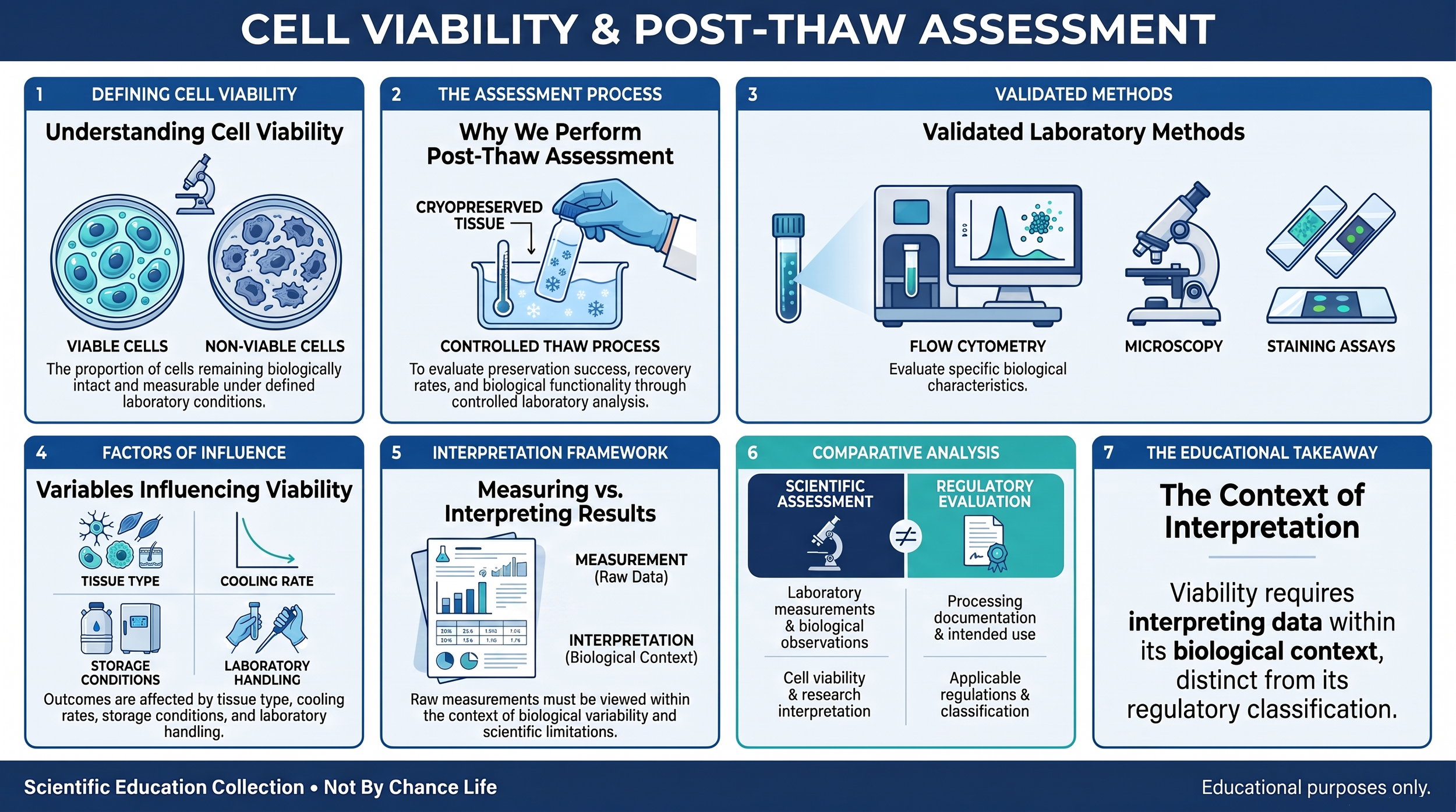
Cell viability assessment is an important area of laboratory science that evaluates the proportion of cells remaining biologically intact and measurable under defined testing conditions following preservation and controlled thawing. Scientific investigations use viability measurements to better understand preservation biology, cellular integrity, laboratory methodology, and tissue characteristics while recognizing that individual measurements represent one component of a broader biological evaluation.
This educational resource explains the scientific principles underlying cell viability testing, post-thaw assessment, commonly used laboratory methods, interpretation of viability measurements, biological variability, and the limitations associated with different analytical approaches. The discussion focuses exclusively on scientific concepts and does not address product-specific performance, clinical outcomes, or regulatory determinations.
Although cell viability measurements are frequently discussed throughout cryobiology and tissue preservation literature, laboratory results should always be interpreted within their biological context. Viability measurements are influenced by tissue type, preservation methodology, storage conditions, laboratory procedures, analytical techniques, and numerous other variables. Understanding these influences helps readers interpret scientific publications responsibly while distinguishing biological observations from regulatory evaluation.
What Is Cell Viability?
Cell viability refers to the proportion of cells that remain biologically intact and measurable under defined laboratory conditions. In scientific research, viability assessments help investigators evaluate how cells respond to preservation, storage, controlled thawing, and laboratory handling. These measurements provide valuable biological information but should always be interpreted within the context of the analytical method used, the tissue being evaluated, and the objectives of the scientific investigation.
Viability is not simply a measure of whether a cell is "alive" or "dead." Rather, it reflects specific biological characteristics that are being assessed through a particular laboratory methodology. Different analytical techniques evaluate different aspects of cellular integrity, such as membrane integrity, metabolic activity, enzyme function, or other measurable biological properties. Consequently, viability measurements obtained using one laboratory method may not be directly comparable with measurements obtained using another.
Because biological tissues are inherently complex, viability measurements represent one component of a broader scientific assessment. Researchers frequently interpret viability alongside additional laboratory observations, including structural analysis, extracellular matrix organization, biochemical measurements, microscopic evaluation, and other scientific findings that collectively contribute to understanding tissue characteristics following preservation.
Numerous biological and technical factors may influence viability measurements. Tissue type, preservation protocol, cryoprotective solutions, cooling rate, storage duration, thawing procedures, sample preparation, analytical equipment, and laboratory technique may all affect measured results. Recognizing these variables is essential for responsible interpretation of scientific literature and laboratory reports.
Understanding the principles of cell viability improves scientific literacy by helping readers recognize both the value and the limitations of laboratory measurements. Rather than viewing viability as an isolated indicator, scientific investigations interpret these measurements within the broader biological context of the study being performed.
Why Post-Thaw Assessment Is Performed
Following cryopreservation, tissues commonly undergo controlled laboratory evaluation to better understand how preservation and thawing may have influenced measurable biological characteristics. Post-thaw assessment allows researchers to examine cellular integrity, tissue structure, extracellular matrix organization, and other biological features under standardized laboratory conditions. These evaluations contribute to scientific understanding of preservation biology and help investigators compare different preservation methodologies within experimental settings.
The timing and methodology of post-thaw assessment are carefully considered because biological characteristics may continue to change during the recovery period following thawing. Scientific protocols therefore establish standardized handling procedures designed to minimize unnecessary variation and improve consistency between laboratory evaluations.
Post-thaw assessments frequently include multiple forms of analysis rather than relying upon a single measurement. Depending upon the objectives of the investigation, researchers may perform cell viability testing, microscopic examination, extracellular matrix evaluation, biochemical analysis, molecular characterization, or additional laboratory techniques that collectively provide a more comprehensive understanding of preserved tissue characteristics.
Importantly, post-thaw laboratory assessments are scientific measurements rather than regulatory determinations. They provide biological information that may contribute to scientific investigation, but they do not independently establish regulatory classification, product characteristics, clinical performance, or FDA authorization. Maintaining this distinction is fundamental throughout the Scientific Education collection.
Validated Laboratory Assessment Methods
Laboratory scientists use a variety of analytical methods to evaluate cell viability following preservation and controlled thawing. Each technique measures different biological characteristics and possesses its own strengths, limitations, and appropriate applications. Consequently, viability measurements should always be interpreted within the context of the specific analytical method used rather than viewed as universally interchangeable values.
One commonly used approach is dye exclusion testing, which evaluates cellular membrane integrity. Certain dyes penetrate cells with compromised membranes while being excluded by cells that maintain membrane integrity under the conditions of the assay. This method provides one measure of cellular condition but does not directly assess every aspect of biological function.
Flow cytometry is another widely used laboratory technique that allows investigators to analyze large numbers of individual cells rapidly. Depending upon the experimental design, flow cytometry may be combined with fluorescent markers to evaluate membrane integrity, cellular characteristics, or other measurable biological properties. Because numerous analytical configurations are possible, interpretation depends upon the specific methodology employed during the investigation.
Microscopic evaluation remains an important component of many post-thaw assessments. Light microscopy, fluorescence microscopy, and other imaging techniques allow researchers to visually examine cellular morphology, tissue architecture, extracellular matrix organization, and structural characteristics that may not be captured by numerical viability measurements alone.
Additional laboratory methods—including fluorescent staining assays, metabolic activity assays, enzyme-based analyses, molecular techniques, and other specialized evaluations—may also be incorporated depending upon the scientific objectives of the investigation. Rather than relying upon a single laboratory measurement, many studies combine multiple analytical approaches to obtain a more comprehensive understanding of preserved biological tissues.
Because each analytical technique measures different biological characteristics, direct comparison between studies requires careful consideration of methodology, laboratory protocols, instrumentation, and reporting standards. Understanding these methodological differences is essential for responsible interpretation of scientific literature.
Factors That Influence Viability Measurements
Cell viability measurements are influenced by numerous biological, physical, and technical variables. As a result, laboratory results should always be interpreted within the context of the preservation process, analytical methodology, and characteristics of the tissue under investigation. Even when identical laboratory methods are used, differences in biological systems may produce different measured outcomes.
Tissue type represents one of the most important variables affecting viability assessment. Different tissues possess unique extracellular matrix composition, cellular organization, hydration, and structural characteristics that influence how they respond to preservation and subsequent laboratory evaluation. Consequently, findings obtained from one tissue type should not automatically be generalized to another.
The preservation protocol also contributes significantly to measured viability. Cooling rate, cryoprotective solutions, storage temperature, storage duration, and controlled thawing procedures may each influence measurable biological characteristics observed during laboratory analysis.
Laboratory handling introduces additional sources of variability. Sample preparation, transport conditions, timing of analysis, operator technique, analytical equipment, calibration procedures, and data processing methods may all affect reported results. Scientific publications therefore describe laboratory methodology in detail so that readers can appropriately interpret findings and evaluate reproducibility.
Biological variability further contributes to differences observed among studies. Individual tissues, donor characteristics, experimental conditions, and natural biological diversity all influence laboratory observations. Responsible scientific interpretation requires recognizing that measured values represent observations obtained under specific experimental conditions rather than universal biological constants.
Interpreting Viability Results
\Interpreting cell viability measurements requires careful consideration of both the laboratory methodology and the broader biological context in which the data were obtained. Numerical viability values represent observations made under specific experimental conditions and should not be interpreted independently of the analytical methods, tissue characteristics, preservation protocol, or study objectives. Responsible scientific interpretation therefore extends beyond reviewing a single percentage or laboratory result.
One important consideration is that different laboratory methods evaluate different biological properties. For example, a method that measures membrane integrity provides different information than one assessing metabolic activity or cellular enzyme function. Because these techniques evaluate distinct aspects of cellular biology, results obtained using different methodologies should not be assumed to represent identical biological observations.
The timing of post-thaw evaluation also influences interpretation. Biological characteristics may continue to change during the period immediately following controlled thawing as tissues gradually recover from preservation conditions. Scientific studies therefore frequently establish standardized evaluation intervals to improve consistency between observations and reduce unnecessary variability within the investigation.
Viability measurements should also be interpreted alongside complementary laboratory findings. Researchers commonly consider structural integrity, extracellular matrix organization, microscopic appearance, biochemical analyses, and other laboratory observations together rather than relying upon a single measurement to characterize preserved tissues. This integrated approach provides a more complete scientific understanding of biological characteristics following preservation.
When reviewing scientific publications, readers should pay close attention to how investigators describe their methodology, analytical limitations, statistical analysis, and interpretation of results. Understanding these details helps distinguish carefully supported conclusions from broader inferences while strengthening the ability to critically evaluate scientific literature.
Scientific Assessment and Regulatory Evaluation
Laboratory assessment and regulatory evaluation serve different purposes and should not be viewed as interchangeable processes. Cell viability testing provides scientific information regarding measurable biological characteristics under defined laboratory conditions, whereas regulatory evaluation considers applicable statutes, regulations, intended use, processing methods, manufacturing practices, and documented product characteristics.
For Human Cells, Tissues, and Cellular and Tissue-Based Products (HCT/Ps), regulatory classification under 21 CFR Part 1271 depends upon the applicable regulatory framework rather than laboratory viability measurements alone. Scientific observations contribute to biological understanding, but they do not independently establish regulatory status, FDA authorization, or product-specific performance.
Maintaining this distinction is essential when interpreting scientific publications and technical documentation. Cell viability represents one scientific measurement within a broader biological evaluation, while regulatory decisions require consideration of multiple factors established through applicable federal regulations and supporting documentation.
Readers seeking additional information regarding the federal regulatory framework should continue with the Regulatory Foundations collection. Those interested in evaluating supplier documentation should explore the Supplier Evaluation Process, where biological concepts are considered alongside documentation review within an educational framework.
Related Scientific Education Resources
- Scientific Education
- Extracellular Matrix (ECM) Biology
- Placental & Perinatal Tissue Biology
- Extracellular Vesicle & Exosome Biology
- Secretome Biology
- Tissue Preservation Science
- Reading Scientific Literature
- Scientific Glossary
Readers seeking additional regulatory context may also benefit from the Regulatory Foundations collection and the Supplier Evaluation Process, which explain how biological science, federal regulations, and documentation review complement one another while serving distinct educational purposes.
This educational resource is provided for scientific education only. Discussions of cell viability, post-thaw assessment, laboratory testing, cryobiology, preservation science, analytical methods, and related biological concepts are intended solely to improve scientific literacy. They should not be interpreted as evidence of regulatory classification, FDA authorization, clinical effectiveness, or product-specific performance. Regulatory determinations should always be based upon applicable statutes, regulations, FDA guidance documents, intended use, processing methods, and the documented characteristics of the individual Human Cell, Tissue, or Cellular and Tissue-Based Product (HCT/P).