
Questions to Ask an HCT/P Supplier
Evaluating supplier documentation for Human Cells, Tissues, and Cellular and Tissue-Based Products (HCT/Ps) involves more than confirming that documents have been provided. A structured documentation review also includes asking thoughtful questions that improve understanding of regulatory concepts, donor eligibility, documentation transparency, quality systems, traceability, and the supporting records accompanying an HCT/P.
The purpose of these questions is educational. Rather than attempting to determine regulatory status or reach conclusions from isolated records, healthcare professionals can use targeted questions to better understand the documentation presented, identify areas requiring clarification, and evaluate documentation within the regulatory framework established under 21 CFR Part 1271.
This guide organizes documentation-related questions into practical categories that support consistent supplier evaluation while strengthening regulatory literacy. It is intended to complement the broader Supplier Documentation Knowledge Center and should be used alongside the HCT/P Supplier Documentation Evaluation Framework, the HCT/P Supplier Documentation Checklist, and the Comparing HCT/P Supplier Documentation guide.
Questions to Ask During HCT/P Supplier Documentation Review
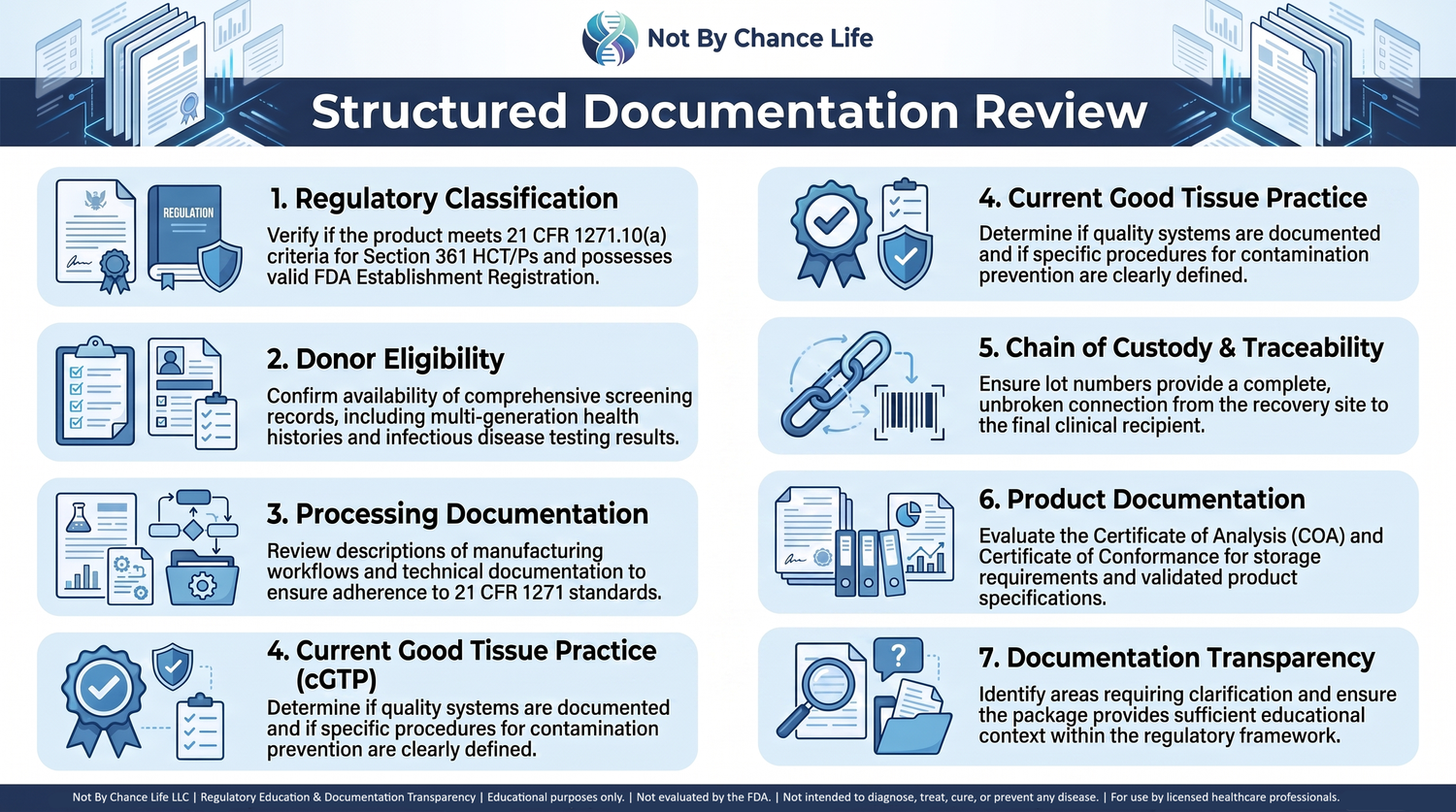
The infographic below provides a structured overview of the major categories of questions licensed healthcare professionals may consider when reviewing HCT/P supplier documentation. It is intended to promote documentation transparency, regulatory literacy, and consistent educational review under 21 CFR Part 1271.
Why Asking Questions Matters
The quality of a documentation review is influenced not only by the documents provided but also by the questions asked during the evaluation process. Thoughtful questions help place individual records into their proper regulatory context while improving documentation transparency and reducing the likelihood of misunderstanding technical information.
Supplier documentation often includes regulatory references, donor eligibility documentation, processing records, Certificates of Analysis, quality documentation, traceability records, storage guidance, and other supporting materials. Each document serves a different purpose. Asking appropriate questions helps healthcare professionals understand how these records relate to one another rather than viewing them as isolated documents.
Educational questions also encourage consistency. Applying the same documentation review process to every supplier promotes objective comparison and helps establish a repeatable methodology that supports regulatory literacy under 21 CFR Part 1271.
Questions should improve understanding—not replace documentation. The objective is to clarify regulatory concepts, understand supporting records, and identify opportunities for additional documentation where appropriate.
Documentation Questions to Ask Before Purchasing
Before evaluating individual technical documents, healthcare professionals may benefit from asking broad questions regarding the supplier's documentation package. These questions establish context for the remainder of the documentation review while helping identify which educational resources and supporting records are available.
Questions to Consider
- What documentation accompanies this HCT/P?
- Is the documentation package complete?
- Which records explain the regulatory framework applicable to this product?
- Are educational resources provided alongside technical documentation?
- How are the individual documents organized?
- What documentation should be reviewed first?
- Which records require additional clarification?
- Who can answer documentation-related questions if clarification is needed?
Beginning with these general questions creates a logical foundation before progressing into regulatory classification, donor documentation, processing information, quality systems, traceability, and product-specific records.
Regulatory Questions
Understanding the regulatory framework provides essential context for reviewing supplier documentation. Rather than relying on assumptions, healthcare professionals may ask questions that clarify how publicly available FDA regulations relate to the documentation being presented.
Questions to Consider
- Which regulatory framework is referenced?
- How does 21 CFR Part 1271 relate to this documentation package?
- Is Section 361 discussed?
- How does 21 CFR 1271.10(a) relate to the documentation?
- Is FDA Establishment Registration documented?
- What educational resources explain the regulatory terminology used throughout the documentation?
- Which publicly available FDA references support the regulatory concepts presented?
These questions help establish regulatory context before reviewing product-specific technical documentation.
Donor Documentation Questions
Donor documentation provides important educational context during HCT/P supplier evaluation. Rather than confirming only that donor documentation exists, healthcare professionals may ask questions that improve understanding of donor qualification, supporting records, and how donor documentation fits within the complete documentation package.
Questions to Consider
- What donor eligibility documentation is provided?
- How is donor screening documented?
- What relevant medical history information accompanies donor eligibility records?
- How is communicable disease testing documented?
- What supporting records accompany donor eligibility documentation?
- How do donor records relate to the remainder of the documentation package?
- Where can additional clarification be obtained if questions remain?
Reviewing donor documentation together with regulatory information, processing records, quality documentation, and traceability records promotes a more complete educational understanding than reviewing donor documentation independently.
Related educational resources: Donor Eligibility Under 21 CFR Part 1271 | Donor Screening, Traceability & Quality Standards | Chain of Custody & Tissue Traceability
Processing & Quality Questions
Processing documentation and quality records provide additional educational context regarding how an HCT/P has been documented throughout regulated activities. Asking consistent questions helps reviewers understand the purpose of these records while promoting documentation transparency.
Questions to Consider
- How is processing described within the documentation?
- What quality system documentation accompanies the product?
- Is Current Good Tissue Practice (cGTP) discussed?
- Which quality procedures are documented?
- What processing records accompany the documentation package?
- How are quality records connected to other supporting documentation?
- Are additional technical documents available if clarification is required?
Processing documentation should be interpreted together with donor documentation, traceability records, Certificates of Analysis, regulatory information, and product-specific supporting documentation to provide a more complete educational understanding.
Traceability & Chain of Custody Questions
Traceability documentation helps explain how products and supporting records remain connected throughout the documented lifecycle of an HCT/P. Questions related to traceability improve understanding of documentation continuity without implying conclusions regarding regulatory status or product performance.
Questions to Consider
- How is chain of custody documented?
- How are lot numbers associated with supporting documentation?
- How is product traceability maintained?
- Which records document storage and distribution?
- How are products identified throughout the documentation package?
- What documentation supports traceability?
- Are additional traceability records available upon request?
Continue reading: Chain of Custody & Tissue Traceability | Documentation Transparency for HCT/Ps
Product Documentation Questions
Product-specific documentation provides technical information that complements the broader regulatory and quality documentation contained within an HCT/P documentation package. Asking consistent questions about product documentation helps healthcare professionals better understand the purpose of individual records while avoiding conclusions based on isolated documents.
Questions to Consider
- Is a Certificate of Analysis (COA) provided?
- Is a Certificate of Conformance (CoC) available?
- What product specifications are documented?
- How are storage recommendations documented?
- Are handling instructions provided?
- How is product identification associated with the supporting documentation?
- Which documents explain technical terminology used throughout the documentation package?
Product documentation should always be reviewed together with donor eligibility records, processing documentation, quality systems, traceability documentation, and applicable regulatory references to provide a more complete educational understanding.
Questions That Often Require Clarification
During documentation review, it is common to encounter questions that cannot be answered by a single document. Rather than making assumptions, healthcare professionals should identify areas where additional clarification or supporting documentation would improve understanding.
Questions to Consider
- Which documents provide additional regulatory context?
- Are supporting records available for referenced technical information?
- Can terminology used throughout the documentation be clarified?
- How are related documents connected?
- What information is summarized rather than fully documented?
- Are additional educational resources available?
- Who is the appropriate contact for documentation-related questions?
Asking questions is part of a structured educational review process. Clarification improves documentation transparency and regulatory literacy while supporting informed professional evaluation. Questions should not be interpreted as evidence of regulatory concerns or deficiencies.
Documentation Review Best Practices
Applying the same review methodology to every supplier promotes consistency and reduces bias during documentation evaluation. Rather than changing the review process based on individual suppliers or products, healthcare professionals benefit from following a repeatable framework that emphasizes documentation transparency and regulatory understanding.
- Review the complete documentation package before reaching conclusions.
- Use educational questions to improve understanding rather than confirm assumptions.
- Interpret each document according to its intended purpose.
- Differentiate educational summaries from technical documentation.
- Identify opportunities for clarification before completing the review.
- Maintain the same documentation review methodology for every supplier.
- Reference publicly available FDA regulations when additional regulatory context is needed.
Frequently Asked Questions
Why should I ask questions during documentation review?
Thoughtful questions improve understanding of supplier documentation, strengthen documentation transparency, and provide additional regulatory context without replacing independent professional judgment.
Should one document answer every question?
No. Different documents serve different purposes. A complete educational review considers how multiple records work together to explain the regulatory, technical, and documentation framework surrounding an HCT/P.
Can suppliers provide additional documentation if questions remain?
Documentation packages vary among suppliers. When clarification is needed, healthcare professionals may request additional supporting documentation or educational resources to improve understanding.
Should documentation questions focus only on regulatory requirements?
No. Questions may also address donor documentation, processing records, quality systems, traceability, product documentation, storage recommendations, and educational resources that contribute to documentation transparency.
Continue Your HCT/P Regulatory Education
Asking thoughtful documentation questions represents only one component of a structured supplier evaluation process. Continue building regulatory literacy through the educational resources below, each of which expands upon topics discussed throughout this guide and supports documentation transparency under 21 CFR Part 1271.
Supplier Documentation Knowledge Center
- HCT/P Supplier Documentation Evaluation Framework
- HCT/P Supplier Documentation Checklist
- Comparing HCT/P Supplier Documentation
- HCT/P Documentation FAQ
- Common HCT/P Documentation Review Mistakes
- Documentation Transparency for HCT/Ps
- Supplier Evaluation Process
- Knowledge Center
Core Regulatory Education
- What Is Section 361?
- 21 CFR Part 1271 Regulatory Framework
- 21 CFR 1271.10(a) Classification Criteria
- Section 361 vs. Section 351 HCT/P Classification
- Minimal Manipulation
- Homologous Use
- Structural vs. Cellular Tissue
- Donor Eligibility
- Current Good Tissue Practice (cGTP)
- HCT/P Regulatory Evaluation Pathway
Professional Documentation Resources
Not By Chance Life provides educational resources intended to improve understanding of HCT/P regulatory concepts, supplier documentation, documentation transparency, and structured documentation evaluation. These materials are designed to support regulatory literacy using publicly available FDA regulations, guidance documents, and educational references.
Licensed healthcare professionals seeking additional educational resources or documentation guidance may continue through the Knowledge Center or request access to provider-specific educational materials after credential verification.
Regulatory & Compliance Notice
Certain materials discussed throughout this educational resource relate to Human Cells, Tissues, and Cellular and Tissue-Based Products (HCT/Ps) regulated under 21 CFR Part 1271. References to FDA regulations are provided solely for educational purposes to improve regulatory literacy and documentation transparency.
FDA establishment registration does not constitute FDA approval, product clearance, certification, endorsement, or a determination regarding product safety or effectiveness.
This information is provided for educational purposes only. It has not been evaluated by the U.S. Food and Drug Administration and is not intended to diagnose, treat, cure, or prevent any disease. The content is intended for licensed healthcare professionals and should be interpreted alongside publicly available FDA regulations, official FDA guidance documents, and independent professional judgment.