
Documentation Transparency for HCT/Ps
Documentation transparency is a foundational principle of educational supplier evaluation. Rather than relying upon individual documents, promotional materials, or isolated records, transparency encourages healthcare professionals to review documentation as a complete, organized body of information. When documentation is presented clearly and reviewed systematically, it provides valuable educational context regarding regulatory classification, donor eligibility, processing documentation, quality systems, traceability, and supporting records.
Within the regulatory framework governing Human Cells, Tissues, and Cellular and Tissue-Based Products (HCT/Ps), documentation transparency helps healthcare professionals organize publicly available information into a structured educational review. While documentation alone does not determine regulatory compliance, FDA classification, product quality, or clinical suitability, it provides the information necessary to better understand how supplier documentation supports the regulatory concepts described throughout 21 CFR Part 1271.
This educational guide expands upon the HCT/P Supplier Documentation Evaluation Framework and the HCT/P Supplier Documentation Checklist by explaining why documentation transparency is an important part of supplier documentation review. Rather than teaching how to evaluate individual documents, this resource explains how multiple documentation categories work together to create a more complete educational understanding of supplier documentation.
On This Page
Documentation transparency is achieved through the organization, completeness, and consistency of supplier documentation rather than through any single document viewed in isolation. This educational guide explains the principles of documentation transparency, the documentation categories that contribute to a structured review, and how organized documentation supports educational understanding within the HCT/P regulatory framework.
Why Documentation Transparency Matters
Healthcare professionals routinely review documentation originating from multiple sources, including regulatory information, donor qualification records, processing documentation, quality systems, storage requirements, traceability records, and product labeling. Documentation transparency helps organize these materials into a structured educational review so that individual records can be understood within the context of the complete documentation package.
Transparent documentation supports consistency. Rather than relying upon isolated documents or promotional summaries, healthcare professionals can evaluate how multiple documentation categories relate to one another and identify areas where additional clarification may be appropriate. This documentation-first approach encourages organized educational review while supporting independent professional judgment.
Documentation transparency should not be interpreted as evidence of regulatory compliance or product quality. Instead, transparency reflects how clearly documentation has been organized, presented, and made available for educational review. Complete and well-organized documentation allows healthcare professionals to better understand the regulatory concepts discussed throughout the Not By Chance educational library.
The Layers of Documentation Transparency
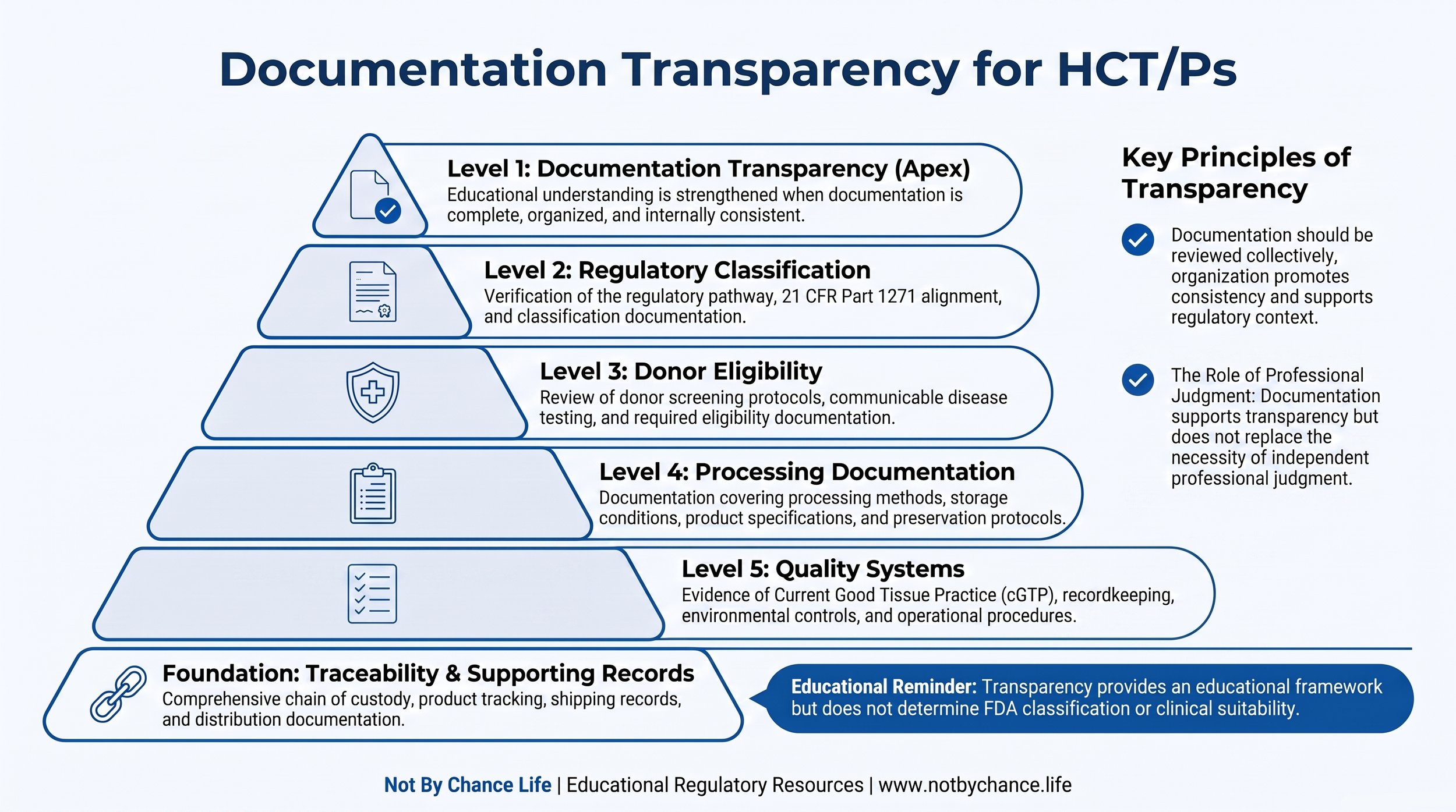
Documentation transparency is built progressively. Foundational supporting records establish product traceability, quality systems provide operational context, processing documentation explains how tissue has been handled, donor eligibility documents describe donor qualification, regulatory classification defines the applicable regulatory pathway, and together these documentation categories contribute to a more complete educational understanding of supplier documentation.
Core Principles of Documentation Transparency
Documentation transparency is not defined by the presence of a single record. Rather, it reflects how multiple categories of supporting documentation work together to provide a more complete educational understanding of a product's regulatory context. The principles below summarize the foundation of a documentation-first approach to supplier evaluation.
Documentation Should Be Reviewed Collectively
Individual documents rarely provide a complete understanding of supplier documentation. Reviewing documentation collectively allows healthcare professionals to understand how regulatory classification, donor eligibility, processing documentation, quality systems, traceability, and supporting records relate to one another.
Organization Promotes Consistency
Organizing documentation into standardized categories encourages a repeatable educational review process. Consistent organization also makes it easier to compare documentation packages over time while identifying questions that may require additional clarification.
Supporting Documentation Provides Context
Supporting records provide important educational context for understanding supplier documentation. Rather than serving as independent conclusions, these records help explain regulatory concepts, operational procedures, product handling, donor qualification, and documentation continuity.
Transparency Supports Educational Understanding
Documentation transparency allows healthcare professionals to better understand the information made available for educational review. It supports organization and informed discussion without determining regulatory compliance, FDA classification, product quality, or clinical suitability.
Independent Professional Judgment Remains Essential
Documentation supports educational review but does not replace independent professional judgment. Healthcare professionals remain responsible for evaluating available information, requesting clarification when appropriate, and making decisions within their own professional and regulatory responsibilities.
Documentation vs. Marketing Materials
Supplier documentation and marketing materials serve different educational purposes. Documentation is intended to communicate supporting information regarding regulatory concepts, donor qualification, processing documentation, quality systems, storage requirements, product specifications, and traceability. Marketing materials, by comparison, are designed to summarize information and communicate educational or commercial messages to their intended audience.
Reviewing documentation before promotional materials encourages healthcare professionals to develop an understanding of the available supporting records before considering summarized descriptions or educational marketing content. This documentation-first approach promotes consistency while helping organize information into a structured educational review.
Documentation transparency does not imply that marketing materials lack value. Rather, each serves a different purpose. Marketing resources may introduce a product or educational topic, while supporting documentation provides additional context that helps healthcare professionals better understand the information presented.
Benefits of Documentation Transparency
A documentation-first educational approach provides several practical benefits for healthcare professionals reviewing supplier documentation.
- Promotes consistent organization of supplier documentation.
- Supports more structured educational review.
- Encourages review of documentation as a complete package.
- Improves communication during documentation discussions.
- Helps identify documentation categories requiring additional clarification.
- Provides greater educational context for regulatory concepts discussed throughout 21 CFR Part 1271.
- Supports documentation transparency without replacing independent professional judgment.
Frequently Asked Questions
What is documentation transparency?
Documentation transparency refers to the organization, completeness, consistency, and accessibility of supplier documentation made available for educational review. Rather than relying on individual documents, documentation transparency encourages healthcare professionals to consider the complete documentation package when developing an educational understanding of regulatory concepts.
Does documentation transparency determine regulatory compliance?
No. Documentation transparency does not determine regulatory compliance, FDA classification, product quality, or clinical suitability. It is an educational principle that promotes organized documentation review and supports a more complete understanding of supplier documentation.
Why is documentation organization important?
Organizing documentation into consistent categories helps healthcare professionals review information systematically, compare documentation packages more consistently, and identify areas where additional clarification may be appropriate.
Does documentation transparency replace independent professional judgment?
No. Documentation transparency provides educational context only. Independent professional judgment remains essential when reviewing supplier documentation, interpreting regulatory information, and making decisions within the scope of professional responsibility.
How does documentation transparency relate to the Supplier Documentation Evaluation Framework?
The HCT/P Supplier Documentation Evaluation Framework explains the overall methodology for reviewing supplier documentation. Documentation transparency explains why organized, complete, and consistent documentation supports that educational review process.
How does this page relate to the Supplier Documentation Checklist?
The HCT/P Supplier Documentation Checklist provides a practical worksheet for organizing documentation. This page explains the educational philosophy behind that checklist and why documentation transparency is important during supplier evaluation.
Related Educational Resources
Continue exploring the Not By Chance Life regulatory education library through the resources below.
Documentation Resources
- HCT/P Supplier Documentation Evaluation Framework
- HCT/P Supplier Documentation Checklist
- HCT/P Regulatory Evaluation Pathway
Regulatory Foundation
Supporting Documentation Topics
Professional Documentation Guidance
Not By Chance Life provides educational regulatory resources designed to help licensed healthcare professionals better understand supplier documentation, documentation transparency, and publicly available regulatory concepts within the Human Cells, Tissues, and Cellular and Tissue-Based Products (HCT/P) regulatory framework.
Healthcare professionals seeking additional educational guidance may request documentation access, regulatory educational resources, or structured documentation review guidance.
Regulatory & Compliance Notice
Certain products discussed throughout this educational resource may be regulated as Human Cells, Tissues, and Cellular and Tissue-Based Products (HCT/Ps) under 21 CFR Part 1271. Regulatory classification depends upon the characteristics, processing methods, and intended use of each product.
Registration with the U.S. Food and Drug Administration does not constitute FDA approval, clearance, certification, or a determination regarding the safety or effectiveness of any product.
This information is provided for educational purposes only. It is not intended to diagnose, treat, cure, or prevent any disease and should not be interpreted as legal, regulatory, or clinical advice. Licensed healthcare professionals should exercise independent professional judgment and consult appropriate regulatory resources when necessary.