
HCT/P Supplier Documentation Checklist
Reviewing supplier documentation in a consistent, organized manner may help licensed healthcare professionals better understand the regulatory information, quality documentation, and supporting records that accompany Human Cells, Tissues, and Cellular and Tissue-Based Products (HCT/Ps). A structured checklist promotes documentation transparency by organizing records into logical categories before a comprehensive educational review begins.
This educational resource expands upon the HCT/P Supplier Documentation Evaluation Framework by providing a practical checklist that may be used during documentation review. Rather than serving as a regulatory audit or supplier scorecard, the checklist is intended to help organize documentation, identify areas requiring additional clarification, and support consistent documentation review under 21 CFR Part 1271.
The documentation categories presented throughout this guide reflect the types of records commonly reviewed when evaluating supplier documentation, including regulatory classification, donor eligibility, processing documentation, Current Good Tissue Practice (cGTP), chain of custody, traceability, storage documentation, and product labeling. Organizing documentation before reviewing individual records promotes a more systematic educational approach and helps ensure that important documentation categories are not overlooked.
On This Page
This educational resource provides a structured documentation checklist for organizing supplier records under the Human Cells, Tissues, and Cellular and Tissue-Based Products (HCT/P) regulatory framework. Each section expands upon a specific documentation category and links to additional educational resources throughout the Not By Chance regulatory library.
- Why Use a Documentation Checklist?
- How to Use This Checklist
- Printable Supplier Documentation Checklist
- Documentation Categories Explained
- Questions Healthcare Professionals May Consider
- Common Documentation Review Mistakes
- Frequently Asked Questions
- Related Educational Resources
- Professional Documentation Guidance
Why Use a Documentation Checklist?
Supplier documentation often includes regulatory information, donor eligibility records, processing documentation, quality system records, storage requirements, product specifications, and traceability documentation. Reviewing these records in a consistent sequence helps healthcare professionals understand how each document contributes to the overall documentation package.
Using a standardized checklist promotes consistency between documentation reviews, reduces the likelihood that important records will be overlooked, and creates a repeatable educational process that can be applied across multiple suppliers. Rather than relying upon promotional materials alone, documentation can be organized into clearly defined categories that support a more structured review.
This checklist should be viewed as an organizational tool rather than a compliance checklist. It does not determine whether documentation is sufficient, nor does it establish regulatory status. Instead, it helps healthcare professionals organize available documentation, record observations, and identify areas where additional clarification may be appropriate.
How to Use This Checklist
This educational checklist is intended to organize supplier documentation before conducting a detailed documentation review. Rather than evaluating documents in isolation, healthcare professionals may find it helpful to first organize available records into consistent documentation categories before reviewing the documentation package as a whole.
A structured documentation review helps create consistency between supplier evaluations, simplifies internal recordkeeping, and provides a repeatable educational process that may be applied whenever new documentation is received.
- Collect the available supplier documentation.
- Organize documents according to the categories listed below.
- Review each documentation category individually.
- Record observations, questions, or areas requiring clarification.
- Evaluate the documentation package collectively before forming an independent professional assessment.
☐ Documentation Not Yet Reviewed
◐ Additional Information Requested
☑ Documentation Reviewed
Printable HCT/P Supplier Documentation Checklist
The printable educational worksheet below summarizes the documentation categories discussed throughout this guide. Healthcare professionals may use this reference during supplier documentation review to organize records, document observations, and promote consistency between supplier evaluations. While the online checklist provides additional educational context, the printable worksheet offers a convenient reference for supplier meetings, internal documentation review, and recordkeeping.
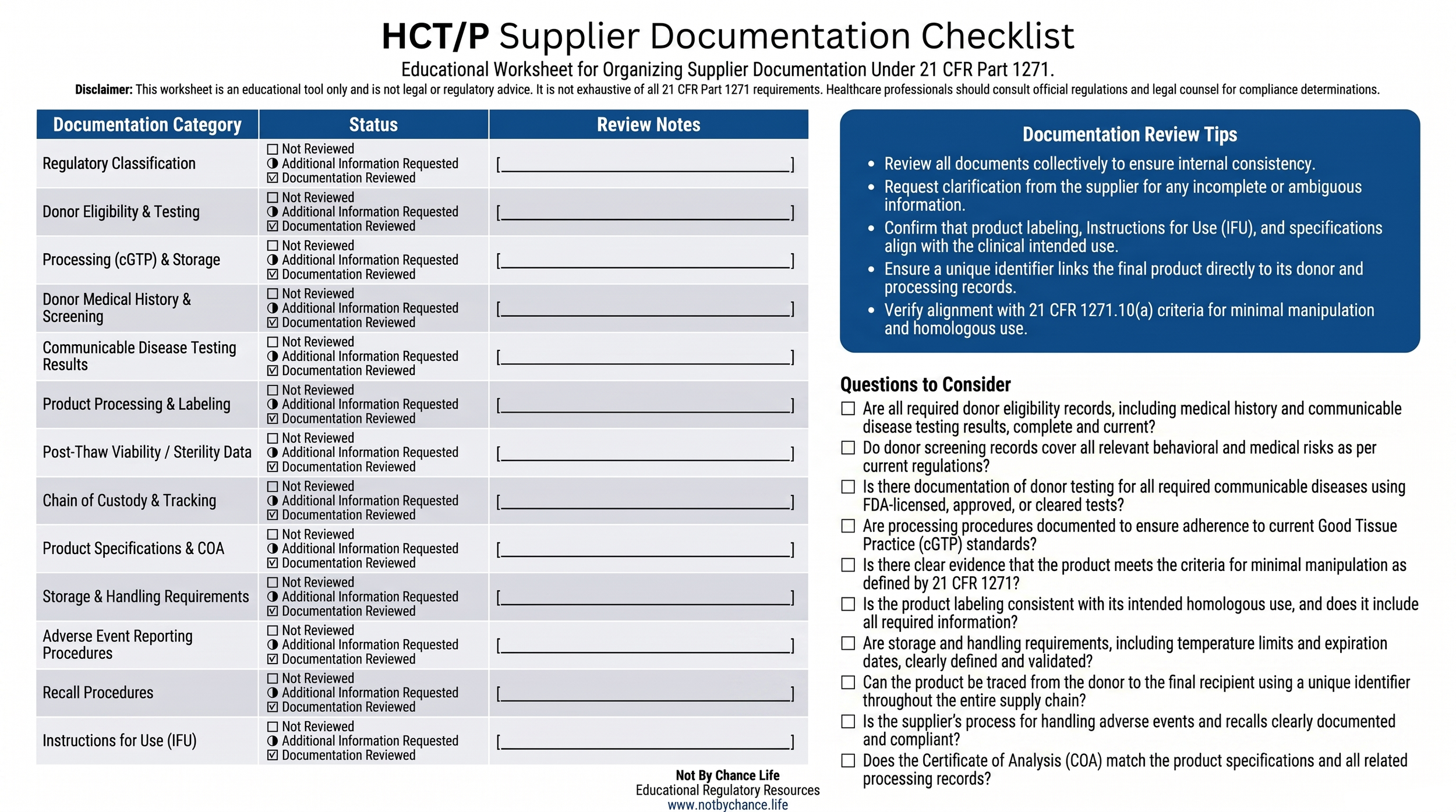
Interactive Documentation Review Worksheet
The interactive worksheet below expands upon the printable checklist by providing additional space to organize observations during documentation review. It is intended to support educational organization of supplier documentation and should not be interpreted as a regulatory audit or supplier ranking tool.
Documentation Categories Explained
Every document included within a supplier documentation package serves a different educational purpose. Understanding why each category is reviewed helps healthcare professionals organize documentation more effectively and develop a broader understanding of the regulatory framework governing Human Cells, Tissues, and Cellular and Tissue-Based Products (HCT/Ps).
The summaries below introduce each documentation category and provide links to more comprehensive educational resources available throughout the Not By Chance regulatory library.
Regulatory Classification
Understanding how a product is represented within the applicable regulatory framework provides the foundation for every documentation review. Regulatory classification establishes the context for interpreting the remaining supporting documentation.
Related Resources: 21 CFR Part 1271 Regulatory Framework | 21 CFR 1271.10(a) | Section 361 vs. Section 351
Donor Eligibility Documentation
Donor eligibility documentation describes the records supporting donor qualification, communicable disease testing, and documentation required under the applicable regulatory framework. Reviewing these records helps organize information related to donor screening and documentation.
Related Resource: Donor Eligibility
Processing Documentation
Processing documentation explains how tissue has been recovered, processed, preserved, packaged, stored, and prepared for distribution. Educational review focuses on understanding the documentation describing these activities rather than evaluating clinical performance.
Related Resources: Minimal Manipulation | Homologous Use
Current Good Tissue Practice (cGTP)
Current Good Tissue Practice (cGTP) documentation describes quality systems, operational controls, environmental monitoring, recordkeeping, and manufacturing procedures intended to support consistent handling and documentation practices.
Related Resource: Current Good Tissue Practice (cGTP)
Chain of Custody & Traceability
Chain of custody documentation supports product identification and traceability throughout recovery, processing, storage, shipping, and distribution. Educational review focuses on understanding how product records are documented and maintained throughout the product lifecycle.
Related Resource: Chain of Custody & Traceability
Product Specifications & Labeling
Product specifications, storage documentation, labeling, and instructions for use provide additional educational context regarding the information distributed with the product. Reviewing these documents collectively helps healthcare professionals understand how documentation supports product identification, handling, and storage.
Questions Healthcare Professionals May Consider
The following educational questions may assist licensed healthcare professionals in organizing supplier documentation during review. These questions are intended to support documentation transparency and identify topics that may benefit from additional clarification.
- How is the product represented within the applicable regulatory framework?
- Does the documentation explain the intended use of the product?
- Is donor eligibility documentation available?
- Is communicicable disease testing documented?
- Are processing methods described?
- Are storage and handling requirements documented?
- Are product specifications available?
- Does the documentation describe Current Good Tissue Practice (cGTP)?
- Can product traceability be followed throughout distribution?
- Are chain of custody records identified?
- Are instructions for use included?
- Does the documentation package appear internally consistent?
Common Documentation Review Mistakes
Even experienced healthcare professionals may encounter challenges when reviewing supplier documentation. A structured documentation-first approach helps reduce inconsistencies by encouraging every documentation package to be organized and reviewed using the same educational process.
Avoid These Common Mistakes
- Reviewing marketing materials before reviewing supporting documentation.
- Evaluating individual documents without considering the complete documentation package.
- Assuming missing documentation has been addressed without requesting clarification.
- Overlooking donor eligibility documentation.
- Ignoring storage, handling, or traceability documentation.
- Comparing promotional language rather than supporting records.
- Failing to document observations or questions during the review process.
- Reviewing suppliers using different evaluation methods rather than a consistent framework.
Frequently Asked Questions
Is this checklist intended to determine regulatory compliance?
No. This checklist is an educational organization tool designed to help licensed healthcare professionals review supplier documentation in a consistent manner. It should not be interpreted as a regulatory audit or compliance determination.
Can this checklist be used to compare suppliers?
The checklist provides a consistent method for organizing documentation from multiple suppliers. It does not rank suppliers or determine product quality, but it may help healthcare professionals compare documentation packages using the same educational framework.
Should documentation be reviewed before marketing materials?
A documentation-first approach encourages healthcare professionals to review supporting documentation before considering promotional materials. This helps ensure that documentation is evaluated within its proper regulatory context.
Why are donor eligibility and cGTP included?
Donor eligibility and Current Good Tissue Practice (cGTP) documentation are important educational components of many HCT/P documentation packages and help provide context regarding donor qualification and manufacturing quality systems.
What should I do if documentation appears incomplete?
Record the question, identify the documentation category involved, and request additional clarification from the supplier before completing the educational review.
Related Educational Resources
Continue exploring the Not By Chance Life regulatory education library with the following resources.
Supplier Documentation
Regulatory Foundation
Supporting Documentation Topics
Professional Documentation Guidance
Not By Chance Life provides educational regulatory resources designed to help licensed healthcare professionals better understand supplier documentation, documentation transparency, and publicly available regulatory concepts under 21 CFR Part 1271.
Healthcare professionals seeking additional educational guidance may request access to regulatory resources or documentation review support.
Regulatory & Compliance Notice
Certain products discussed throughout this educational resource may be regulated as Human Cells, Tissues, and Cellular and Tissue-Based Products (HCT/Ps) under 21 CFR Part 1271. Regulatory classification depends upon the characteristics, processing methods, and intended use of each product.
Registration with the U.S. Food and Drug Administration does not constitute FDA approval, clearance, certification, or a determination regarding the safety or effectiveness of any product.
This information is provided for educational purposes only. It is not intended to diagnose, treat, cure, or prevent any disease and should not be interpreted as legal, regulatory, or clinical advice. Licensed healthcare professionals should exercise independent professional judgment and consult appropriate regulatory resources when necessary.