

FDA HCT/P Establishment Registration Requirements
What is FDA HCT/P establishment registration?
FDA establishment registration is the process through which certain organizations engaged in activities involving Human Cells, Tissues, and Cellular and Tissue-Based Products (HCT/Ps) provide required registration information to the U.S. Food and Drug Administration under 21 CFR Part 1271.
In simple terms, qualifying tissue establishments may be required to register their operations with the FDA, but registration does not mean a product has been approved.
Organizations involved in the recovery, processing, storage, labeling, packaging, or distribution of human cell and tissue products may be subject to establishment registration requirements under 21 CFR Part 1271.
Registration requirements are established primarily under Subpart B and operate alongside other regulatory requirements including 21 CFR 1271.10(a), donor eligibility, and Current Good Tissue Practice (cGTP).
For a structured overview showing how establishment registration fits within the complete regulatory review process, see the HCT/P Regulatory Evaluation Pathway .
Documentation and Regulatory Education
Not sure how these requirements apply to your current sourcing or protocols?
Licensed medical professionals and organizations may request educational materials related to establishment registration, supplier documentation, regulatory classification, and compliance practices referenced throughout this resource.
Credential verification may be required prior to documentation access.
Request Regulatory Information
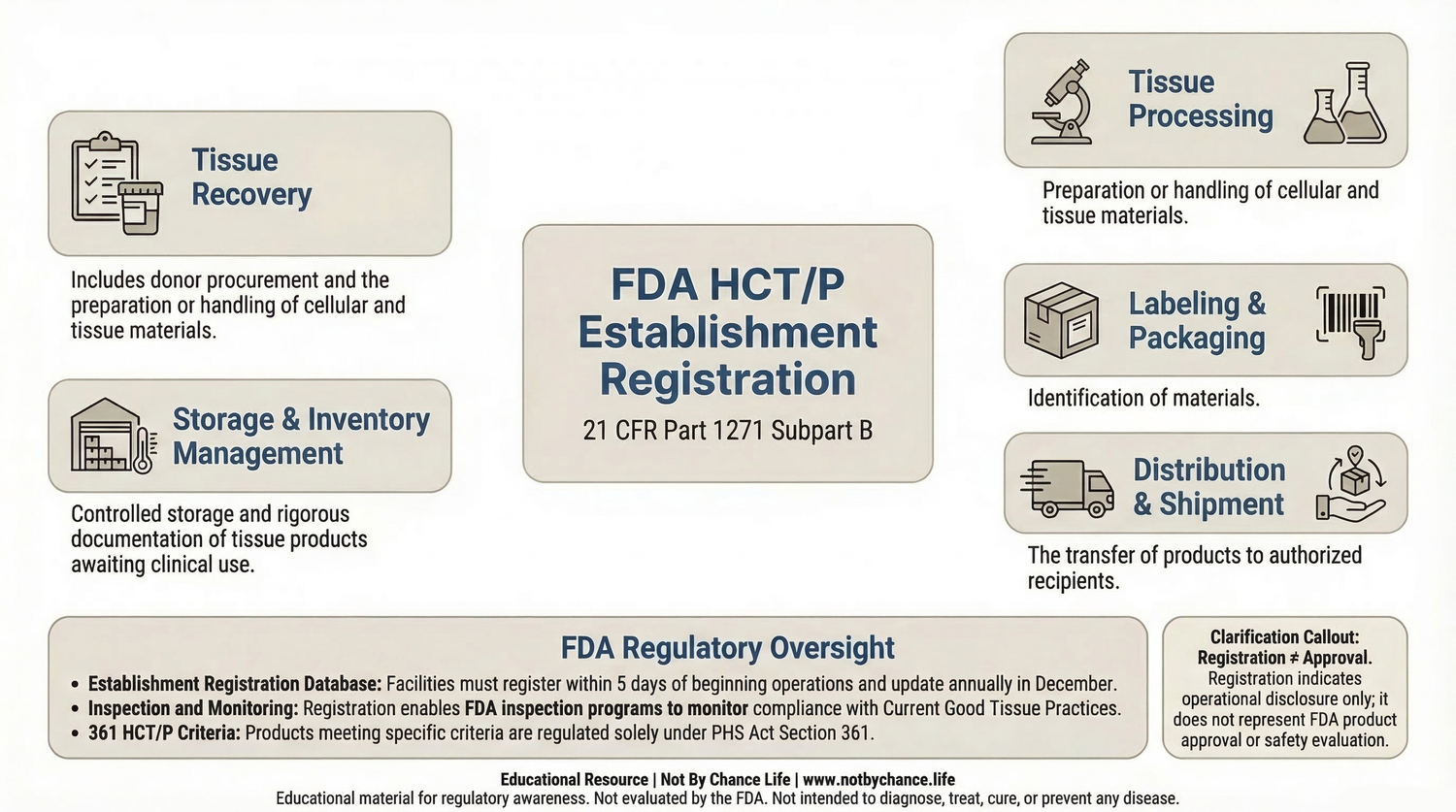
Educational diagram illustrating FDA establishment registration under 21 CFR Part 1271 Subpart B and its relationship to broader HCT/P regulatory oversight.
Purpose of Establishment Registration
FDA establishment registration enables the agency to maintain records of tissue establishments engaged in activities involving Human Cells, Tissues, and Cellular and Tissue-Based Products (HCT/Ps). This framework supports regulatory oversight, inspection activities, and monitoring of compliance with applicable requirements.
Registration helps identify facilities involved in the recovery, processing, storage, labeling, packaging, and distribution of HCT/Ps. It is one component of the broader regulatory framework established under 21 CFR Part 1271.
Entities That May Be Required to Register
Under 21 CFR Part 1271 Subpart B, certain organizations performing regulated HCT/P activities may be required to register with the FDA. Activities may include:
- Recovery of human tissues
- Processing of HCT/Ps
- Storage of tissue materials
- Labeling or packaging of HCT/Ps
- Distribution of human tissue products
Registration obligations depend upon the activities performed and whether the products satisfy the regulatory criteria described in 21 CFR 1271.10(a).
Registration Does Not Mean FDA Approval
FDA establishment registration does not constitute product approval, clearance, endorsement, or a determination of safety or effectiveness.
Registration indicates that a qualifying establishment has submitted required registration information to the FDA regarding its operations involving HCT/Ps.
Related Regulatory Requirements
Establishment registration operates alongside additional regulatory requirements that may include:
- Donor Eligibility Determination
- Current Good Tissue Practice (cGTP)
- Chain-of-Custody Documentation
- Recordkeeping and traceability requirements
- FDA inspection and regulatory oversight
Understanding these requirements together provides a more complete view of the regulatory framework governing HCT/P establishments.
Role of Establishment Registration in Regulatory Oversight
FDA establishment registration supports regulatory oversight by identifying organizations involved in the recovery, processing, storage, labeling, packaging, and distribution of Human Cells, Tissues, and Cellular and Tissue-Based Products (HCT/Ps). Registration contributes to transparency within the regulatory framework established under 21 CFR Part 1271.
Healthcare professionals, tissue establishments, and regulatory specialists may review establishment registration together with supplier documentation, donor eligibility records, quality systems, and chain-of-custody documentation when evaluating HCT/P products.
Related Regulatory Education Resources
- 21 CFR Part 1271 Regulatory Framework
- HCT/P Regulatory Evaluation Pathway
- 21 CFR Part 1271 Subparts A–D
- 21 CFR 1271.10(a) Classification Criteria
- Minimal Manipulation
- Homologous Use
- Donor Eligibility Requirements
- Current Good Tissue Practice (cGTP)
- Tissue Chain of Custody
- Section 361 vs Section 351
This information is provided for educational purposes only.
Certain referenced materials may be regulated as Human Cells, Tissues, and Cellular and Tissue-Based Products (HCT/Ps) under 21 CFR Part 1271. Registration under 21 CFR Part 1271 does not constitute FDA approval, clearance, endorsement, or evaluation of safety or effectiveness.
This information is not intended to diagnose, treat, cure, or prevent any disease.
For use by licensed medical professionals.