

Recognizing Documentation Review Red Flags
Documentation review is an important component of evaluating Human Cells, Tissues, and Cellular and Tissue-Based Products (HCT/Ps). During this process, healthcare professionals may encounter situations that warrant additional clarification or supporting documentation. These situations are commonly referred to throughout this guide as documentation review red flags.
A documentation review red flag does not indicate regulatory noncompliance, product quality, or product safety. Instead, it identifies an opportunity to obtain additional information, clarify documentation, or better understand how individual records fit within the broader regulatory framework established under 21 CFR Part 1271.
This educational guide explains common documentation review red flags, how they should be interpreted, and how healthcare professionals can respond using a consistent, documentation-based approach that promotes transparency and regulatory literacy. It complements the broader Supplier Documentation Knowledge Center, including the Questions to Ask an HCT/P Supplier, Documentation Checklist, and Supplier Documentation Evaluation Framework.
Recognizing Documentation Review Red Flags
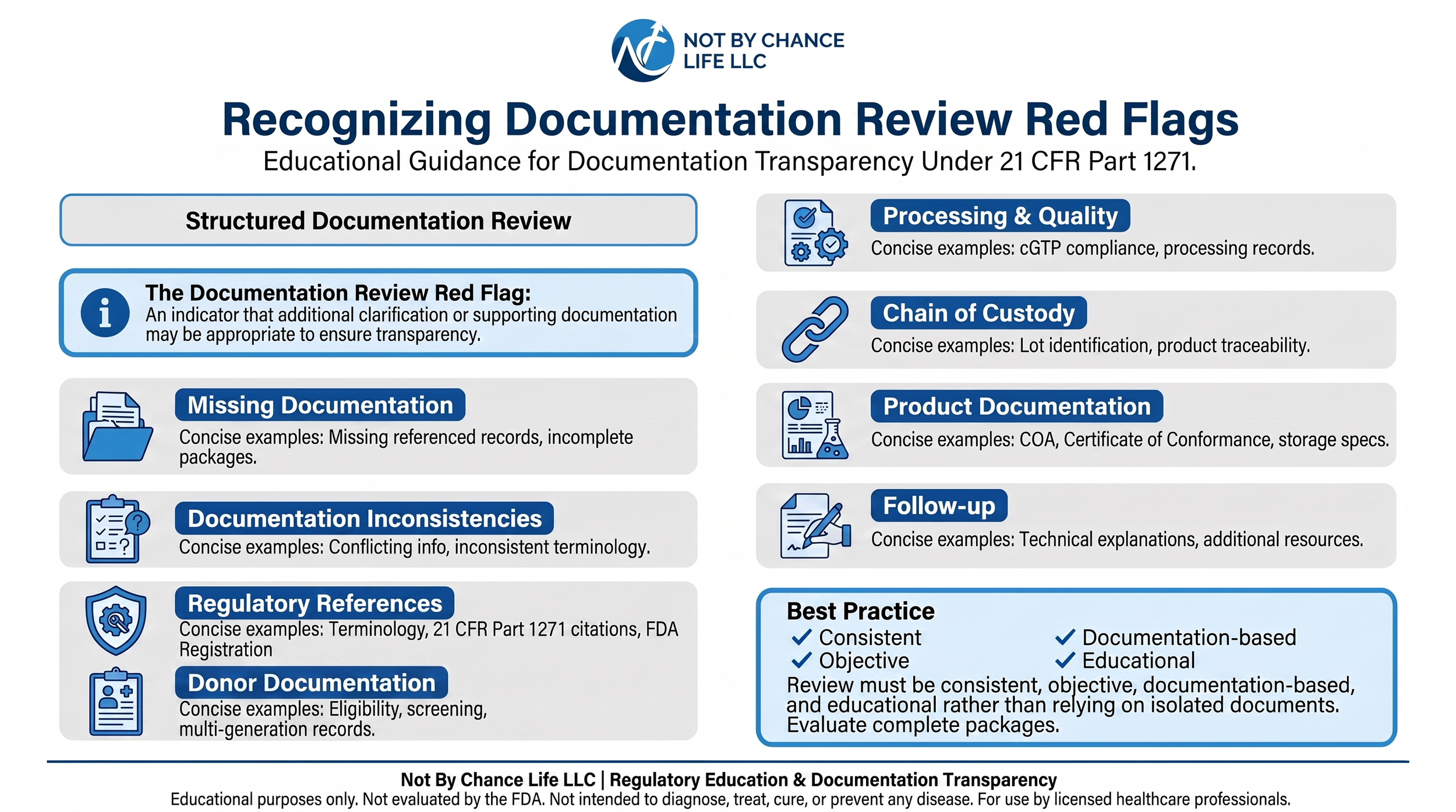
The infographic below summarizes common documentation situations that may warrant additional clarification during HCT/P supplier evaluation. These educational examples support documentation transparency and structured documentation review under 21 CFR Part 1271.
Understanding Documentation Review Red Flags
A documentation review red flag is an educational indicator that additional clarification or supporting documentation may be appropriate during supplier documentation evaluation. Documentation review should focus on improving understanding rather than reaching conclusions based on individual records.
Documentation packages often contain regulatory references, donor eligibility records, processing documentation, Certificates of Analysis, quality documentation, traceability records, storage guidance, and technical information. When one portion of the documentation package raises questions, the appropriate response is to seek clarification rather than assume a deficiency exists.
Consistent documentation review encourages objective evaluation and helps healthcare professionals understand how documentation supports transparency within the regulatory framework established under 21 CFR Part 1271.
A documentation review red flag is an indication that additional clarification or supporting documentation may be appropriate. It should never be interpreted by itself as evidence of regulatory noncompliance, product quality, product safety, or clinical performance.
Common Documentation Review Red Flags
The following examples represent common documentation situations that may justify requesting additional explanation or supporting documentation. These examples are educational in nature and should not be interpreted as conclusions regarding any supplier or product.
Missing Documentation
- Referenced documentation is unavailable.
- The documentation package appears incomplete.
- Supporting records are not included.
- Documents referenced elsewhere cannot be located.
Documentation Inconsistencies
- Terminology differs between documents.
- Information appears inconsistent and requires clarification.
- Relationships between documents are unclear.
- Technical descriptions require additional explanation.
Regulatory References Requiring Clarification
- Regulatory terminology is unfamiliar.
- References to Section 361 require explanation.
- 21 CFR 1271.10(a) is referenced without supporting educational context.
- FDA Establishment Registration documentation raises additional educational questions.
Documentation Categories That May Require Follow-up
Certain categories of documentation frequently generate follow-up questions because they are closely connected to other supporting records. Reviewing these documents together helps improve understanding while promoting documentation transparency.
Donor Documentation
- Donor eligibility documentation.
- Donor screening records.
- Relevant medical history documentation.
- Supporting donor records.
Processing & Quality Documentation
- Processing records.
- Quality system documentation.
- Current Good Tissue Practice (cGTP) documentation.
- Technical processing information.
Chain of Custody & Traceability
- Lot identification records.
- Traceability documentation.
- Storage and distribution records.
- Documentation continuity.
How to Respond to a Documentation Review Red Flag
Identifying a documentation review red flag should initiate a structured educational review rather than an immediate conclusion. The objective is to improve understanding by requesting clarification, reviewing supporting documentation, and evaluating the documentation package as a whole.
Healthcare professionals should approach documentation questions consistently across all suppliers. A repeatable review process supports documentation transparency while reducing the likelihood of decisions based on incomplete or isolated information.
- Review the complete documentation package before reaching conclusions.
- Identify which document or statement requires clarification.
- Request supporting documentation when appropriate.
- Determine whether additional regulatory references provide context.
- Review related records together rather than individually.
- Document questions that remain unresolved for follow-up discussion.
- Maintain the same documentation review methodology for every supplier.
Documentation Transparency Supports Better Evaluation
Documentation transparency allows healthcare professionals to better understand how regulatory references, donor eligibility records, processing documentation, quality systems, chain of custody, and product documentation work together within the overall HCT/P documentation package.
When documentation is organized clearly and supported by appropriate educational resources, questions can often be resolved through additional explanation rather than assumption. Transparency encourages more informed documentation review and promotes consistent regulatory literacy under 21 CFR Part 1271.
Documentation transparency should be viewed as an ongoing educational process that supports communication between healthcare professionals and suppliers throughout documentation evaluation.
Situations That Are Not Documentation Review Red Flags
Not every difference between documentation packages represents a concern. Documentation may legitimately vary between suppliers while still supporting an organized educational review. The following examples should not automatically be interpreted as documentation review red flags.
- Different document layouts or formatting.
- Different terminology that is adequately explained.
- Different organization of documentation packages.
- Different educational resources accompanying documentation.
- Technical language requiring additional explanation.
- Variations in document presentation that do not affect understanding.
- Differences in document design or branding.
Differences in documentation presentation should be distinguished from missing information. Educational review focuses on understanding documentation content rather than evaluating document appearance.
Documentation Review Best Practices
A structured documentation review process promotes objective evaluation and improves consistency across supplier comparisons. Applying the same educational methodology during every review supports documentation transparency while strengthening regulatory understanding.
- Review documentation as a complete package.
- Use educational questions to improve understanding.
- Request clarification before reaching conclusions.
- Evaluate supporting records together with primary documentation.
- Reference publicly available FDA regulations when additional context is needed.
- Document follow-up questions throughout the review process.
- Maintain a consistent documentation review methodology for every supplier.
Frequently Asked Questions
Does a documentation review red flag mean a supplier is not compliant?
No. A documentation review red flag is an educational indicator that additional clarification or supporting documentation may be appropriate. It should not be interpreted by itself as evidence of regulatory noncompliance.
Should every documentation package look exactly the same?
No. Documentation packages may differ in organization, formatting, terminology, and presentation. Educational review should focus on the content and supporting documentation rather than document appearance.
What should I do if documentation appears incomplete?
Rather than making assumptions, identify which records require clarification and request additional supporting documentation or educational resources that provide appropriate context.
Can different suppliers organize documentation differently?
Yes. Documentation organization varies among suppliers. Consistent review methods help healthcare professionals evaluate documentation objectively regardless of how individual documents are arranged.
Why is documentation transparency important?
Documentation transparency improves understanding by helping healthcare professionals evaluate how regulatory references, donor eligibility documentation, quality systems, processing records, and traceability documentation work together as a complete educational package.
Should documentation review replace independent professional judgment?
No. Documentation review is intended to improve regulatory literacy and documentation understanding. Healthcare professionals should continue to apply independent professional judgment when evaluating documentation.
Continue Your HCT/P Regulatory Education
Recognizing documentation review red flags is one component of a structured supplier evaluation process. Continue your regulatory education through the resources below to strengthen documentation review skills and improve understanding of the regulatory framework governing Human Cells, Tissues, and Cellular and Tissue-Based Products.
Supplier Documentation Knowledge Center
- HCT/P Supplier Documentation Evaluation Framework
- HCT/P Supplier Documentation Checklist
- Comparing HCT/P Supplier Documentation
- Questions to Ask an HCT/P Supplier
- HCT/P Documentation FAQ
- Common HCT/P Documentation Review Mistakes
- Documentation Transparency for HCT/Ps
- Knowledge Center
Core Regulatory Education
Professional Documentation Resources
Not By Chance Life provides educational resources that support documentation transparency, regulatory literacy, and structured HCT/P supplier documentation evaluation using publicly available FDA regulations and educational references.
Licensed healthcare professionals seeking additional educational resources or documentation guidance may request provider documentation access after credential verification.
Regulatory & Compliance Notice
Certain materials discussed throughout this educational resource relate to Human Cells, Tissues, and Cellular and Tissue-Based Products (HCT/Ps) regulated under 21 CFR Part 1271. References to FDA regulations are provided solely for educational purposes to improve documentation transparency and regulatory literacy.
FDA establishment registration does not constitute FDA approval, product clearance, certification, endorsement, or a determination regarding product safety or effectiveness.
This information is provided for educational purposes only. It has not been evaluated by the U.S. Food and Drug Administration and is not intended to diagnose, treat, cure, or prevent any disease. The content is intended for licensed healthcare professionals and should be interpreted alongside publicly available FDA regulations, official FDA guidance documents, and independent professional judgment.