
Documentation & Traceability for HCT/Ps Under 21 CFR Part 1271
Documentation and traceability are fundamental components of the regulatory framework governing Human Cells, Tissues, and Cellular and Tissue-Based Products (HCT/Ps). Throughout the lifecycle of an HCT/P, records establish transparency, support quality systems, and maintain continuity from donor recovery through processing, storage, distribution, and final clinical use.
Within 21 CFR Part 1271, documentation provides the recorded history of regulated activities, while traceability connects those records into a continuous chain that supports regulatory oversight and supplier transparency. Together they help healthcare professionals understand how products are documented throughout their lifecycle.
Documentation and traceability should always be evaluated alongside Current Good Tissue Practice (cGTP), Donor Eligibility, and HCT/P Quality Systems as complementary elements of the broader regulatory framework.
This page explains how documentation and traceability contribute to regulatory transparency within the HCT/P framework. It is intended for educational purposes only and should not be interpreted as legal advice or an official FDA interpretation.
Documentation & Traceability Throughout the HCT/P Lifecycle
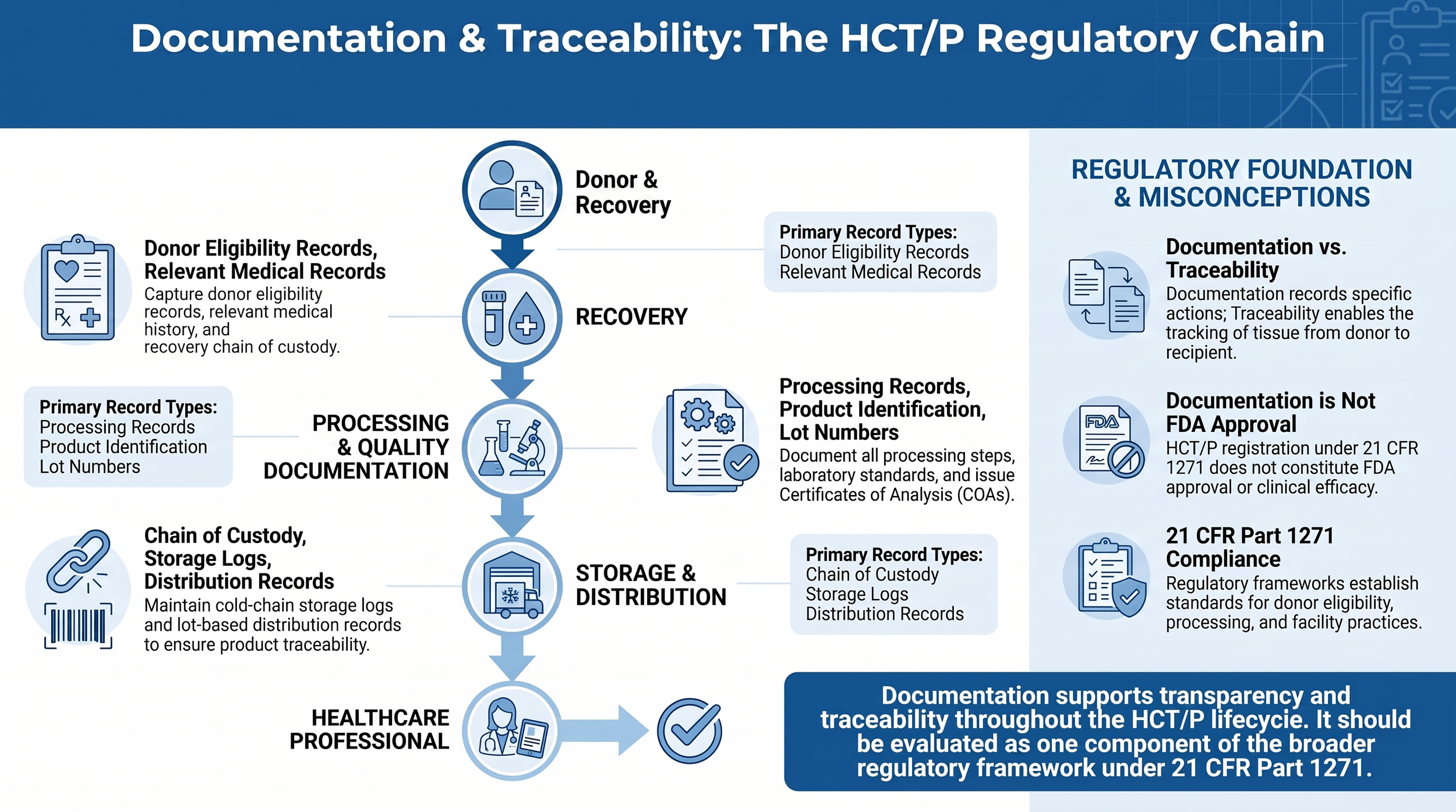
The infographic below illustrates how documentation supports transparency and traceability from donor recovery through processing, storage, distribution, and healthcare professional review.
On This Page
Documentation vs. Traceability
Although the terms are often used together, documentation and traceability represent two distinct concepts within the HCT/P regulatory framework. Documentation consists of the records created throughout regulated activities, while traceability is the ability to connect those records and follow an HCT/P through each stage of its documented lifecycle.
Documentation records what occurred during donor eligibility determination, recovery, processing, storage, labeling, packaging, distribution, and other regulated activities. Traceability links those records together, allowing healthcare professionals to understand the documented history associated with an HCT/P.
Documentation records individual activities. Traceability connects those records into a continuous history. Together they support transparency within the regulatory framework established under 21 CFR Part 1271.
Although closely related, documentation should not be confused with traceability. Complete documentation supports effective traceability, while traceability depends upon complete, accurate, and organized documentation throughout the HCT/P lifecycle.
Why Documentation Matters
Documentation serves as the permanent record of regulated activities performed throughout the HCT/P lifecycle. These records support transparency, consistency, accountability, and continuity while helping establish the documented history associated with an HCT/P.
Within the framework established by 21 CFR Part 1271, documentation may include records related to donor eligibility, recovery, processing, product identification, storage, labeling, packaging, distribution, and record retention. Each record contributes to the broader documentation system supporting regulatory oversight.
Healthcare professionals frequently review documentation when evaluating supplier transparency. Documentation provides important regulatory context but should never be interpreted by itself as evidence of FDA approval, product quality, or clinical effectiveness.
Documentation helps explain how regulated activities were recorded. It should always be evaluated alongside donor eligibility, Current Good Tissue Practice (cGTP), quality systems, and other applicable regulatory requirements.
Types of HCT/P Documentation
Different records are generated throughout the lifecycle of an HCT/P. Each serves a distinct purpose while contributing to documentation continuity and traceability.
| Documentation Type | Educational Purpose |
|---|---|
| Donor Eligibility Records | Document donor screening, testing, and eligibility determinations where applicable. |
| Relevant Medical Records | Provide supporting medical information used during donor evaluation. |
| Processing Records | Document processing activities performed by the establishment. |
| Product Identification | Assign unique identifiers supporting documentation continuity and traceability. |
| Lot Numbers | Support lot-based product identification throughout the documented lifecycle. |
| Storage Records | Document storage conditions and inventory management. |
| Distribution Records | Record product movement and distribution activities. |
| Certificates of Analysis (COAs) | Provide analytical information associated with the product where applicable. |
| Certificates of Conformance (CoCs) | Document conformance to specified manufacturing or quality requirements where applicable. |
Understanding Traceability
Traceability refers to the ability to connect documentation throughout the HCT/P lifecycle, allowing records to remain associated with the product from donor recovery through processing, storage, distribution, and final receipt by the healthcare professional. Rather than representing a single document, traceability is established through the continuity of multiple records working together.
Within the HCT/P regulatory framework, traceability supports transparency by linking donor eligibility documentation, product identification, lot numbers, processing records, storage documentation, labeling, packaging, and distribution records into a documented history.
Traceability should not be confused with FDA approval, product quality, or clinical performance. Instead, it provides a structured method for understanding the documented path of an HCT/P throughout regulated activities.
Traceability follows the documentation. It does not replace regulatory review, donor eligibility, quality systems, or Current Good Tissue Practice (cGTP). Instead, it connects those records into a continuous documentation history that supports transparency.
Documentation Review During Supplier Evaluation
Documentation review is an important educational component of supplier evaluation. Licensed healthcare professionals frequently examine documentation to better understand how regulated activities have been recorded and whether supporting records appear complete, organized, and transparent.
Documentation should always be reviewed within its proper regulatory context. No single record should be interpreted as demonstrating FDA approval, regulatory compliance, product quality, or clinical effectiveness. Rather, multiple records are considered together to better understand supplier documentation practices and regulatory transparency.
Documentation Commonly Reviewed
- Donor Eligibility Documentation
- Relevant Medical Records
- Processing Records
- Product Identification
- Lot Number Documentation
- Storage Records
- Distribution Records
- Current Good Tissue Practice (cGTP)
- Certificates of Analysis (COAs)
- Certificates of Conformance (CoCs)
Reviewing documentation within its broader regulatory framework helps healthcare professionals better understand supplier transparency while recognizing that documentation represents only one component of the overall HCT/P regulatory system.
Common Misconceptions About Documentation & Traceability
Documentation Means FDA Approval
Documentation supports regulatory transparency but should never be interpreted as FDA approval, product clearance, certification, endorsement, or a determination regarding product safety or effectiveness.
More Documentation Always Means Higher Quality
The quantity of documentation alone does not determine quality. Documentation should be evaluated for relevance, completeness, consistency, and context within the applicable regulatory framework.
Traceability Guarantees Product Safety
Traceability supports documentation continuity and transparency. It should not be interpreted as a guarantee regarding product safety, quality, or clinical performance.
Certificates Replace Documentation Review
Certificates such as Certificates of Analysis (COAs) and Certificates of Conformance (CoCs) provide valuable information but should be reviewed alongside donor eligibility records, quality systems, cGTP documentation, and other supporting records.
Frequently Asked Questions
What is the difference between documentation and traceability?
Documentation refers to the records created throughout regulated activities involving Human Cells, Tissues, and Cellular and Tissue-Based Products (HCT/Ps). Traceability refers to the ability to connect those records and follow an HCT/P throughout its documented lifecycle.
Why is documentation important for HCT/Ps?
Documentation supports transparency by recording regulated activities associated with donor eligibility, processing, storage, labeling, packaging, distribution, and other quality system functions established under 21 CFR Part 1271.
Does documentation indicate FDA approval?
No. Documentation provides information regarding regulated activities and supplier transparency. It should not be interpreted as FDA approval, clearance, certification, endorsement, or a determination regarding product safety or effectiveness.
What records support traceability?
Traceability may include product identification, lot numbers, donor eligibility documentation, processing records, storage records, distribution records, and other records maintained throughout the HCT/P lifecycle.
Can healthcare professionals review supplier documentation?
Yes. Licensed healthcare professionals frequently review documentation to better understand supplier transparency and the regulatory context surrounding Human Cells, Tissues, and Cellular and Tissue-Based Products (HCT/Ps).
Do Certificates of Analysis replace documentation review?
No. Certificates of Analysis provide only one portion of the available documentation. They should be reviewed alongside donor eligibility records, quality systems, Current Good Tissue Practice (cGTP), and other supporting documentation.
Does traceability guarantee product quality?
No. Traceability supports documentation continuity and regulatory transparency. It should not be interpreted as evidence of product quality, safety, effectiveness, or FDA approval.
How does documentation relate to Current Good Tissue Practice (cGTP)?
Documentation supports many activities associated with Current Good Tissue Practice (cGTP), including recordkeeping, product identification, storage, distribution, and quality system documentation.
Why are lot numbers important?
Lot numbers help associate products with related documentation and support traceability throughout the documented lifecycle of an HCT/P.
What documentation is commonly reviewed during supplier evaluation?
Documentation review may include donor eligibility records, relevant medical records, processing documentation, storage records, distribution records, product identification, Certificates of Analysis (COAs), Certificates of Conformance (CoCs), and Current Good Tissue Practice (cGTP) documentation.
Related Regulatory Resources
Documentation and traceability represent one portion of the broader HCT/P regulatory framework. Continue your learning with these related educational resources.
Documentation & Regulatory Education
Licensed healthcare professionals seeking additional educational information regarding HCT/P documentation, traceability, supplier documentation, or regulatory transparency may request documentation review guidance.
Credential verification is required before access to certain manufacturer documentation.
Request Documentation Access →
Provider Credential Verification Portal →
This information is for educational purposes only.Not evaluated by the FDA.
Not intended to diagnose, treat, cure, or prevent any disease.
For use by licensed healthcare professionals.
Regulatory Notice
Documentation and traceability support transparency within the regulatory framework governing Human Cells, Tissues, and Cellular and Tissue-Based Products (HCT/Ps). Documentation should not be interpreted as FDA approval, product clearance, certification, endorsement, or a determination regarding product safety or effectiveness.
This information is provided for educational purposes only.
Not evaluated by the FDA. Not intended to diagnose, treat, cure, or prevent any disease. For use by licensed healthcare professionals.