
FDA Establishment Registration for HCT/Ps: What It Means and What It Does Not Mean
One of the most common misconceptions surrounding Human Cells, Tissues, and Cellular and Tissue-Based Products (HCT/Ps) is the meaning of the phrase "FDA Registered." Because the term appears frequently in supplier documentation and product literature, it is often assumed to indicate that the FDA has reviewed, approved, certified, or endorsed a product. Under the regulatory framework governing many HCT/Ps, that assumption is incorrect.
FDA Establishment Registration is an administrative requirement that applies to certain establishments engaged in activities involving HCT/Ps regulated under 21 CFR Part 1271. Registration informs the FDA that an establishment performs regulated activities such as recovery, processing, storage, labeling, packaging, or distribution. It should not be interpreted as FDA approval, FDA clearance, a determination of safety or effectiveness, or an endorsement of any establishment or product.
Understanding what FDA Establishment Registration does—and does not—mean is an important part of evaluating supplier documentation responsibly. Throughout this guide, you'll learn why establishments register, who is required to register, how registration relates to 21 CFR Part 1271, and why registration should never be confused with FDA approval.
Understanding FDA Establishment Registration
FDA Establishment Registration is best understood as one component of the broader regulatory framework governing Human Cells, Tissues, and Cellular and Tissue-Based Products (HCT/Ps). Rather than representing FDA approval or product evaluation, registration identifies certain establishments that perform regulated activities and informs the FDA of those activities.
The following infographic summarizes the concepts introduced throughout this guide and illustrates one of the most important distinctions healthcare professionals should understand:
FDA Establishment Registration is not the same as FDA Approval.
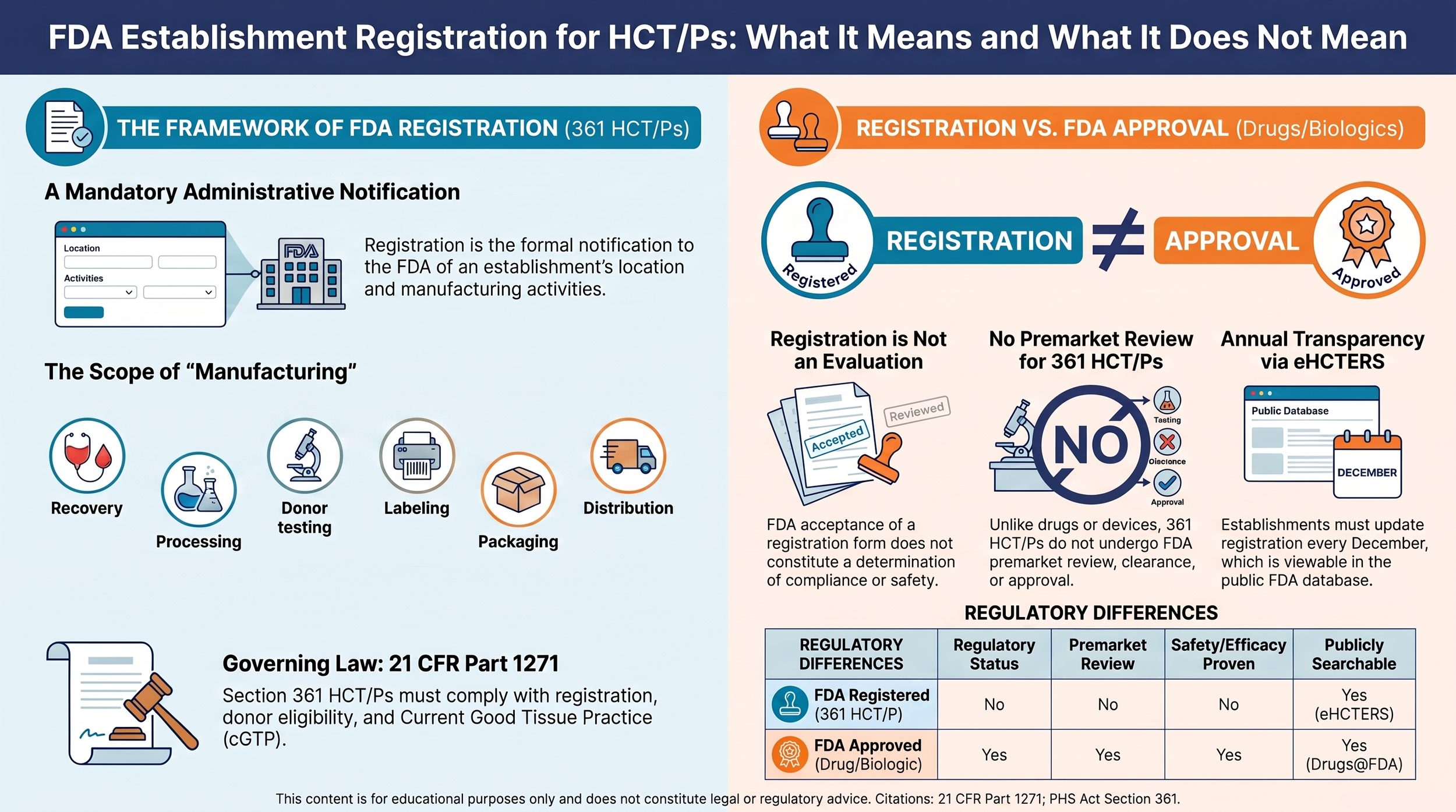
As you continue through this guide, each section expands on one portion of this infographic, providing additional educational context and connecting FDA Establishment Registration to the broader HCT/P regulatory framework.
On This Page
What Is FDA Establishment Registration?
FDA Establishment Registration is an administrative requirement under the federal regulatory framework that applies to certain establishments engaged in activities involving Human Cells, Tissues, and Cellular and Tissue-Based Products (HCT/Ps). Registration provides the FDA with information about the establishment and the types of regulated activities it performs, supporting regulatory oversight and transparency.
For many HCT/Ps regulated solely under Section 361 of the Public Health Service Act and 21 CFR Part 1271, registration helps the FDA identify establishments that recover, process, store, label, package, or distribute HCT/Ps. It is one component of the broader regulatory framework and should always be understood within that context.
Because the phrase "FDA Registered" is frequently used without additional explanation, healthcare professionals should understand exactly what registration communicates—and equally important, what it does not communicate.
Why FDA Establishment Registration Exists
FDA Establishment Registration serves an administrative and regulatory purpose. It provides the U.S. Food and Drug Administration with information about establishments that perform regulated activities involving Human Cells, Tissues, and Cellular and Tissue-Based Products (HCT/Ps), allowing the Agency to identify those establishments and maintain current registration information.
Registration promotes regulatory transparency by identifying who is performing regulated activities and what types of HCT/P activities those establishments report. This information supports FDA oversight under the applicable regulatory framework but should not be interpreted as an evaluation of a product's safety, effectiveness, or clinical performance.
Registration is one component of a broader system that also includes donor eligibility requirements, Current Good Tissue Practice (cGTP), recordkeeping, documentation, and traceability. Together, these elements help establish the regulatory framework governing many HCT/Ps regulated under Section 361 of the Public Health Service Act and 21 CFR Part 1271.
Who Must Register?
Under the applicable regulatory framework, certain establishments that manufacture Human Cells, Tissues, and Cellular and Tissue-Based Products (HCT/Ps) are generally required to register with the FDA and submit HCT/P listings. Whether registration is required depends upon the activities performed and the applicable federal regulations.
Examples of activities that may require establishment registration include:
- Recovery of HCT/Ps
- Processing and preservation
- Storage of HCT/Ps
- Labeling and packaging
- Distribution of HCT/Ps
- Screening and testing activities associated with donor eligibility, when applicable
Registration requirements are based on the functions performed by an establishment rather than on marketing claims or product names. Because regulatory obligations vary depending on the specific activities conducted, healthcare professionals should review supplier documentation within the context of the applicable regulations.
Registration Does Not Mean Every Establishment Performs the Same Activities
Two establishments may both be FDA registered while performing very different functions. One establishment may recover tissue, another may process tissue, and another may perform storage or distribution activities. Registration identifies that regulated activities are being conducted but does not indicate that all registered establishments perform identical operations.
The FDA Establishment Registration Process
FDA Establishment Registration is more than a one-time administrative filing. Registered establishments are generally responsible for maintaining current registration information and submitting updates in accordance with applicable FDA requirements. This helps ensure that FDA records accurately reflect the establishment and the regulated activities it performs.
Although the specific administrative requirements are established by regulation, the registration process generally includes several key components.
Initial Registration
An establishment subject to registration requirements submits identifying information to the FDA, including details regarding the establishment and the HCT/P-related activities it performs.
HCT/P Listing
Where applicable, establishments submit information identifying the HCT/Ps associated with their regulated activities. Product listing supports FDA awareness of the types of HCT/Ps being handled by registered establishments.
Registration Updates
Registered establishments are generally responsible for updating registration information when required so that FDA records remain current and accurately reflect the establishment's regulated activities.
Public Registration Information
The FDA maintains publicly available establishment registration information that healthcare professionals may use as one component of a broader documentation review. However, inclusion within a public registration database should not be interpreted as FDA approval or product endorsement.
FDA Establishment Registration vs. FDA Approval
One of the most important concepts healthcare professionals should understand is the distinction between FDA Establishment Registration and FDA Approval. Although these terms are often confused, they describe entirely different regulatory concepts and should never be used interchangeably.
FDA Establishment Registration is an administrative requirement that identifies certain establishments performing regulated activities involving Human Cells, Tissues, and Cellular and Tissue-Based Products (HCT/Ps). FDA Approval, by contrast, refers to a separate regulatory pathway in which the Agency evaluates a product for a specific intended use under applicable statutory and regulatory authorities.
| FDA Establishment Registration | FDA Approval |
|---|---|
| Administrative registration of certain establishments. | Formal FDA review of a product under an applicable approval pathway. |
| Identifies regulated activities. | Evaluates evidence supporting a specific intended use. |
| Required for certain establishments under applicable regulations. | Applies only where an FDA approval pathway exists. |
| Does not determine product safety or effectiveness. | Represents a separate regulatory determination under the applicable approval process. |
| Does not constitute FDA endorsement. | Should not be confused with establishment registration. |
Understanding this distinction helps healthcare professionals interpret supplier documentation more accurately and avoid one of the most common misconceptions encountered within the HCT/P industry.
Relationship to 21 CFR Part 1271
FDA Establishment Registration does not exist independently of the broader regulatory framework. For many Human Cells, Tissues, and Cellular and Tissue-Based Products (HCT/Ps), registration functions alongside the requirements established under 21 CFR Part 1271.
The regulatory framework includes multiple interconnected components that support regulatory oversight and documentation transparency, including donor eligibility, Current Good Tissue Practice (cGTP), recordkeeping, and establishment registration. Each serves a different purpose, but together they create the regulatory structure applicable to many Section 361 HCT/Ps.
Registration and Current Good Tissue Practice (cGTP)
Current Good Tissue Practice establishes requirements related to methods, facilities, controls, and documentation intended to reduce the risk of communicable disease transmission. FDA Establishment Registration identifies certain establishments operating within this regulatory framework but should not be interpreted as confirming compliance with every applicable cGTP requirement.
Learn more about Current Good Tissue Practice (cGTP) →
Registration and Donor Eligibility
Donor eligibility requirements establish procedures for donor screening, donor testing, and review of relevant medical records where applicable. Registration does not replace these requirements and should not be viewed as evidence that donor eligibility documentation has been independently reviewed by the FDA.
Learn more about Donor Eligibility →
Registration and Quality Systems
Quality systems provide the documented framework supporting operational consistency, documentation integrity, traceability, and quality oversight. Registration identifies certain establishments within the regulatory system, while quality systems describe how documented activities are organized and maintained.
Common Misconceptions About FDA Establishment Registration
Because the phrase "FDA Registered" is frequently used without additional explanation, misunderstandings are common. The following clarifications can help healthcare professionals interpret supplier documentation more accurately.
Misconception #1 — FDA Registered Means FDA Approved
This is incorrect. FDA Establishment Registration is an administrative regulatory requirement for certain establishments. It does not indicate FDA approval of a product.
Misconception #2 — Registration Guarantees Product Safety or Effectiveness
Registration does not represent an FDA determination regarding product safety, effectiveness, or clinical performance. Those concepts involve separate regulatory considerations.
Misconception #3 — Every Registered Establishment Operates the Same Way
Registered establishments may perform different regulated activities. Recovery, processing, storage, labeling, packaging, and distribution responsibilities vary depending on the establishment and the applicable regulatory requirements.
Misconception #4 — Registration Replaces Documentation Review
Registration is only one component of supplier evaluation. Healthcare professionals should continue reviewing donor eligibility documentation, quality systems, Current Good Tissue Practice (cGTP), traceability, and other supporting documentation when evaluating HCT/Ps.
Applying FDA Establishment Registration During Supplier Evaluation
FDA Establishment Registration should be viewed as one component of a broader documentation review rather than as a stand-alone indicator of quality. Healthcare professionals evaluating Human Cells, Tissues, and Cellular and Tissue-Based Products (HCT/Ps) benefit from considering registration alongside the complete regulatory and quality documentation package.
Registration answers an important administrative question:
"Is this establishment identified within the FDA registration system for the regulated activities it reports?"
However, registration does not answer many of the additional questions healthcare professionals should consider when reviewing HCT/P documentation.
Questions Registration Helps Answer
- Is the establishment registered with the FDA where registration is applicable?
- What regulated activities has the establishment reported?
- Can the establishment be located within the FDA registration database?
- Does the supplier provide transparent regulatory documentation?
Questions Registration Does Not Answer
- Has the FDA approved this product?
- Has the FDA determined the product is safe or effective?
- Does the registration verify manufacturing quality?
- Does the registration evaluate clinical outcomes?
- Does registration replace supplier documentation review?
Frequently Asked Questions
What is FDA Establishment Registration?
FDA Establishment Registration is an administrative requirement that applies to certain establishments engaged in regulated activities involving Human Cells, Tissues, and Cellular and Tissue-Based Products (HCT/Ps). Registration identifies the establishment and the regulated activities it reports to the FDA.
Does FDA Establishment Registration mean a product is FDA approved?
No. FDA Establishment Registration and FDA approval are separate regulatory concepts. Registration should not be interpreted as FDA approval, clearance, certification, endorsement, or a determination regarding product safety or effectiveness.
Why do some suppliers emphasize that they are FDA registered?
Registration is an important regulatory requirement for certain establishments and may appropriately appear within supplier documentation. However, healthcare professionals should understand what registration communicates and avoid assuming that registration represents FDA approval or product evaluation.
Can healthcare professionals verify FDA Establishment Registration?
The FDA maintains publicly available registration information for applicable establishments. Reviewing this information may be one component of a broader documentation evaluation.
Does registration guarantee compliance with all FDA requirements?
No. Registration identifies certain establishments within the regulatory system but should not be interpreted as confirmation of compliance with every applicable regulatory requirement.
What other documentation should be reviewed in addition to registration?
Healthcare professionals should also review documentation relating to donor eligibility, Current Good Tissue Practice (cGTP), quality systems, traceability, and other supporting regulatory records that help explain how an HCT/P is recovered, processed, documented, and distributed.
If you are a licensed healthcare professional seeking additional educational resources regarding HCT/P regulatory concepts, supplier documentation, or quality systems, Not By Chance Life provides educational materials designed to support informed documentation review.
Contact Not By Chance Life
Phone: (786) 868-8052
Email: info@notbychance.life
You can also visit our Provider Portal or Contact Page to request additional educational resources.
Understanding FDA Establishment Registration begins with recognizing its proper role within the HCT/P regulatory framework. Registration supports administrative transparency by identifying certain regulated establishments, but it should never be confused with FDA approval or interpreted as an evaluation of product safety, effectiveness, or clinical performance. When reviewed alongside donor eligibility documentation, Current Good Tissue Practice (cGTP), quality systems, and traceability records, FDA Establishment Registration becomes one important part of a comprehensive, documentation-based approach to evaluating HCT/Ps.