
FDA Establishment Registration for HCT/Ps: What It Means and What It Does Not Mean
One of the most important distinctions in HCT/P regulatory literacy is understanding the meaning of the phrase “FDA Registered.”
Because that phrase appears frequently in supplier documentation, websites, and product-related materials, it can be misunderstood as meaning that FDA has reviewed, approved, cleared, certified, or endorsed a product or establishment.
FDA establishment registration does not mean FDA approval.
Under 21 CFR Part 1271, certain establishments that manufacture Human Cells, Tissues, and Cellular and Tissue-Based Products (HCT/Ps) are required to register with FDA and list their HCT/Ps, subject to applicable requirements and exemptions.
Registration and listing provide FDA with information concerning establishments and HCT/Ps within the regulatory system. They are regulatory requirements, but they should not be interpreted as FDA approval, clearance, certification, endorsement, or a determination that a particular HCT/P satisfies every applicable regulatory requirement.
This guide explains FDA establishment registration and HCT/P listing within the federal regulatory framework. It is intended to support regulatory and documentation literacy and does not provide legal advice, regulatory determinations, or an official FDA interpretation.
Understanding FDA Establishment Registration
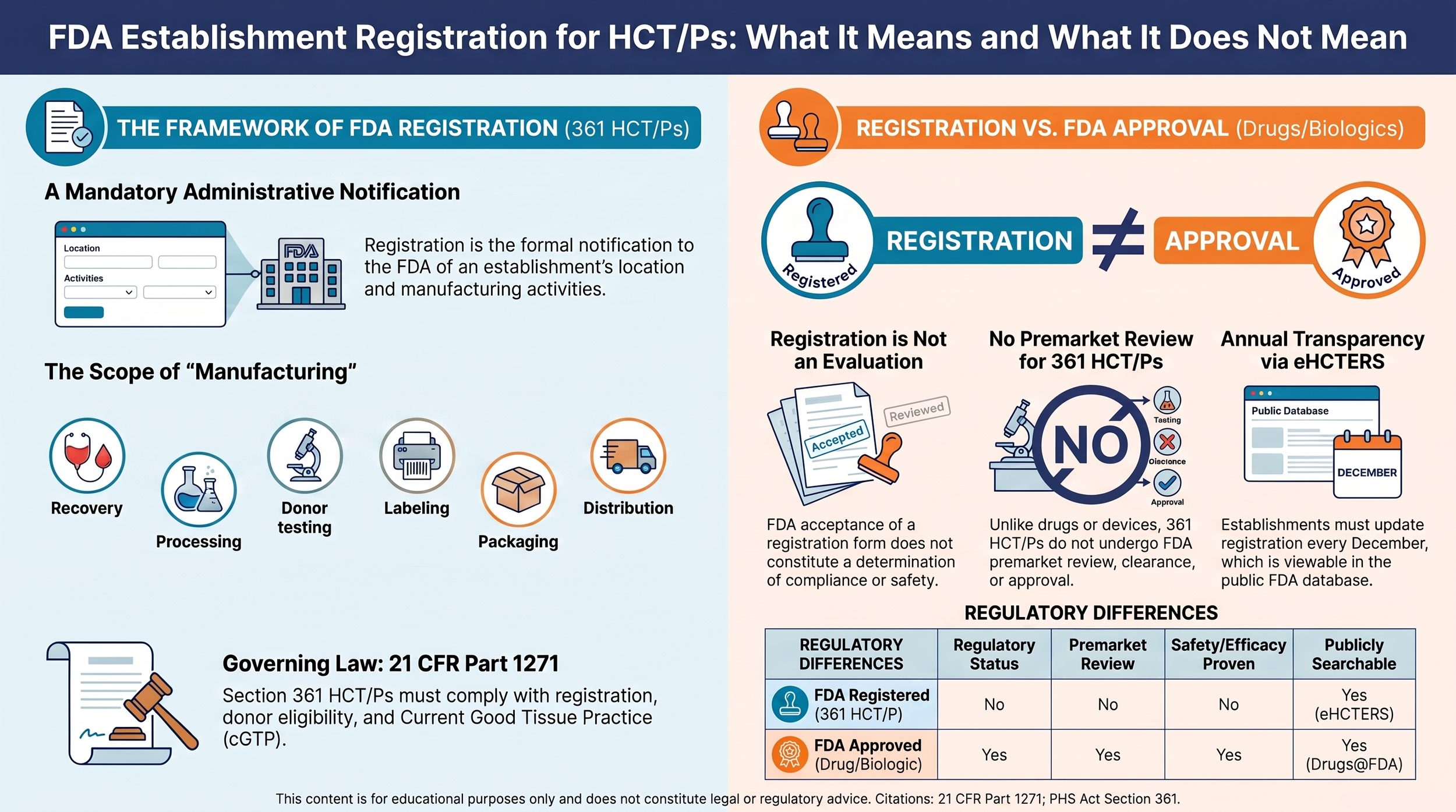
The infographic below introduces the central distinction discussed throughout this guide:
FDA establishment registration is not the same as FDA approval.
On This Page
- What Is FDA Establishment Registration?
- Registration and HCT/P Listing
- Why Registration Exists
- Who Must Register?
- Registration and Listing Requirements
- FDA Registration vs. FDA Approval
- Relationship to 21 CFR Part 1271
- Common Misconceptions
- Supplier Documentation Evaluation
- Frequently Asked Questions
What Is FDA Establishment Registration?
FDA establishment registration is a regulatory requirement applicable to certain establishments that manufacture HCT/Ps.
Under Part 1271, the term manufacture encompasses activities including, but not limited to, recovery, processing, storage, labeling, packaging, and distribution of HCT/Ps, as well as screening or testing a cell or tissue donor.
Subject to the applicable provisions and exemptions, establishments that manufacture HCT/Ps must register with FDA and submit a list of each HCT/P manufactured.
Registration identifies an establishment within FDA's HCT/P regulatory system. Registration does not establish that FDA has approved the establishment, approved its products, certified its manufacturing operations, or determined that every applicable regulatory requirement has been satisfied.
Registration and HCT/P Listing Are Related but Distinct
FDA establishment registration and HCT/P listing are closely related requirements, but they describe different information.
- Establishment registration provides identifying information concerning an establishment subject to the applicable registration requirements.
- HCT/P listing provides information concerning HCT/Ps manufactured by the registered establishment, subject to the applicable listing requirements.
This distinction matters during documentation review. The existence of an establishment registration should not be treated as proof that every product, activity, claim, or regulatory characterization associated with an organization has been reviewed or accepted by FDA.
Likewise, an HCT/P listing is not equivalent to FDA approval of the listed HCT/P.
Why FDA Establishment Registration Exists
Registration and listing support FDA's administration and oversight of the HCT/P regulatory framework by providing information about establishments and HCT/Ps subject to applicable requirements.
Registration helps identify establishments performing HCT/P manufacturing activities. Listing provides information about HCT/Ps associated with those establishments.
These requirements operate within the broader framework of 21 CFR Part 1271, which also addresses donor eligibility, Current Good Tissue Practice (cGTP), reporting, labeling, inspections, and other requirements where applicable.
Registration and listing provide regulatory information. They do not substitute for analysis of the regulatory requirements applicable to a particular HCT/P or establishment.
Who Must Register?
Whether an establishment is required to register depends on the activities it performs and the applicable provisions of 21 CFR Part 1271.
Part 1271 generally requires establishments that manufacture HCT/Ps to register and list their HCT/Ps, unless an applicable exception or exemption applies.
Because manufacture is defined broadly within the HCT/P framework, activities potentially relevant to registration may include:
- Recovery
- Processing
- Storage
- Labeling
- Packaging
- Distribution
- Donor screening or donor testing
The regulatory obligations of a particular establishment depend on the activities it actually performs and the applicable requirements. Registration should therefore not be used as a shortcut for determining the complete regulatory responsibilities of an organization.
Two registered establishments may perform very different activities. Registration status alone does not describe the complete scope of an establishment's operations.
Registration and Listing Requirements
Registration is not simply a permanent one-time designation. Part 1271 contains requirements concerning initial registration, HCT/P listing, annual registration, and updates to certain information.
Initial Registration
An establishment subject to the registration requirements must submit the required establishment information according to the applicable regulation.
HCT/P Listing
Registered establishments subject to the listing requirements must submit a list of each HCT/P manufactured and provide the information required by the regulation.
Annual Registration
Establishments subject to the requirements must register annually during the period specified by the regulation.
Updates
Changes to certain registration or listing information must be reported according to the applicable requirements and timeframes.
Public FDA Information
FDA makes establishment registration information publicly searchable. Public registration information can be useful during documentation evaluation, but its meaning must remain limited to what the record actually establishes.
A database entry should not be represented as FDA approval, certification, endorsement, or proof that every applicable regulatory requirement has been satisfied.
FDA Establishment Registration vs. FDA Approval
FDA establishment registration and FDA approval are fundamentally different regulatory concepts.
Registration is an establishment-level regulatory requirement under applicable provisions of Part 1271. FDA approval refers to separate premarket regulatory pathways that may apply to products regulated under other statutory and regulatory authorities.
The statement “FDA Registered” should not be used to imply that FDA has approved, cleared, certified, endorsed, or determined the safety or effectiveness of a particular HCT/P.
| FDA Establishment Registration | FDA Approval |
|---|---|
| Applies to establishments subject to applicable registration requirements. | Involves a separate FDA premarket regulatory pathway where applicable. |
| Provides information identifying an establishment within the regulatory system. | Involves FDA review under the applicable statutory and regulatory pathway. |
| May be accompanied by HCT/P listing requirements. | Is not created by establishment registration or HCT/P listing. |
| Does not itself establish product safety or effectiveness. | Represents a different regulatory determination under the applicable pathway. |
| Does not constitute FDA endorsement or certification. | Should not be confused with registration. |
This distinction is especially important when evaluating supplier statements such as “FDA Registered.” The statement may communicate a factual registration status, but it should not be expanded into claims that the registration itself does not support.
Relationship to 21 CFR Part 1271
FDA establishment registration and HCT/P listing are only one part of the broader HCT/P regulatory framework.
Other provisions of Part 1271 address separate subjects and should not be collapsed into registration status.
Registration and 21 CFR 1271.10(a)
Registration does not determine whether an HCT/P satisfies the criteria in 21 CFR 1271.10(a) for regulation solely under Section 361 of the Public Health Service Act and 21 CFR Part 1271.
Those criteria require their own analysis. Registration should therefore never be used as evidence that an HCT/P has automatically qualified for a particular regulatory pathway.
Registration and Current Good Tissue Practice (cGTP)
Current Good Tissue Practice (cGTP) establishes separate manufacturing requirements under 21 CFR Part 1271 Subpart D.
Registration does not, by itself, demonstrate compliance with all applicable cGTP requirements.
Registration and Donor Eligibility
Donor eligibility addresses separate requirements concerning donor screening, testing, and eligibility determinations where applicable.
Registration does not establish that donor eligibility requirements have been satisfied for a particular donor or HCT/P.
Registration and Minimal Manipulation
Minimal manipulation is a separate regulatory criterion relevant to 21 CFR 1271.10(a). Registration does not determine whether processing satisfies that criterion.
Registration and Homologous Use
Homologous use is another separate criterion relevant to 21 CFR 1271.10(a). Registration does not determine whether an intended use is homologous.
Common Misconceptions About FDA Establishment Registration
Misconception #1 — FDA Registered Means FDA Approved
Incorrect. Establishment registration does not constitute FDA approval, clearance, certification, or endorsement of a product.
Misconception #2 — Registration Proves Section 361 Status
Incorrect. Registration does not establish that an HCT/P satisfies the criteria for regulation solely under Section 361 and 21 CFR Part 1271.
Misconception #3 — Registration Proves cGTP Compliance
Incorrect. Registration and cGTP are separate regulatory requirements. A registration record should not be treated as proof of compliance with every applicable manufacturing requirement.
Misconception #4 — Registration Guarantees Product Safety or Effectiveness
Incorrect. Registration does not represent an FDA determination regarding the safety, effectiveness, clinical performance, or suitability of a particular HCT/P.
Misconception #5 — Every Registered Establishment Performs the Same Activities
Incorrect. Establishments may perform different manufacturing activities and may have different regulatory responsibilities.
Misconception #6 — Registration Replaces Documentation Review
Incorrect. Registration information is one type of regulatory documentation. A structured documentation evaluation may require review of additional information depending on the question being evaluated.
Applying FDA Registration Information During Supplier Documentation Evaluation
FDA registration information can be useful during supplier documentation evaluation when its evidentiary role is properly understood.
A registration record may help confirm that an establishment appears in FDA's registration system and provide information concerning the establishment and reported activities.
It should not be interpreted beyond what the record actually demonstrates.
Questions Registration Information May Help Explore
- Does the establishment appear in FDA's registration database?
- What establishment information is shown in the public record?
- What activities or HCT/P information are associated with the registration record?
- Is supplier-provided registration information consistent with the public FDA information reviewed?
- Is the available registration information current for the period being evaluated?
Questions Registration Does Not Independently Answer
- Has FDA approved the HCT/P?
- Does the HCT/P satisfy 21 CFR 1271.10(a)?
- Is the HCT/P regulated solely under Section 361?
- Has FDA determined that the establishment complies with every applicable cGTP requirement?
- Does the product satisfy the minimal-manipulation criterion?
- Does the intended use satisfy the homologous-use criterion?
- Has donor eligibility been established for a particular donor?
- Is the HCT/P clinically effective or appropriate for a particular patient?
FDA registration information should be evaluated according to what it actually demonstrates. Registration, donor eligibility documentation, cGTP-related records, processing documentation, scientific literature, and other sources answer different questions and should not be treated as interchangeable evidence.
Continue with the Supplier Evaluation Process, Supplier Documentation Evaluation Framework, and HCT/P Documentation Checklist.
Regulatory Sources vs. Supplier Documentation vs. Scientific Evidence
FDA establishment registration is also a useful example of why different information sources should remain clearly separated during HCT/P evaluation.
- Federal statutes and regulations establish applicable legal and regulatory requirements.
- FDA guidance and official FDA publications may provide regulatory interpretation and educational context.
- FDA registration information provides administrative information concerning registered establishments and associated information within the registration system.
- Supplier documentation may provide organization- or product-specific information relevant to a professional evaluation.
- Scientific literature may provide biological, analytical, or methodological context.
These sources can complement one another, but they do not have the same evidentiary role. Supplier documentation or scientific literature should not override applicable statutes, regulations, or official regulatory requirements.
Frequently Asked Questions
What is FDA Establishment Registration?
FDA establishment registration is a regulatory requirement applicable to certain establishments that manufacture HCT/Ps. Subject to applicable provisions and exemptions, establishments register with FDA and list the HCT/Ps they manufacture.
Does FDA Establishment Registration mean a product is FDA approved?
No. Registration does not constitute FDA approval, clearance, certification, endorsement, or a determination regarding the safety or effectiveness of a particular product.
What is HCT/P listing?
HCT/P listing is a requirement associated with establishment registration under which applicable establishments provide FDA with information concerning the HCT/Ps they manufacture.
Does HCT/P listing mean FDA approved the listed product?
No. HCT/P listing should not be interpreted as FDA approval or endorsement of the listed HCT/P.
Can healthcare professionals verify FDA Establishment Registration?
FDA provides publicly searchable establishment registration information that may be reviewed as one component of documentation evaluation.
Does every organization associated with an HCT/P have to register?
Registration requirements depend on the activities performed and the applicable provisions, exceptions, and exemptions under the regulatory framework.
Does registration demonstrate compliance with cGTP?
No. Registration and cGTP are separate requirements. A registration record does not, by itself, establish compliance with every applicable cGTP provision.
Does registration determine whether an HCT/P is a Section 361 HCT/P?
No. Regulatory status requires analysis of the applicable criteria. Registration alone does not determine whether an HCT/P satisfies 21 CFR 1271.10(a).
Can two FDA-registered establishments perform different activities?
Yes. Establishments may perform different manufacturing activities and therefore may have different responsibilities within the HCT/P regulatory framework.
Why should registration information be reviewed with other documentation?
Registration answers a limited administrative question. Other documentation may be needed to understand donor eligibility, manufacturing controls, processing, traceability, labeling, testing, intended use, and other matters relevant to a structured evaluation.
Professional Evaluation Through NBCL Connect
The Not By Chance Life Knowledge Center provides public regulatory, documentation, and scientific education. Qualified healthcare professionals who are ready to move from education into structured professional evaluation and communication with participating organizations may use NBCL Connect.
Knowledge Center → Learn & Understand
Use the Knowledge Center to understand regulatory foundations, supplier documentation principles, and scientific context.
NBCL Connect → Evaluate & Connect
Use NBCL Connect for structured professional evaluation, documentation requests to participating organizations, professional communication, meeting coordination, and ongoing relationship management.
NBCL Connect does not determine FDA registration requirements, verify regulatory classification, determine cGTP compliance, approve supplier documentation, determine product suitability, or make clinical or purchasing decisions. It does not rank, recommend, or endorse participating organizations.
Regulatory Notice
This page is provided for educational purposes and is intended to support regulatory and documentation literacy concerning FDA establishment registration, HCT/P listing, and 21 CFR Part 1271.
FDA establishment registration and HCT/P listing should not be interpreted as FDA approval, clearance, certification, endorsement, or a determination regarding the safety or effectiveness of a particular HCT/P.
Registration does not independently establish regulatory classification, compliance with 21 CFR 1271.10(a), compliance with all applicable cGTP requirements, donor eligibility, minimal manipulation, homologous use, or clinical appropriateness.
Supplier documentation may provide relevant organization- or product-specific information, but documentation alone does not determine regulatory classification or establish compliance with every applicable requirement.
Not By Chance Life LLC provides regulatory education, documentation guidance, scientific education, and professional evaluation infrastructure. It does not provide medical care, legal advice, regulatory determinations, diagnosis, treatment recommendations, or clinical protocols.