
Exosome-Related Formulations — Scientific, Documentation & Regulatory Context
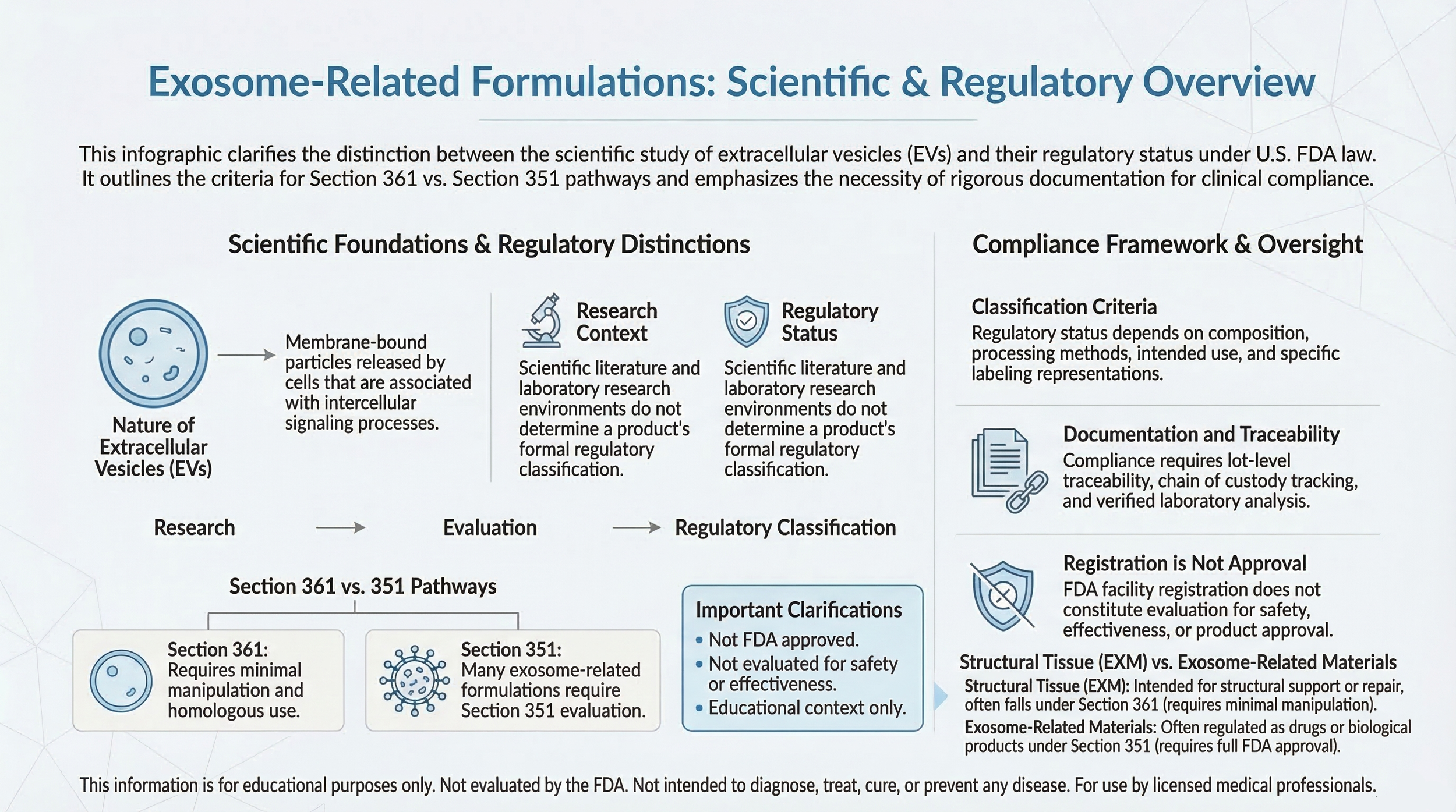
Educational infographic illustrating scientific and regulatory concepts associated with extracellular vesicles and exosome-related formulations.
The term exosome-related formulations may be used in connection with products described as containing, being associated with, or being derived from extracellular vesicles or other cell-derived materials.
This page provides educational context for professionals seeking to distinguish among the scientific literature, supplier documentation, and federal regulatory considerations that may arise when evaluating these types of materials.
These sources of information serve different purposes. Scientific publications may explain biological concepts. Supplier documentation may describe a particular product, process, source, analytical method, or quality system. Regulatory classification depends on the applicable legal and regulatory framework and the facts associated with the particular product.
This page does not describe clinical use, treatment protocols, dosing, therapeutic outcomes, or patient-specific applications.
This overview is part of the broader Biologic Material Education collection.
When reviewing exosome-related terminology or materials, professionals should distinguish among:
- Regulatory requirements and FDA guidance — used to understand the applicable federal framework.
- Supplier documentation — used to understand what a particular organization reports or documents about a product, process, source, testing method, or quality system.
- Scientific literature — used to understand biological mechanisms, research methods, extracellular-vesicle science, and related scientific concepts.
Scientific literature does not independently determine regulatory classification, and supplier documentation alone does not establish regulatory status.
Extracellular Vesicle Research Context
Extracellular vesicles are membrane-bound particles released by cells and studied in research environments for their involvement in intercellular communication and other biological processes.
Exosomes are generally discussed within the broader field of extracellular-vesicle research. Scientific terminology, isolation methods, characterization approaches, analytical methods, and reporting practices can vary across studies.
For that reason, scientific claims should be interpreted according to the methods, materials, study design, analytical techniques, limitations, and specific biological questions addressed by the research.
Research discussing extracellular vesicles or exosomes provides scientific context. It does not by itself establish FDA approval, regulatory classification, product suitability, or clinical appropriateness.
Additional scientific education is available within the Scientific Education Collection.
Regulatory Context
The use of terms such as exosome, extracellular vesicle, acellular, or similar scientific terminology does not by itself determine how a particular product is regulated.
Regulatory analysis depends on the applicable statutory and regulatory framework and the specific facts associated with the product being evaluated.
Depending on the product and circumstances, relevant considerations may include composition, source material, processing, intended use, labeling and promotional representations, combination with other articles, and other facts relevant under the applicable federal framework.
Professionals seeking to understand the HCT/P framework should begin with the 21 CFR Part 1271 Regulatory Framework and the HCT/P Regulatory Evaluation Pathway.
21 CFR 1271.10(a) and Section 361
For an HCT/P to be regulated solely under Section 361 of the Public Health Service Act and the regulations in 21 CFR Part 1271, the applicable criteria in 21 CFR 1271.10(a) must be satisfied.
Those criteria should be evaluated as a complete regulatory framework rather than reduced to a single characteristic or simplified checklist.
Important concepts within that framework include:
- Minimal Manipulation
- Homologous Use
- Whether the HCT/P is combined with another article, subject to the provisions and exceptions within the regulation.
- The applicable criteria concerning systemic effect and dependence on the metabolic activity of living cells for primary function.
The presence of extracellular-vesicle or exosome-related terminology does not establish that these criteria are satisfied.
For the complete educational framework, review 21 CFR 1271.10(a) Classification Criteria.
Section 361 and Section 351 Are Different Regulatory Pathways
Products that do not meet the applicable criteria for regulation solely under Section 361 and 21 CFR Part 1271 may be regulated under other federal authorities depending on the product and its characteristics.
The distinction should not be inferred from a product name, supplier description, scientific publication, or isolated documentation statement.
For additional educational context, review: Section 361 vs. Section 351.
Supplier Documentation & Transparency
Documentation review is a separate part of professional evaluation. Documentation can help a reviewer understand what an organization reports about a particular material, its sourcing, processing, testing, traceability, quality systems, or other relevant characteristics.
Depending on the product and the organization, documentation available for review may address topics such as:
- Source-material information.
- Processing descriptions or summaries.
- Analytical methods and laboratory reports.
- Lot-level information and traceability.
- Chain-of-custody information.
- Quality-system information.
- Storage or handling information.
- Regulatory information supplied by the organization.
The existence of a document does not establish that its contents have been independently verified by Not By Chance Life. Likewise, documentation alone does not determine regulatory classification, regulatory compliance, product suitability, or clinical appropriateness.
Professionals can use the Supplier Evaluation Process to develop a consistent documentation-review methodology.
Documentation Questions for Exosome-Related Materials
A documentation-first evaluation may involve asking what the terminology used by an organization actually refers to and what documentation supports the description.
Depending on the scope of the evaluation, professionals may consider questions such as:
- How does the organization define the material or formulation?
- What source material is identified?
- What processing information is available?
- What analytical methods were used to characterize the material?
- What does a reported analytical result actually measure?
- Are methods, units, detection limits, controls, and other relevant analytical details provided?
- What lot-level traceability information is available?
- What quality-system documentation is available?
- What regulatory position does the organization communicate, and what information is provided to support that position?
- What limitations are identified within the documentation?
These questions support documentation literacy. They do not constitute a determination that a product satisfies any particular regulatory pathway.
How the Three Educational Pillars Apply
The Not By Chance Life Knowledge Center separates regulatory education, supplier documentation education, and scientific education so that information from one category is not incorrectly used as a substitute for another.
1. Regulatory Foundations
Regulatory Foundations explains the federal framework, including 21 CFR Part 1271, Section 361, 21 CFR 1271.10(a), minimal manipulation, homologous use, donor eligibility, Current Good Tissue Practice (cGTP), establishment registration, and related regulatory concepts.
Regulatory questions should be evaluated using applicable statutes, regulations, FDA guidance, and other authoritative regulatory sources.
Explore Regulatory Foundations →
2. Supplier Documentation
Supplier Documentation education teaches professionals how to request, organize, review, question, and compare documentation using a consistent documentation-first methodology.
Documentation can provide important information about a particular product or organization. It does not independently establish regulatory classification, regulatory compliance, product suitability, or clinical appropriateness.
Explore Supplier Documentation →
3. Scientific Education
Scientific Education explains biological concepts, research methods, extracellular-vesicle science, tissue science, preservation science, cell signaling, and peer-reviewed scientific literature.
Scientific evidence provides biological and research context. Scientific publications alone do not determine regulatory classification or establish that a particular product satisfies applicable regulatory requirements.
Distinction from Structural Tissue Materials
Extracellular-vesicle and exosome-related scientific concepts should not be treated as interchangeable with structural tissue concepts.
Structural HCT/P evaluation may involve different questions concerning the original relevant characteristics of structural tissue, processing, intended use, and the regulatory criteria applicable to the particular HCT/P.
For educational information concerning extracellular matrix and structural tissue concepts, review the Extracellular Matrix Allograft Overview.
For related educational discussion of secretome terminology, review the Secretome Formulation Overview.
Professional Evaluation Pathway
Public Knowledge Center resources are designed to help professionals learn how to understand regulatory concepts, scientific evidence, and supplier documentation.
When a qualified professional is ready to move from education into structured evaluation or communication with a participating organization, that activity belongs within NBCL Connect.
NBCL Connect — Professional Evaluation Management Platform
NBCL Connect supports structured professional evaluation and communication between qualified healthcare professionals and participating organizations.
Qualified professionals may use NBCL Connect to:
- Complete platform qualification and obtain professional access.
- Evaluate participating organizations.
- Start a professional evaluation or connection request.
- Request documentation made available by participating organizations.
- Communicate with participating organizations.
- Coordinate professional meetings.
- Manage an established professional relationship.
Professionals who would like to understand platform qualification before entering Connect may review the Professional Access & Platform Qualification page →
Not By Chance Life does not use public Knowledge Center pages or general contact inquiries as substitutes for the structured professional evaluation workflow available through NBCL Connect.
NBCL Connect facilitates professional evaluation and communication. Platform participation does not constitute approval, endorsement, certification, recommendation, regulatory classification, validation of documentation, determination of product suitability, or a clinical or purchasing decision.
Knowledge Center and NBCL Connect
Knowledge Center → Learn & Understand
Use the public Knowledge Center to study regulatory concepts, supplier documentation evaluation, documentation transparency, extracellular-vesicle science, and related scientific literature.
NBCL Connect → Evaluate & Connect
Qualified professionals may use NBCL Connect to conduct structured professional evaluation and communication with participating organizations.
The two systems complement one another but serve different purposes. Educational information does not constitute a regulatory determination, and participation in a professional evaluation workflow does not convert supplier documentation or scientific information into regulatory verification.
Frequently Asked Questions
Does the term “exosome” mean a product is FDA approved?
No. The use of exosome, extracellular-vesicle, or related scientific terminology does not by itself indicate FDA approval, clearance, licensure, certification, or evaluation of safety or effectiveness.
Does an exosome-related formulation automatically qualify for regulation solely under Section 361?
No. A product name or scientific description does not establish Section 361 status. For an HCT/P to be regulated solely under Section 361 of the Public Health Service Act and 21 CFR Part 1271, the applicable criteria in 21 CFR 1271.10(a) must be satisfied.
Does FDA establishment registration mean a product is FDA approved?
No. FDA establishment registration does not constitute FDA approval, clearance, licensure, certification, endorsement, or a determination regarding the safety or effectiveness of a particular product.
Can scientific literature establish the regulatory classification of an exosome-related product?
No. Scientific literature may provide biological and research context, but regulatory classification depends on the applicable legal and regulatory framework and the facts associated with the particular product.
Can supplier documentation establish regulatory status?
Supplier documentation can provide information relevant to professional evaluation, but documentation alone does not determine regulatory classification or establish regulatory compliance.
Does this page provide clinical guidance?
No. This page provides educational regulatory, documentation, and scientific context. It does not provide patient-specific medical advice, treatment recommendations, dosing guidance, treatment protocols, or clinical decision-making.
Continue Learning
This page is one part of the broader Not By Chance Life educational system. Continue with the resources most relevant to the question you are evaluating:
Regulatory & Educational Notice
Not By Chance Life LLC provides educational resources intended to improve regulatory literacy, scientific literacy, supplier documentation evaluation, documentation transparency, and professional education related to Human Cells, Tissues, and Cellular and Tissue-Based Products (HCT/Ps) and related scientific topics.
Regulatory classification depends upon the applicable legal and regulatory framework and the facts associated with a particular product, including its characteristics, processing, intended use, labeling and representations, and other relevant considerations.
Supplier documentation may provide information relevant to professional evaluation but does not independently determine regulatory classification, regulatory compliance, product suitability, or clinical appropriateness.
Scientific publications may provide biological and scientific context but do not independently determine regulatory classification, product suitability, or clinical appropriateness.
FDA establishment registration does not constitute FDA approval, clearance, licensure, certification, endorsement, or a determination regarding the safety or effectiveness of a particular product.
Not By Chance Life does not provide medical treatment, patient care, legal advice, regulatory determinations, diagnosis, treatment recommendations, dosing guidance, treatment protocols, or patient-specific clinical recommendations.
This information is provided for educational purposes only and should not be interpreted as legal, regulatory, medical, or clinical advice.