
FDA Enforcement Trends Under 21 CFR Part 1271
What does the FDA enforce under 21 CFR Part 1271?
The FDA enforces regulatory requirements governing Human Cells, Tissues, and Cellular and Tissue-Based Products (HCT/Ps), including establishment registration, donor eligibility determination, Current Good Tissue Practice (cGTP), recordkeeping, labeling, and regulatory classification. Enforcement actions may occur when products or establishments do not comply with applicable federal requirements.
The U.S. Food and Drug Administration (FDA) enforces the regulatory framework established under 21 CFR Part 1271 and applicable provisions of the Public Health Service Act governing Human Cells, Tissues, and Cellular and Tissue-Based Products (HCT/Ps).
FDA enforcement activity commonly focuses on regulatory classification, intended use, donor eligibility requirements, Current Good Tissue Practice (cGTP), manufacturing controls, labeling, advertising, and other compliance obligations applicable to HCT/P establishments.
For a structured overview showing how these regulatory criteria are evaluated before enforcement considerations arise, see the HCT/P Regulatory Evaluation Pathway.
Documentation and Regulatory Education
Not sure how FDA enforcement principles relate to your current documentation or sourcing practices?
Licensed medical professionals and organizations may request educational materials related to FDA regulatory oversight, enforcement trends, documentation practices, supplier transparency, and regulatory concepts referenced throughout this resource.
This educational process supports documentation review, regulatory understanding, and supplier evaluation under 21 CFR Part 1271.
Credential verification is required prior to documentation access.
Request Regulatory Information
Provider Credential Verification Portal
Schedule a Professional Consultation
Requests are reviewed to confirm professional credentials and determine the appropriate documentation access pathway.
Scope of FDA Oversight
FDA oversight of HCT/P establishments may include activities intended to evaluate compliance with the regulatory framework established under 21 CFR Part 1271. Depending on the circumstances, oversight may include:
- Inspection of registered tissue establishments
- Review of labeling, advertising, and public-facing educational materials
- Evaluation of donor eligibility documentation under Subpart C
- Assessment of Current Good Tissue Practice (cGTP) compliance under Subpart D
- Review of records supporting traceability and chain of custody
Enforcement considerations are closely connected to broader regulatory classification principles, including 21 CFR 1271.10(a), minimal manipulation, homologous use, and Section 361 versus Section 351 classification.
Common Enforcement Themes
Publicly available FDA warning letters, inspection observations, and other enforcement actions frequently involve one or more of the following regulatory issues:
- Claims implying the diagnosis, treatment, cure, mitigation, or prevention of disease
- Failure to satisfy minimal manipulation criteria
- Marketing that is inconsistent with homologous use requirements
- Combination with another article outside applicable regulatory exceptions
- Deficiencies involving Current Good Tissue Practice (cGTP) quality systems
- Incomplete documentation supporting regulatory classification
Public-facing materials, including websites, advertising, educational content, product labeling, and promotional communications, may all be considered during regulatory evaluation.
Warning Letters and Regulatory Action Pathways
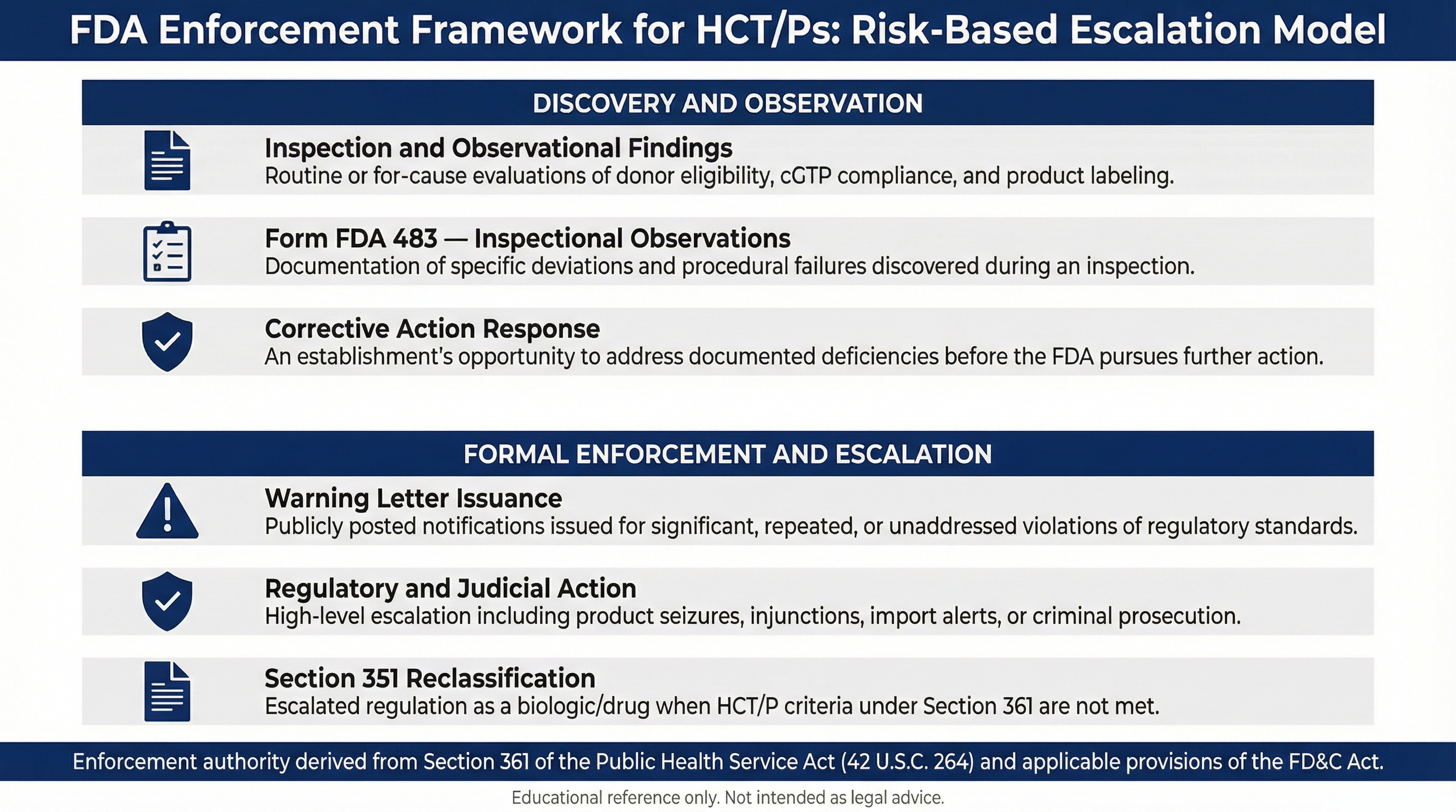
When FDA identifies potential compliance concerns, regulatory actions may include:
- Form FDA 483 inspection observations
- Untitled Letters
- Warning Letters
- Product seizure
- Injunction proceedings
- Other enforcement actions authorized under applicable law
Public warning letters and inspection records provide educational insight into the types of compliance issues that have historically resulted in regulatory action and can help organizations better understand regulatory expectations.
Regulatory Risk Mitigation
Organizations evaluating HCT/P regulatory compliance often focus on maintaining documentation that supports regulatory classification and applicable manufacturing requirements.
- Documentation supporting minimal manipulation
- Documentation supporting homologous use
- Verified donor eligibility procedures
- Compliance with Current Good Tissue Practice (cGTP)
- Complete chain-of-custody and traceability documentation
- Accurate, conservative, and well-supported public communications
These elements are evaluated collectively as part of an organization's overall regulatory compliance program.
Recent Enforcement Focus Areas
Recent publicly available FDA enforcement activity has frequently focused on:
- Marketing that extends beyond applicable regulatory classification
- Intended use statements inconsistent with Section 361 eligibility
- Manufacturing activities requiring additional regulatory oversight
- Inadequate quality systems and documentation
- Insufficient records supporting regulatory compliance
Understanding these trends requires consideration of the complete regulatory framework, including:
Related Regulatory Topics
- 21 CFR Part 1271 Regulatory Framework
- 21 CFR 1271.10(a) Classification Criteria
- Section 361 vs. Section 351 Classification
- Minimal Manipulation
- Homologous Use
- Structural vs. Cellular Tissue
- Donor Eligibility
- Current Good Tissue Practice (cGTP)
- Tissue Chain of Custody
- HCT/P Regulatory Evaluation Pathway
Documentation & Regulatory Education
Need additional educational resources or documentation references?
Licensed medical professionals and organizations may request educational materials related to FDA regulatory expectations, publicly available enforcement resources, supplier documentation practices, and HCT/P regulatory evaluation.
Credential verification may be required before access to certain documentation resources.
Request Regulatory Information
Regulatory Notice
This information is provided for educational purposes only.
The discussion of FDA enforcement activities is intended to explain publicly available regulatory actions and should not be interpreted as legal advice or as a determination regarding any specific organization, product, or regulatory status.
Establishment registration under 21 CFR Part 1271 does not constitute FDA approval, clearance, or evaluation of safety or effectiveness.
Not evaluated by the FDA. Not intended to diagnose, treat, cure, or prevent any disease.
For use by licensed medical professionals.