

HCT/P Regulatory Decision Tree — Determining Qualification Under 21 CFR Part 1271
The regulatory classification of certain human biological materials depends on the evaluation criteria defined in 21 CFR Part 1271. These regulations establish the framework used to determine whether a biological material may qualify for regulation as a Human Cells, Tissues, and Cellular and Tissue-Based Product (HCT/P).
The regulatory decision process evaluates multiple factors, including processing methods, intended use, and manufacturing practices. These criteria help determine whether a product may be regulated solely under Section 361 of the Public Health Service Act or under the biologics regulatory pathway associated with Section 351.
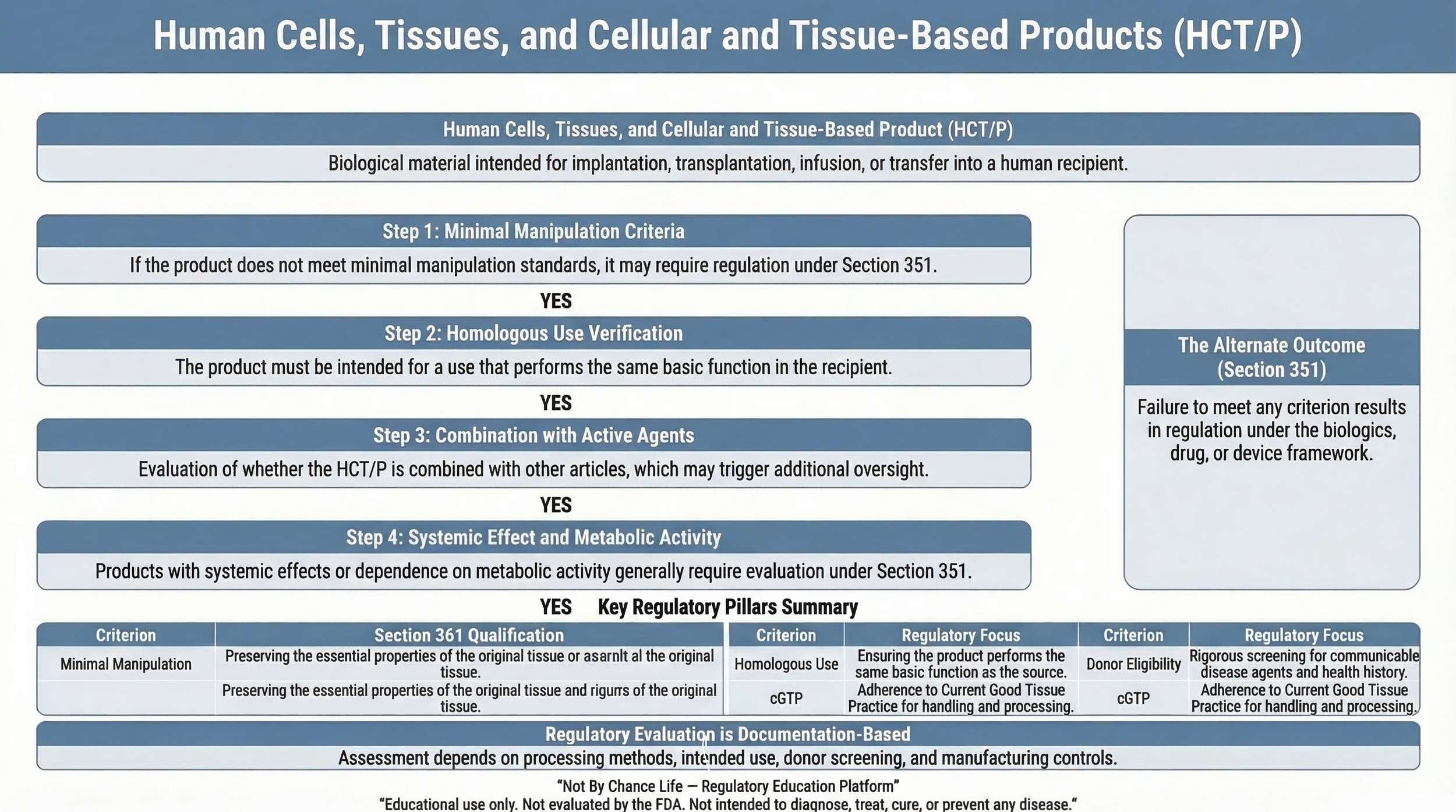
The infographic below summarizes the regulatory decision pathway commonly used to evaluate HCT/P classification under 21 CFR Part 1271.
Regulatory Evaluation Criteria
To qualify for regulation solely under Section 361, a biological material must satisfy the regulatory criteria outlined in 21 CFR 1271.10(a). These criteria are evaluated collectively when determining regulatory classification.
- Minimal manipulation of the biological material
- Homologous use in the recipient
- No combination with other active agents
- No systemic effect or metabolic activity unless specific exceptions apply
Failure to meet these criteria may result in the product being regulated under the biologics pathway rather than solely under the HCT/P regulatory framework.
Minimal Manipulation
Minimal manipulation refers to processing that does not alter the original relevant characteristics of structural tissue or the biological characteristics of cells or non-structural tissue.
Additional educational explanation is available in Minimal Manipulation Under 21 CFR Part 1271.
Homologous Use
Homologous use refers to situations in which the biological material performs the same basic function in the recipient as it performed in the donor.
Further regulatory explanation is available in Homologous Use Under 21 CFR Part 1271.
Donor Eligibility Determination
Donor eligibility determination requirements are established to reduce the risk of communicable disease transmission associated with human tissue products.
These procedures include medical history evaluation, risk assessment, and communicable disease testing.
More information is available in Donor Eligibility Requirements.
Section 361 vs Section 351 Regulatory Classification
Products that satisfy the regulatory criteria defined in 21 CFR 1271.10(a) may qualify for regulation solely under Section 361 of the Public Health Service Act.
Products that do not meet these criteria may be regulated as biologics under Section 351, which involves additional regulatory pathways and oversight.
Further explanation is available in Section 361 vs Section 351 HCT/P Regulatory Comparison.
Professional Documentation Access
Licensed healthcare professionals and qualified institutions evaluating Human Cells, Tissues, and Cellular and Tissue-Based Products (HCT/Ps) may request structured documentation related to regulatory classification, supplier transparency, and compliance review processes.
Documentation review may include:
- Regulatory classification framework summaries (21 CFR 1271.10(a))
- Supplier qualification and transparency standards
- Donor eligibility determination verification (Subpart C)
- Current Good Tissue Practice (cGTP) quality system controls (Subpart D)
- Chain-of-custody and traceability documentation
- Post-processing handling and storage considerations
Request Professional Information
Access is limited to licensed medical professionals and qualified organizations.
Request Documentation ReviewThis information is for educational purposes only.
Establishment registration under 21 CFR Part 1271 does not constitute FDA approval, clearance, or evaluation of safety or effectiveness.
Not intended to diagnose, treat, cure, or prevent any disease.
For use by licensed healthcare professionals.