
Risk Awareness & Enforcement Landscape
The regenerative biologics space operates within an evolving regulatory environment. Federal agencies have issued guidance, public statements, and enforcement actions addressing products that exceed the boundaries of 21 CFR Part 1271 and Section 361 of the Public Health Service Act.
This page outlines key compliance considerations relevant to licensed medical professionals and qualified institutions.
Regulatory Scrutiny in the HCT/P Space
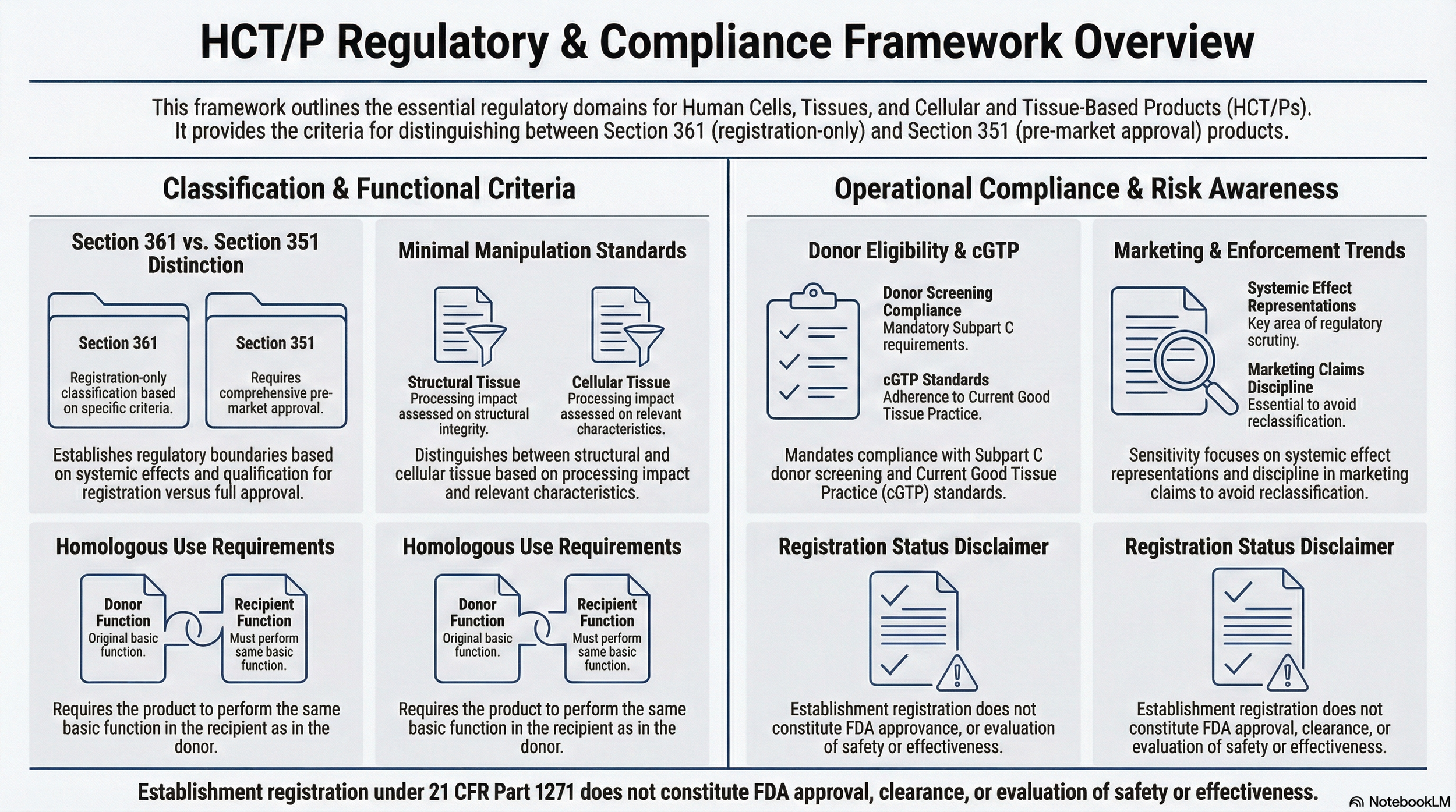
Regulatory oversight has increasingly focused on products marketed beyond homologous use limitations or that involve more than minimal manipulation.
Enforcement activity has addressed representations that imply disease treatment, systemic therapeutic effects, or regulatory approval where none exists.
Common Areas of Enforcement Focus
- Non-homologous use positioning
- Expanded or cultured cellular products lacking appropriate authorization
- Marketing claims implying disease treatment or cure
- Statements suggesting FDA approval absent premarket review
- Failure to meet donor eligibility or cGTP standards
Public enforcement history demonstrates that regulatory interpretation is influenced by labeling, advertising, and surrounding communications.
Homologous Use & Communication Risk
Intended use representations may affect regulatory classification. Claims inconsistent with homologous use limitations can alter a product’s regulatory posture.
Clinics and providers should maintain disciplined communication standards consistent with regulatory classification.
Minimal Manipulation Interpretation
Determinations regarding minimal manipulation depend on whether the tissue is structural or cellular in nature.
Processing methods that alter relevant characteristics may result in regulatory reclassification.
Registration Does Not Equal Approval
Establishment registration under 21 CFR Part 1271 does not constitute FDA approval, clearance, or evaluation of safety or effectiveness.
Communications suggesting otherwise may create regulatory risk.
Compliance-Forward Posture
A conservative compliance posture includes:
- Alignment with homologous use limitations
- Avoidance of disease-treatment claims
- Clear differentiation between registration and approval
- Documentation and traceability discipline
- Periodic review of public communications
Licensed medical professionals retain independent responsibility for regulatory evaluation and compliant communication.
Educational reference only. Certain products referenced may be regulated as Human Cells, Tissues, and Cellular and Tissue-Based Products (HCT/Ps) under 21 CFR Part 1271. These materials have not been evaluated by the FDA and are not intended to diagnose, treat, cure, or prevent any disease.