Professional Regulatory FAQ — Licensed Medical Professionals
This regulatory FAQ provides structured clarification regarding HCT/P classification under 21 CFR Part 1271 Section 361, including Section 361 vs Section 351 distinctions, minimal manipulation standards, homologous use interpretation, donor eligibility requirements, and communicable disease control obligations.
1. What regulatory framework applies to certain biologic products?
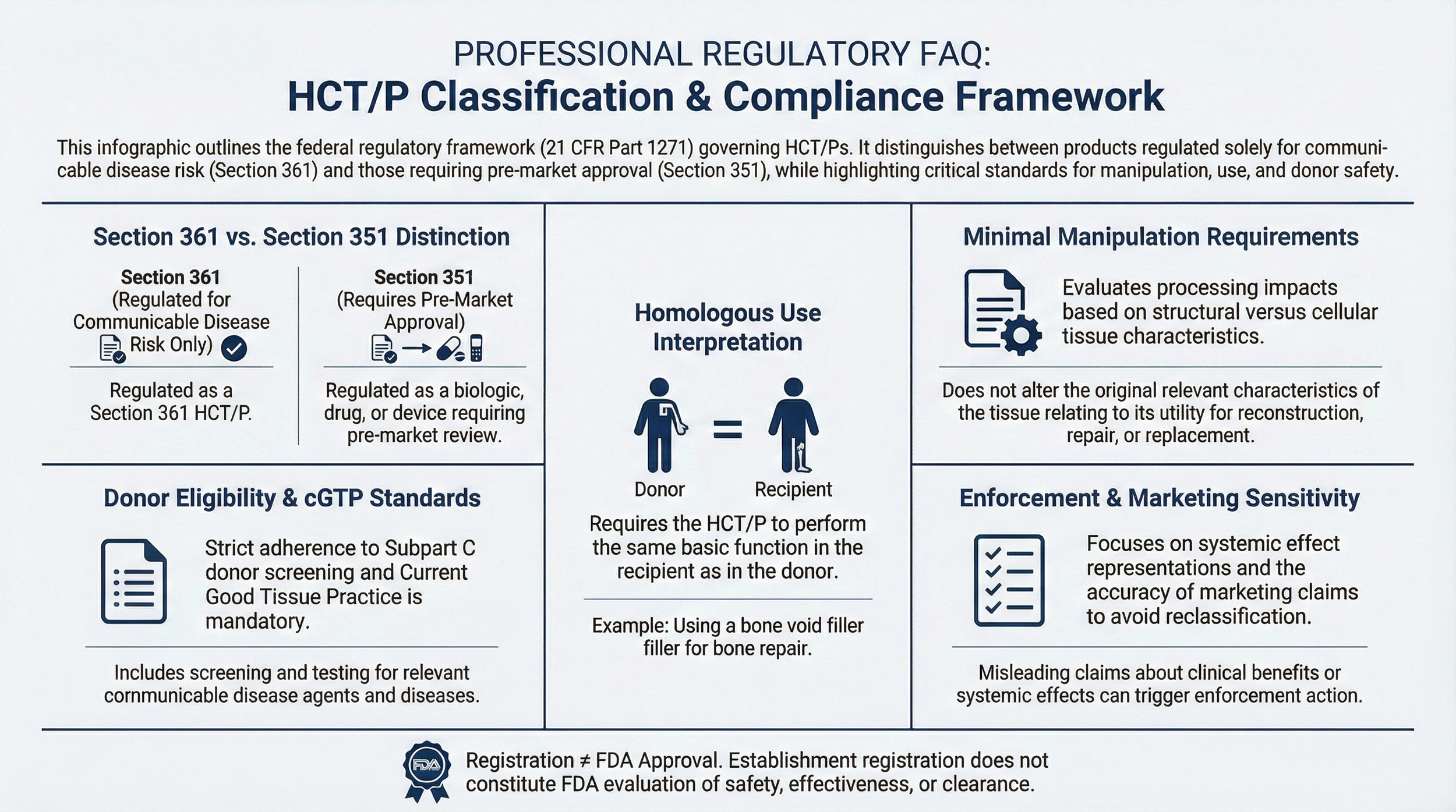
Certain products may be regulated as Human Cells, Tissues, and Cellular and Tissue-Based Products (HCT/Ps) under 21 CFR Part 1271. If qualification criteria are met, the product may fall within the Section 361 HCT/P communicable disease control pathway. If criteria are not met, regulation may shift to Section 351 as a biological product.
2. What is the difference between Section 361 and Section 351?
Section 361 HCT/Ps are regulated primarily for communicable disease control. Section 351 products are regulated as biological products and may require premarket approval or biologics licensure. The 361 vs 351 distinction is central to regulatory risk evaluation.
3. What defines minimal manipulation under 21 CFR 1271?
The minimal manipulation standard differs depending on whether the tissue is structural or cellular. Structural tissues must retain original relevant structural characteristics. Cellular or non-structural tissues must retain relevant biological characteristics. See HCT/P Classification Explained for expanded analysis.
4. What is homologous use under 21 CFR 1271.3(c)?
Homologous use means the HCT/P performs the same basic function in the recipient as it did in the donor. Intended use statements, labeling, and marketing language influence homologous use interpretation.
5. What are donor eligibility requirements?
Donor eligibility determination under 21 CFR 1271 Subpart C includes: medical history screening, communicable disease risk evaluation, and laboratory testing. See Donor Screening & Traceability Standards.
6. What is Current Good Tissue Practice (cGTP)?
cGTP under 21 CFR 1271 Subpart D establishes facility, process control, documentation, and quality system requirements applicable to Section 361 HCT/P establishments. Registration does not equal FDA approval.
7. Does FDA registration mean a product is approved?
No. Establishment registration under 21 CFR Part 1271 reflects compliance with communicable disease control, donor eligibility, and cGTP requirements. It does not represent approval, clearance, or licensure.
8. What role does communicable disease control play?
The Section 361 pathway exists to prevent transmission of communicable disease. This is the primary regulatory intent of 21 CFR Part 1271.
9. What happens if a product fails minimal manipulation criteria?
Failure to meet minimal manipulation standards may trigger classification under Section 351, potentially requiring investigational or premarket regulatory review.
10. What happens if homologous use criteria are not met?
Non-homologous use claims may move a product outside the Section 361 HCT/P framework and into Section 351 biological product regulation.
11. What documentation should providers review?
Providers may review donor eligibility records, Certificate of Analysis (COA), lot traceability documentation, and communicable disease testing confirmation.
12. What enforcement trends should providers understand?
Regulatory enforcement frequently focuses on: minimal manipulation interpretation, homologous use positioning, systemic effect claims, and manufacturing boundary clarity. See Risk Awareness & Enforcement Landscape.
13. What is the systemic effect clause?
Section 361 qualification requires that the HCT/P does not have a systemic effect and is not dependent upon the metabolic activity of living cells for its primary function, unless specific exceptions apply.
14. Who may access detailed documentation?
Documentation access is restricted to licensed medical professionals, authorized administrators, and qualified institutions. Credential verification is required.
15. What is the role of Not By Chance Life LLC?
Not By Chance Life LLC operates exclusively as an educational and access coordination entity. Manufacturing, testing, and fulfillment are performed directly by Regenerative Research Group (RRG). See Governance & Compliance Policy.
Educational reference only. Certain products may be regulated as Human Cells, Tissues, and Cellular and Tissue-Based Products (HCT/Ps) under 21 CFR Part 1271 Section 361. Registration does not constitute FDA approval, clearance, or evaluation of safety or effectiveness.

