

HCT/P Classification Under 21 CFR Part 1271 Explained
Human Cells, Tissues, and Cellular and Tissue-Based Products (HCT/Ps) are regulated under 21 CFR Part 1271 Section 361. Proper classification determines whether a product qualifies for regulation solely under the Section 361 communicable disease control pathway or whether it requires regulation as a biological product under Section 351 of the Public Health Service Act.
This page outlines structural versus cellular tissue distinctions, minimal manipulation standards, homologous use interpretation, systemic effect analysis, and the Section 361 vs Section 351 regulatory divide.
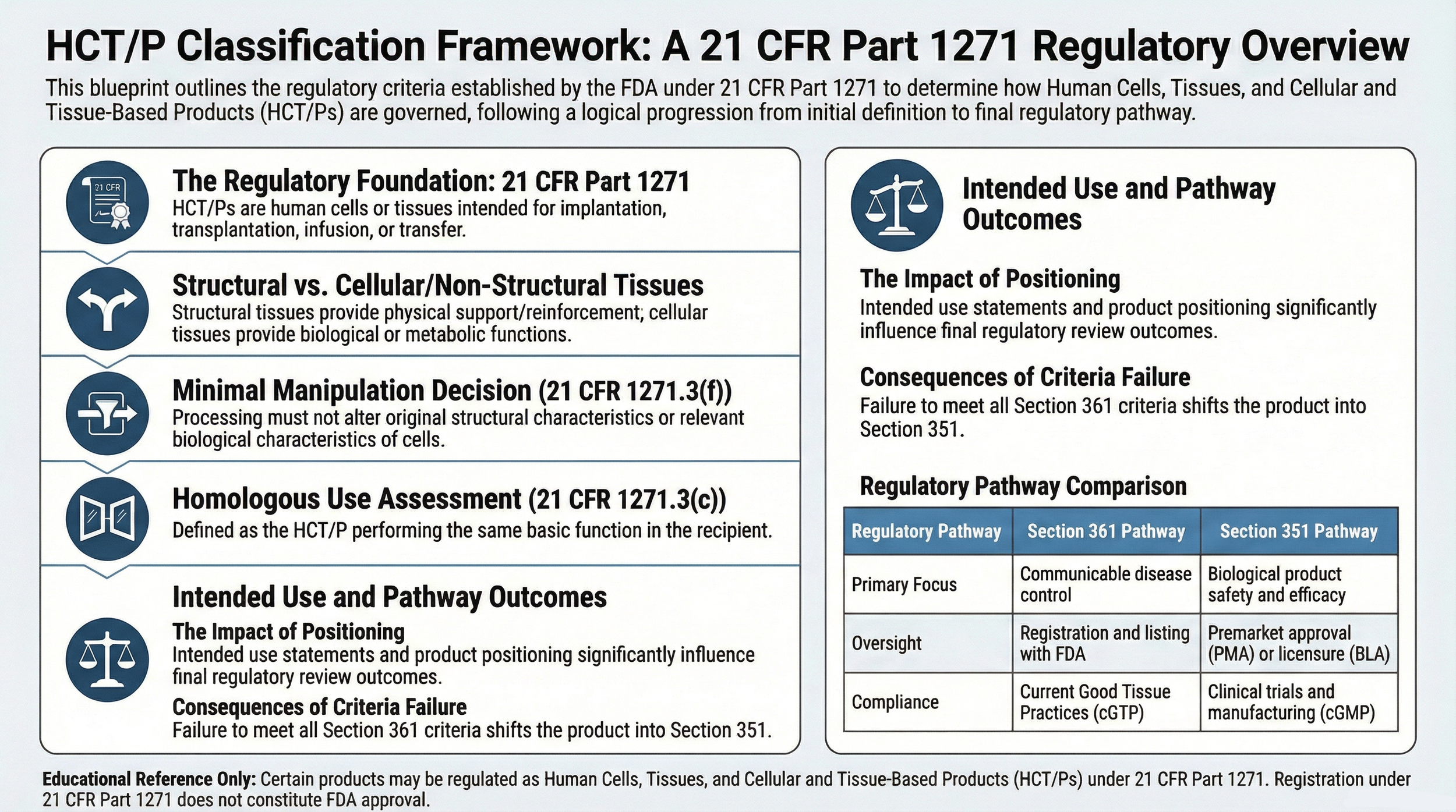
Regulatory Foundation of HCT/P Classification
Qualification under Section 361 requires that the HCT/P meet defined criteria related to:
- Minimal manipulation
- Homologous use
- Combination limitations
- Systemic effect considerations
Failure to satisfy any of these criteria may result in regulation under Section 351, which typically requires additional premarket review or licensure.
Structural vs. Cellular Tissue — Minimal Manipulation
Minimal manipulation standards differ depending on whether the HCT/P is classified as structural or cellular/non-structural tissue.
- Structural tissues are evaluated based on whether processing alters the original relevant structural characteristics.
- Cellular or non-structural tissues are evaluated based on whether processing alters relevant biological characteristics of the cells.
Detailed interpretation is discussed in: Structural vs Cellular Tissue .
Homologous Use Interpretation
Homologous use requires that the HCT/P perform the same basic function in the recipient as it performed in the donor.
Intended use representations, labeling language, and positioning statements are considered when determining homologous use alignment.
Further discussion: Homologous Use Regulatory Guidance.
Systemic Effect Analysis
An HCT/P must not have a systemic effect and must not depend upon the metabolic activity of living cells for its primary function unless qualifying exceptions apply under the regulatory framework.
Systemic activity and metabolic dependence are important considerations when determining whether a product remains within the Section 361 HCT/P pathway or falls within biological product regulation under Section 351.
Section 361 vs. Section 351 Comparison
| Criteria | Section 361 HCT/P | Section 351 Product |
|---|---|---|
| Regulatory Pathway | Communicable disease control framework | Biological product regulation |
| Premarket Approval | Not required if qualification criteria are met | Generally required |
| Establishment Registration | Required under 21 CFR Part 1271 | Required |
| Donor Eligibility | Mandatory | Mandatory |
| cGTP Compliance | Required | Required plus additional standards |
Documentation & Due Diligence
Proper classification requires review of sourcing transparency, processing methodology, homologous use positioning, systemic effect analysis, and establishment registration status.
Licensed professionals and institutions remain responsible for independent regulatory evaluation.
For a visual overview of how these regulatory elements connect across the HCT/P framework, see the Regulatory Knowledge Map.
Initiate Provider Credential Verification →
This information is provided for educational purposes only. Certain products may be regulated as Human Cells, Tissues, and Cellular and Tissue-Based Products (HCT/Ps) under 21 CFR Part 1271 Section 361. Registration with the U.S. Food and Drug Administration does not constitute FDA approval, clearance, or evaluation of safety or effectiveness. These materials are not intended to diagnose, treat, cure, or prevent any disease. For use by licensed medical professionals.