

FDA Warning Letters Related to HCT/P Regulation
What are FDA warning letters?
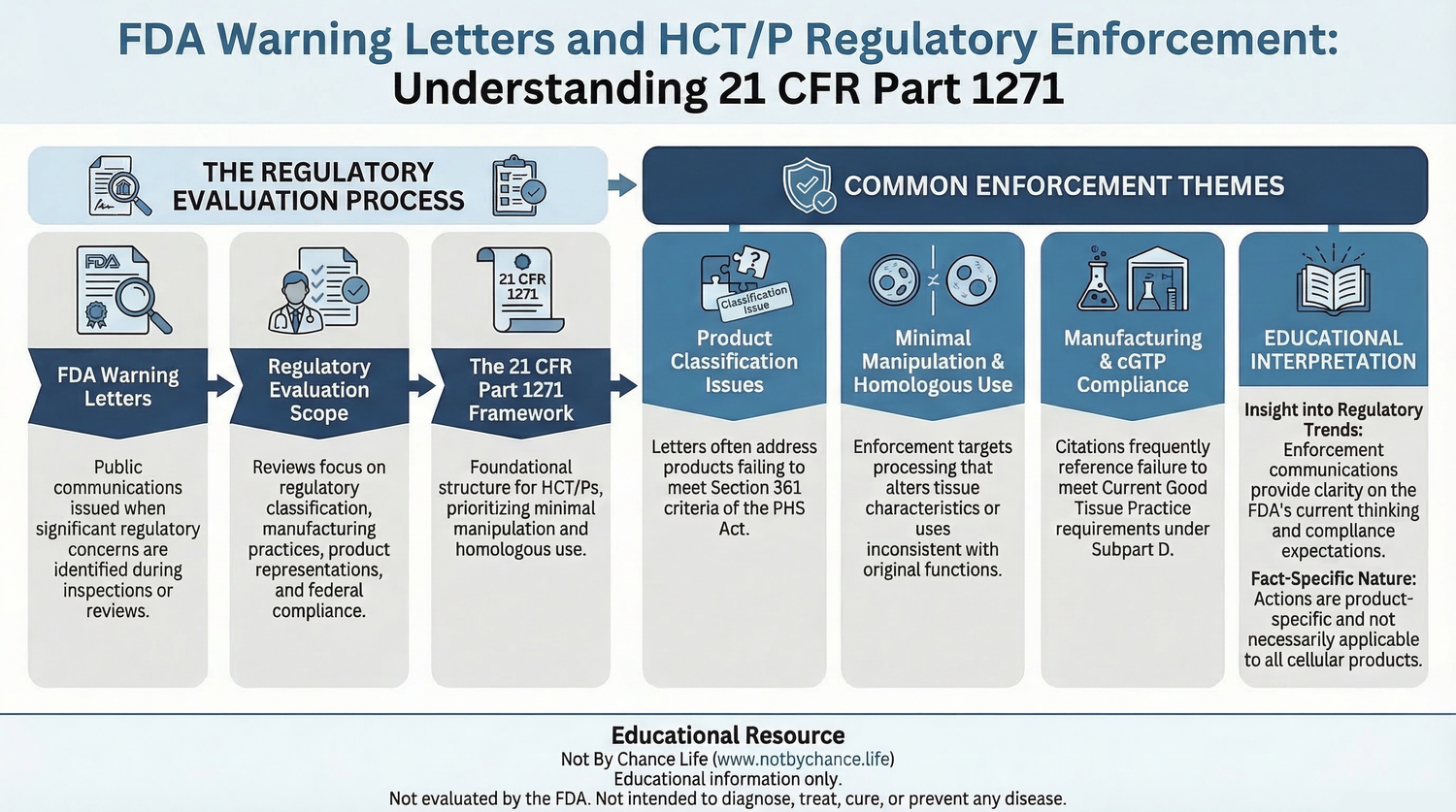
FDA warning letters are publicly available enforcement communications that describe significant regulatory concerns identified during inspections or other compliance activities. They provide insight into how the FDA interprets and applies regulatory requirements, including those governing Human Cells, Tissues, and Cellular and Tissue-Based Products (HCT/Ps) under 21 CFR Part 1271.
Public warning letters are educational resources that help healthcare professionals, tissue establishments, and regulatory specialists better understand compliance expectations and common regulatory deficiencies.
FDA warning letters are one component of the broader regulatory framework established under 21 CFR Part 1271.
For a structured overview showing how regulatory classification is evaluated before enforcement actions occur, see the HCT/P Regulatory Evaluation Pathway.
Documentation and Regulatory Education
Not sure how FDA warning letters relate to your current documentation or regulatory review process?
Licensed medical professionals and organizations may request educational materials related to FDA warning letters, regulatory interpretation, supplier documentation, and compliance concepts referenced throughout this resource.
Credential verification may be required prior to documentation access.
Request Regulatory Information
Why FDA Warning Letters Matter
FDA warning letters provide publicly available examples of how the agency has interpreted and applied regulatory requirements in specific situations. While each warning letter is based on its own facts and circumstances, collectively they help illustrate common compliance issues and recurring regulatory themes.
Warning letters should be read as educational resources rather than generalized statements that apply to every product or establishment. Regulatory determinations depend on the complete facts, documentation, intended use, manufacturing practices, and applicable regulations for each situation.
Common Regulatory Themes Referenced in Warning Letters
Publicly available FDA warning letters involving HCT/Ps frequently discuss regulatory concepts including:
- Minimal Manipulation
- Homologous Use
- Section 361 vs. Section 351 Classification
- Current Good Tissue Practice (cGTP)
- Donor Eligibility
- Manufacturing controls and documentation practices
Understanding these concepts provides important context when reviewing FDA enforcement communications and evaluating regulatory compliance.
Examples of Regulatory Themes Referenced in Warning Letters
Product Classification
Some FDA warning letters discuss situations in which the agency concluded that an HCT/P did not satisfy the regulatory criteria necessary for regulation solely under Section 361 of the Public Health Service Act.
These discussions often involve evaluation of the classification criteria described in 21 CFR 1271.10(a), including whether the product qualifies for regulation under the Section 361 framework or may instead be regulated under the biologics pathway associated with Section 351.
Minimal Manipulation
Warning letters may discuss processing methods that the FDA determined altered the original relevant characteristics of structural tissue or the relevant biological characteristics of cells or nonstructural tissues.
Additional educational information is available in Minimal Manipulation Under 21 CFR Part 1271.
Homologous Use
Some enforcement communications address intended uses that the FDA determined did not satisfy the homologous use criterion described in 21 CFR 1271.3(c).
Educational guidance on this regulatory concept is available in Homologous Use Under 21 CFR Part 1271.
Current Good Tissue Practice (cGTP)
FDA warning letters may also reference deficiencies involving quality systems, documentation, recordkeeping, processing controls, or other Current Good Tissue Practice (cGTP) requirements established under 21 CFR Part 1271 Subpart D.
Additional educational information is available in Current Good Tissue Practice (cGTP).
Understanding FDA Enforcement Communications
FDA warning letters provide valuable educational insight into how the agency has interpreted regulatory requirements in specific situations. They can help healthcare professionals, compliance personnel, and regulatory reviewers better understand recurring compliance themes and documentation expectations.
However, each warning letter reflects the specific facts and circumstances of an individual inspection or investigation. Regulatory conclusions should not be generalized without considering the complete regulatory context, applicable regulations, and supporting documentation.
Related Regulatory Resources
- 21 CFR Part 1271 Regulatory Framework
- 21 CFR 1271.10(a) Classification Criteria
- Section 361 vs. Section 351 HCT/P Classification
- Minimal Manipulation
- Homologous Use
- Donor Eligibility
- Current Good Tissue Practice (cGTP)
- 21 CFR Part 1271 Subparts A–D
- HCT/P Regulatory Evaluation Pathway
- Regulatory Resource Library
Regulatory Notice
FDA warning letters provide insight into the agency's interpretation of specific facts and circumstances presented during inspections or investigations. They should not be interpreted as establishing broad regulatory conclusions applicable to every Human Cell, Tissue, and Cellular and Tissue-Based Product (HCT/P).
Establishment registration under 21 CFR Part 1271 does not constitute FDA approval, clearance, or evaluation of safety or effectiveness.
This information is provided for educational purposes only.
Not evaluated by the FDA. Not intended to diagnose, treat, cure, or prevent any disease.
For use by licensed medical professionals.